
Marvion's Strategic Partnerships and Centralized Warehousing Shape Growth Amid Market Pressures
The latest quarterly results highlight Marvion’s revenue expansion driven by logistics and solar power sales while financial constraints and mainland competition remain key concerns.
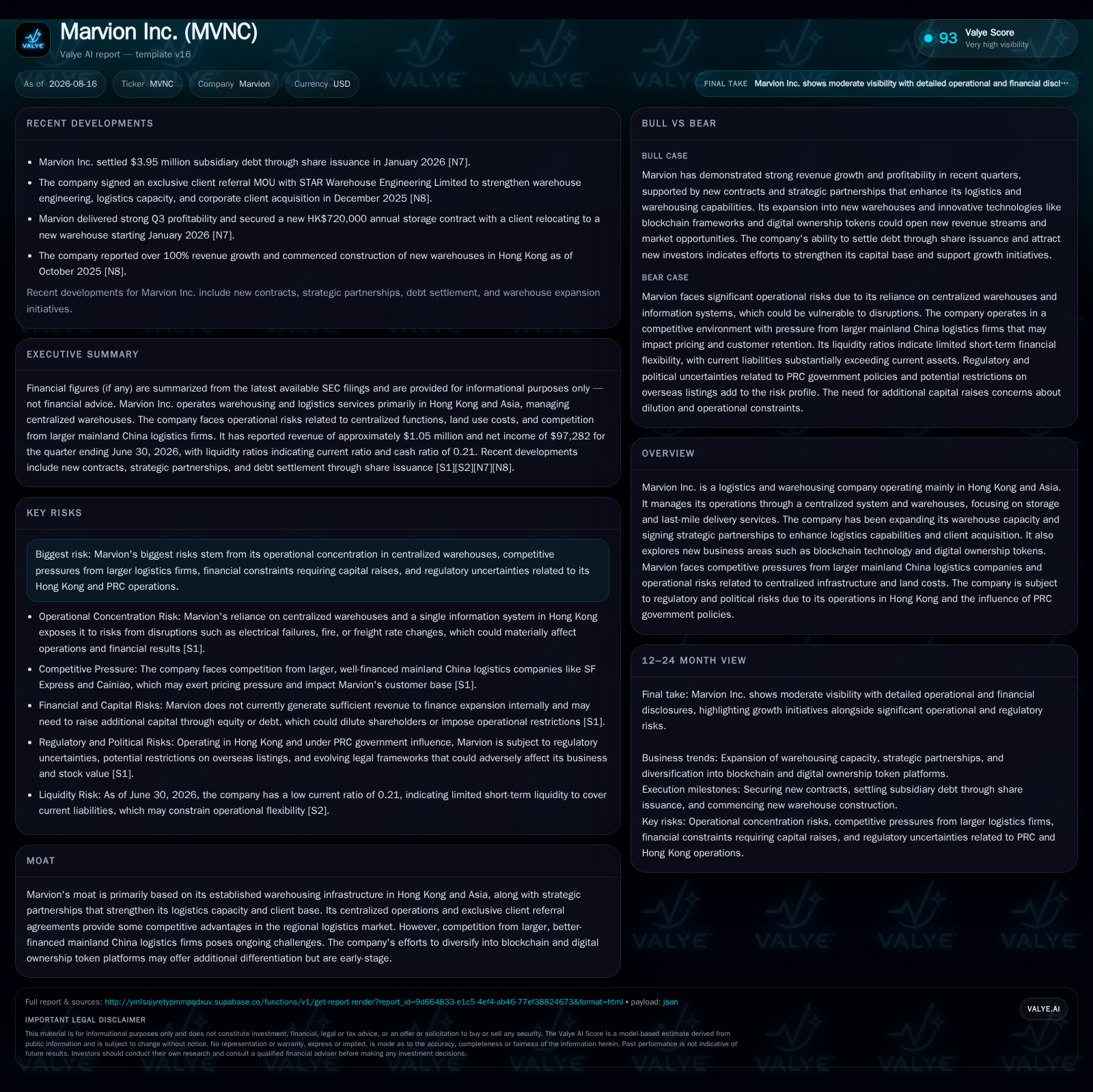
Marvion Inc.'s August 2026 quarterly filing confirms ongoing revenue growth largely fueled by increased logistics, warehousing income, and emerging solar power sales under a strategic partnership. The company's business model leverages centralized warehouse operations in Hong Kong and targeted last-mile delivery services for cable and data equipment industries. However, concentrated infrastructure exposes Marvion to operational risks and cost pressures from local land values, while intensifying competition from larger mainland China logistics firms constrains pricing and client retention. Liquidity remains tight with a low current ratio, underscoring reliance on external capital for sustaining expansion plans. Key upcoming milestones include ramping solar power revenue streams and improving warehouse utilization amid evolving regional supply chain dynamics.
Updated Operating Trajectory Anchored by Latest Quarterly Results
Marvion Inc. reported notable revenue progress in Q2 2026 combining traditional logistic services with a newly operational solar power revenue stream. This uplift was driven primarily by logistics service income and warehousing service income, with mid-2025 marking the commencement of recurring solar energy sales to China Light and Power (CLP) via their Service Partnership Agreement with Starwarehouse Engineering, adding HKD 150,000 per quarter [S1]. This diversification introduces an emerging stable cash flow reducing carbon footprint impact while incrementally boosting revenues.
Although these top-line gains are encouraging, Marvion disclosed ongoing reliance on shareholder support to maintain operations during continued capital needs [S1]. The company achieved a net income turnaround of $345,083 in 2025 from losses experienced in 2024 but maintains tight liquidity conditions with current liabilities substantially surpassing current assets [F1]. This suggests that while operational momentum is improving, funding sufficiency remains a near-term concern.
Logistics and Warehousing Model Leveraging Centralization and Partnerships
Marvion’s business is seated firmly in midstream supply chain activities focused on warehousing and last-mile delivery services within Hong Kong and neighboring Asian markets. Its three primary subsidiaries provide specialized services: KSK Logistic Limited delivers last-mile shipments particularly aligned with cable and data equipment industries; United Warehouse Management Limited offers warehousing and distribution; while Propose Enterprise Limited provides ancillary business consulting [S1]. The company operates six warehouses centrally managed through one integrated IT system based in Hong Kong [S1].
The centralized model delivers benefits in operational coordination and cost control but poses material risks linked to geographic concentration. As the company notes, disruptions—whether infrastructure failures or regulatory changes—could disproportionately impact business continuity compared to competitors with diversified facilities [S3]. Furthermore, warehousing costs are sensitive to local land value fluctuations given Hong Kong’s high property prices. Marvion attempts to mitigate this via long-term land use agreements secured during lower market valuations; however, any upward trend threatens margin compression through higher fixed expense burdens.
An innovative complement comes from their Service Partnership Agreement enabling rooftop solar PV installations that feed electricity into regional grids under defined tariff terms [S1]. This arrangement embodies both a renewable energy initiative—supporting environmental sustainability—and an incremental revenue source leveraging existing physical assets.
Standing against Giants: Competition with Mainland China Logistics Specialists
Hong Kong’s logistics market features intense competition from large mainland Chinese operators such as SF Express and Alibaba-backed Cainiao Network who benefit from deeper financing pools and more extensive service networks [S1]. These firms’ scale can exert downward pressure on pricing structures in last-mile delivery segments where Marvion also competes.
Despite being smaller-scale regionally focused players may retain niche positioning servicing specific industrial segments requiring tailored delivery solutions—such as cable/data equipment sectors—however customer switching risk remains elevated due to convenience criteria tied largely to price-performance trade-offs. Marvion recognizes this challenge yet aims to address it partly through cooperative arrangements servicing last-mile needs of larger competitors [S1]. These dynamics underscore vulnerable pricing power which can limit margin expansion opportunities absent either significant operational efficiencies or successful technology differentiation.
Solar Energy Ventures Boost Services Portfolio & Sustainability Goals
Marvion’s integration of solar power generation onto warehouse rooftops reflects growing industry trends toward sustainability-linked value chains. Under the partnership with Starwarehouse Engineering starting mid-2025, electricity generated is sold directly to CLP at tariff rates extending through December 2033 [S1]. This venture not only diversifies income streams but helps reduce carbon emissions associated with logistics operations—a key stakeholder expectation increasingly influencing vendor selection in supply chains.
While currently modest at HKD 150,000 per quarter initially recognized in mid-2025 revenues, scale-up potential exists depending on system capacity expansions or replicating similar setups across other facilities if economically feasible. These renewable assets could enhance Marvion’s brand positioning relative to peers lacking comparable green credentials or alternatives embedded into client contracts incentivizing environmental compliance.
Restraining Forces: Operational Risks & Capital Constraints That Could Stall Momentum
Marvion’s operational concentration into six central warehouses controlled via a single IT platform heightens exposure to disruption—from natural disasters to technological outages—with insurance coverage limits acknowledged as potentially insufficient should substantial losses occur [S3]. This risk profile is atypical versus logistics companies leveraging distributed infrastructure which affords redundancy networks lowering downtime probabilities.
Land-related costs significantly influence total operating expenses; surging property values in Hong Kong risk amplifying fixed occupancy costs squeezing operating margins absent corresponding freight rate increases which themselves face competitive constraints [S3]. Freight rate volatility also imposes planning complexity given its outsized role in delivery cost structures across last-mile services.
Financially, although reporting positive net income for the first time recently ($345K net income vs prior loss), Marvion’s liquidity picture is fragile: as of June 30, 2026 current liabilities stand at ~$4.93 million dwarfing current assets near $1.03 million yielding a low current ratio around 0.21—a sign of working capital pressures inherent in this capital-intensive industry segment [F1]. The firm explicitly acknowledges dependence on external funding sources including equity injections or debt financings to sustain expansion goals beyond organic cash flow generation horizons [S1]. Uncertainty around timely access to such capital could constrain investments critical for expanding warehouse capacity or IT infrastructure modernization required for competitive positioning going forward.
What To Watch Next: Key Execution Metrics And Business Milestones In A Dynamic Market
Investors should monitor several KPIs signaling trajectory shifts within Marvion’s core logistics platform: improvements in warehouse capacity utilization rates would reflect firmer demand absorption supporting leverage of fixed-cost investments; rising order volume handled coupled with strong on-time delivery percentages would evidence operational scale efficiencies enhancing client satisfaction crucial for retention especially against mainland competitors; expansions or renewals of strategic partnerships—particularly those linking solar energy initiatives or cross-regional cooperations—will indicate enhanced revenue diversification prospects.
Financially, developments relating to capital raises—whether equity offerings or structured financing vehicles—and execution of related acquisition or expansion plans will shape runway longevity amidst persistent liquidity constraints noted above [S2][S1]. Additional updates on solar power contract performance including actual quarterly billing variability or scaling efforts will also provide early clues about this line's stability as a non-logistics recurring revenue pillar.
Financial Profile Discussion: Balancing Tight Liquidity Amid Capital Intensive Growth
Marvion’s financial snapshot underscores salient tension between encouraging operational improvements offset by working capital limitations characteristic of the logistics sector’s capital demands. At June 30, 2026 cash & equivalents stood at approximately $670K against current liabilities nearing $4.93 million resulting in a current ratio of about 0.21 indicative of near-term liquidity stress requiring external capital support [F1]. While net income swing positively from prior-year losses signals better operating margins potentially enabling organic cash flow cushioning over time (operating income was $208K end-2025), the scale gap between liquid resources and liabilities implies ongoing reliance on shareholder financing remains a material uncertainty affecting going concern considerations stated publicly [S1].
Marginal operating margin expansion thus far supports scalability aspirations but reflects necessity for prudent cash management given Hong Kong land cost inflation risks paired with stiff competitive freight rate environments that limit pricing flexibility critical for profitability enhancement. The company’s continuing ability to raise capital on acceptable terms remains pivotal both for near-term survival and medium-term growth execution involving expanding warehousing footprint or upgrading IT systems needed for efficient multi-client inventory management critical in third-party logistics roles typical among peers such as Kerry Logistics or larger integrated platforms like Cainiao Network serving broader Asian supply chains.
This analysis synthesizes Marvion Inc.'s recent quarterly filings alongside established industry knowledge capturing its hybrid logistics-energy revenue model within a challenging Hong Kong-Asia competitive framework weighted by capital intensity and infrastructural vulnerabilities. Outcomes ahead depend heavily on effective execution of strategic diversification initiatives like solar energy sales combined with maintaining core hauling/warehousing efficiency whilst navigating rising local costs amid heightened competition from mainland conglomerates with deep capital pools. Careful tracking of cash flow dynamics paired with partnership developments will be essential indicators guiding business sustainability assessments.
This article presents an independent analytical evaluation based solely on publicly available information without providing investment advice.
Disclaimer: This is research-only, informational analysis and not investment advice. It may include AI-generated interpretation and general industry context. Always verify important details using primary sources.

Comments