
PMGC Holdings Leverages Diversified Subsidiaries Amid Financial Sustainability Challenges
The holding company navigates clinical development, precision manufacturing, and specialty packaging sectors while contending with capital constraints.
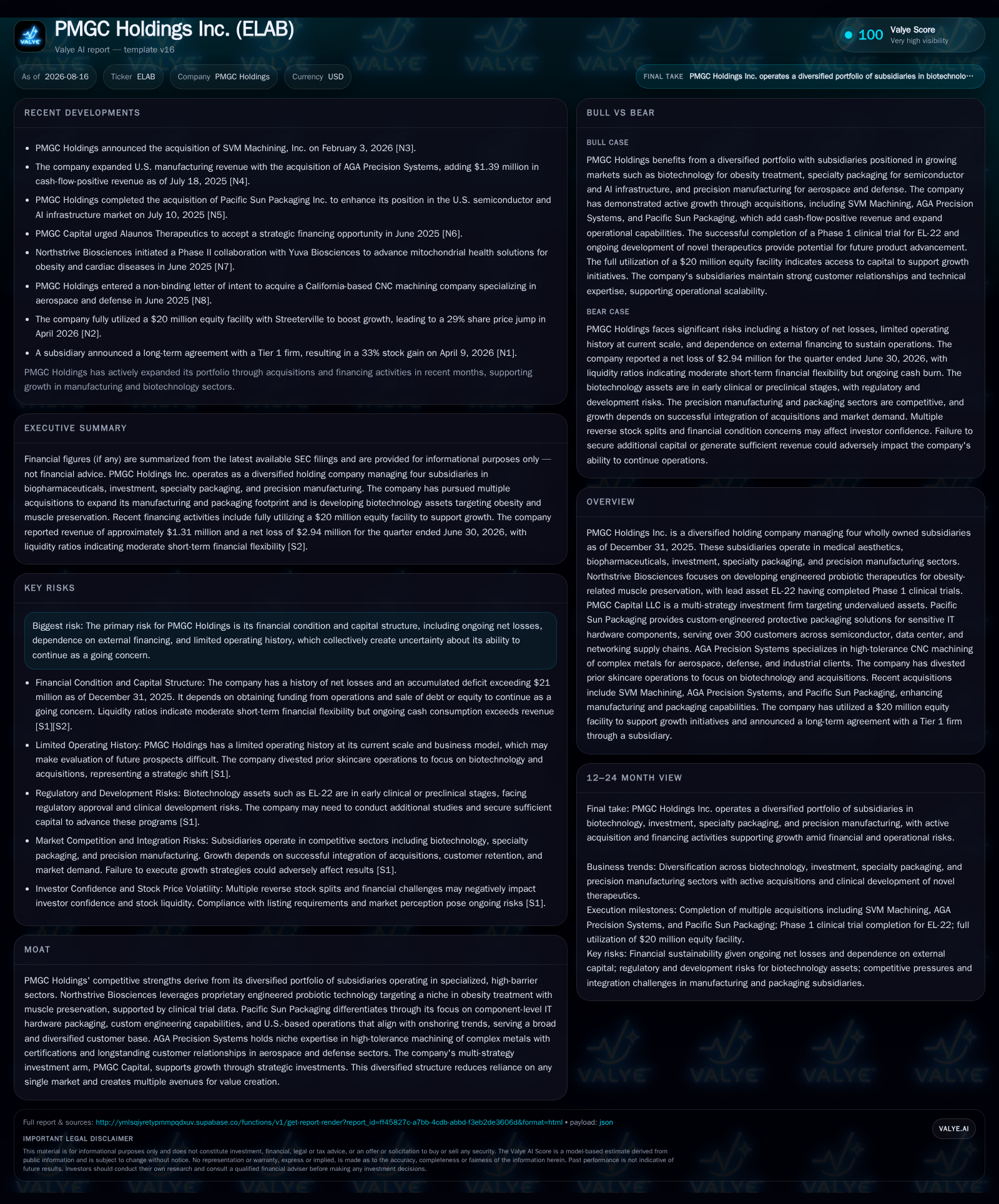
PMGC Holdings Inc. operates as a diversified holding company managing four subsidiaries spanning biopharmaceuticals, investment, specialty packaging, and precision manufacturing. Its lead biotech asset EL-22 has completed Phase 1 trials targeting muscle preservation in obesity combined with GLP-1 therapies. Pacific Sun Packaging and AGA Precision serve specialized niches in IT hardware protection and aerospace/defense machining, respectively. Despite these strategic positions, PMGC continues to face significant net losses and operating cash burn that outpaces revenues, raising going concern risks and dependence on external financing for sustaining operations.
Recent Operating Update
PMGC Holdings Inc.'s latest quarterly report reaffirms its operation of four wholly owned subsidiaries—Northstrive Biosciences (biopharma), PMGC Capital LLC (investment management), Pacific Sun Packaging (specialty packaging), and AGA Precision Systems (precision CNC machining)—each positioned in specialized, high-barrier sectors [S2],[S1]. The recent filings do not indicate major shifts in subsidiary structure but emphasize ongoing efforts to execute growth strategies against significant financial headwinds. A key development is the continuation of clinical work on Northstrive’s lead asset EL-22 which has completed Phase 1 clinical trials targeting muscle preservation during obesity weight loss treatments involving GLP-1 receptor agonists. This milestone validates early clinical progress though future regulatory approvals remain uncertain [S11].
Business Model Overview
As a diversified holding company, PMGC acts primarily as a capital allocator and strategic overseer without direct large-scale operational revenue itself. Instead, its funds flow through multiple subsidiary arms whose revenue mechanics differ substantially:
Northstrive Biosciences generates value by advancing proprietary therapeutic candidates via R&D investments and clinical milestones aimed at eventual commercialization or partnership/licensing deals. Its EL-22 is an engineered probiotic designed to mitigate muscle wasting associated with obesity treatments — a niche unmet medical need within the expanding obesity therapeutics market dominated by GLP-1 receptor agonists. The biopharma model is characterized by long development cycles, heavy R&D spend, regulatory complexity, and delayed revenue onset [S1],[S11].
PMGC Capital LLC executes multi-strategy investments in undervalued private and public companies across sectors to optimize returns on deployed capital. This segment focuses on deal sourcing, investment monitoring, and portfolio management leveraging financial markets expertise [S1],[S9].
Pacific Sun Packaging addresses increasing demand for custom-engineered protective packaging in the IT hardware space — covering CPUs, memory modules (DIMMs/SO-DIMMs), SSDs/HDDs, and fiber-optic components used primarily by semiconductor manufacturers and data centers. Revenue depends on negotiated contracts with over 300 customers reflecting unit volume, product customization complexity, materials costs, and supply chain integration efficiency [S14]. The U.S.-based operations capitalize on trends toward supply chain localization amidst geopolitical trade tensions
AGA Precision Systems serves aerospace, defense contractors, and industrial clients by providing high-tolerance CNC milling/turning of exotic metals like titanium and Inconel critical for mission-sensitive applications. Certifications such as ITAR registration and AS9100 quality standard underpin its competitive positioning. Revenue arises from contract manufacturing emphasizing precision engineering expertise rather than commodity pricing [S14],[S20].
Overall revenue reported was below $600K for calendar year 2025 highlighting the nascent commercial scale at the holding level; negative operating income exceeding $2M signals ongoing investment rather than operating profit generation consistent with early-stage development business models in part [F1],[S1].
Industry Structure and Competitive Positioning
PMGC's diversified portfolio spans industries marked by distinct value chains but common themes of technical specialization:
Biopharmaceuticals: Northstrive competes indirectly against established GLP-1 leaders like Novo Nordisk (Ozempic/Wegovy) and Eli Lilly (Mounjaro), but differentiates via its first-in-class oral myostatin-targeting probiotic aiming to preserve lean muscle mass—a critical unmet gap in obesity medicines’ side effect profiles. Regulatory barriers remain high given complex FDA scrutiny around novel oral biologics targeting musculoskeletal pathways [S11],[S12].
Specialty Packaging: Pacific Sun operates among mid-sized domestic suppliers offering high customization versus large global players like Sonoco or Sealed Air who focus on broader packaging markets. Its focus on component-level protection for expensive semiconductors aligns well with customer priorities around ESD protection, vibration dampening, automated handling compatibility amid semiconductor device fragility—a segment supported by ongoing semiconductor industry investments globally [S14].
Precision Manufacturing: AGA Precision serves niche segments requiring exotic metal machining—an area dominated by both boutique shops specializing in aerospace/defense components (similar to Kennametal or Precision Castparts at scale) alongside vertically integrated OEM suppliers. ITAR compliance adds customer trust but also operational complexity tied to government spending cycles [S20],[S25].
Investment Arm: PMGC Capital functions akin to smaller multi-strategy firms that combine direct acquisition targeting of undervalued companies with opportunistic lending structures. This arm supports internal capital recycling but faces market risk dependencies common among alternative asset managers.
The company's multi-industry diversification strategy reduces reliance on cyclicality or performance volatility specific to any one sector but brings challenges coordinating growth across disparate operational metrics.
Growth Drivers
Key growth vectors within PMGC’s holdings include:
Progression of Northstrive’s clinical assets through IND submissions toward Phase 2 trials will enhance valuation potential drastically if safety/efficacy thresholds are met since biopharmaceuticals typically command premium multiples upon clinical validation milestones [S11]
Increasing demand for Pacific Sun’s custom packaging aligns directly with broader semiconductor market expansion fueled by cloud infrastructure buildouts, AI hardware deployment trends, and supply chain localization policies favoring U.S.-based providers; customer retention across over 300 accounts supports stable revenue increments from volume/mix gains [S14]
Defense spending upticks expand AGA Precision’s addressable market especially with specialization in titanium/Inconel parts critical for aerospace platforms; targeted business development efforts can leverage reputation among existing customers toward larger-scale contracts leveraging operational certifications [S25],[S20].
Strategic acquisitions remain part of the corporate agenda enabling portfolio enhancement either by expanding subsidiary capabilities or integrating complementary biotechnology assets; this M&A activity depends heavily on available capital resources but offers inorganic growth avenues beyond organic development alone [S8],[S13].
Risks and Constraints
Despite promising sector dynamics at subsidiary level, PMGC confronts several material challenges:
Persistent net losses totaling $7.7 million annually coupled with minimal current revenue underscore a burn rate necessitating regular external financing injections or capital raises; inability to secure such funds would threaten going concern status as disclosed explicitly in filings [F1],[S1],[S21].
Biopharmaceutical development risk persists around regulatory delays or failures inherent to novel oral biologics targeting muscle preservation pathways—any trial setback could derail clinical timelines or increase expenditures significantly exposing the firm to value destruction.- Packaging/manufacturing operations face exposure to supply chain disruptions including raw material cost inflation impacted by trade policies/tariffs especially given global political tensions affecting component sourcing or logistics costs; also customer concentration risk exists albeit somewhat mitigated by over 300 client relationships JV.
The necessity to repeatedly restructure equity through reverse stock splits has contributed to negative investor perceptions impacting liquidity levels further complicating timely equity raises needed for sustainable operations [S17]
Integration risks from acquisitions require strong execution capabilities; failure here could dilute operational focus amid already constrained management bandwidth across diverse industry verticals.
What to Watch Next
Investors should monitor several key factors that may act as inflection points:
Announcement of Phase 2 IND submission timing for EL-22 would validate clinical pipeline momentum especially if capital resources permit accelerated development investment.
Quarterly revenue trajectories from Pacific Sun Packaging reflecting order volume trends amidst semiconductor sector cyclicality provide near-term guidance on subsidiary commercialization progress.
New contract wins or capacity utilization improvements within AGA Precision will indicate strengthening competitive positioning within aerospace/defense manufacturing subsegments.
Capital market activity including equity/debt raises by PMGC Holdings will reveal viability of sustaining operations absent near-term profitability.
Any announced M&A transactions expanding biotechnology or advanced manufacturing holdings signal management’s ability to deploy capital strategically despite financial headwinds.
Financial Profile Discussion
As of mid-year 2026 data shows approximately $20.8 million in current assets against $15.3 million in current liabilities yielding a current ratio of 1.36 which signals moderate short-term liquidity coverage though much is likely tied up outside cash equivalents [F1]. Cash on hand was roughly $4 million as of December 2024 quarter end showing limited runway without fresh financing input likely necessary given continued operating losses outpacing revenues severely ($7.7 million net loss vs sub-$600k revenue fiscal 2025) [F1],[S21]. Total debt stands minimal at about $63,750 suggesting low leverage but no substantial borrowing cushion exists either; consequently operating cash flow remains negative reflecting investment-heavy posture typical for diversified holdings balancing long-cycle biotech assets against more immediate retrieval sectors like packaging/manufacturing [F1],[S21]. Ongoing dependence on access to debt/equity financings represents a pivotal financial watchpoint that ultimately shapes corporate continuity prospects.
This analysis is based strictly on publicly disclosed evidence from SEC filings as of August 16, 2026 without speculative extrapolation or investment advice.
Disclaimer: This is research-only, informational analysis and not investment advice. It may include AI-generated interpretation and general industry context. Always verify important details using primary sources.

Comments