
KBS Real Estate Investment Trust III Confronts Refinancing Challenges Amid Office Market Headwinds
The REIT's latest quarter underscores significant refinancing risks and strategic portfolio management amid ongoing commercial office sector pressures.
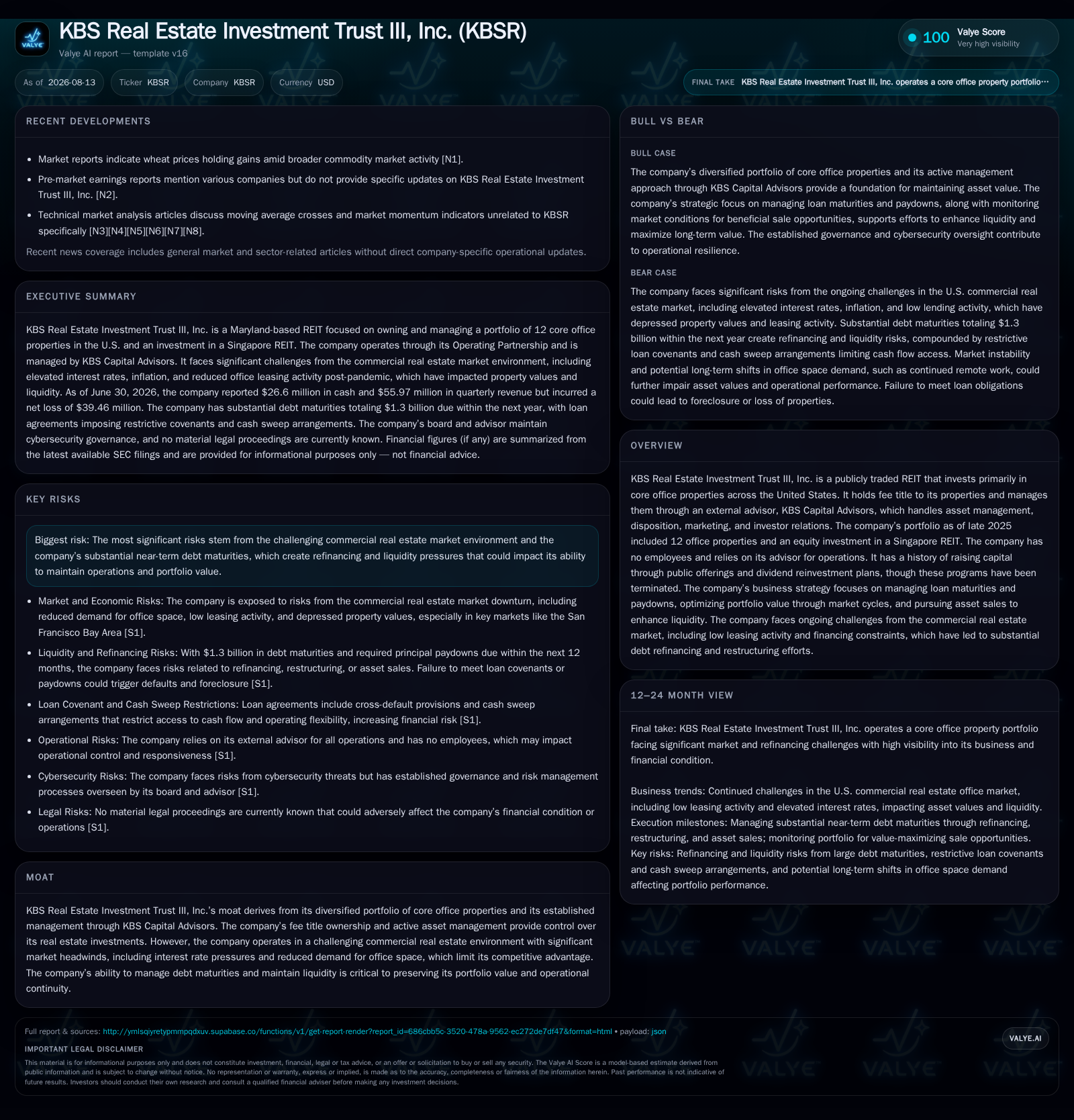
KBS Real Estate Investment Trust III, Inc. operates as a publicly traded REIT focused on core U.S. office properties with fee title ownership and external asset management. Its latest quarterly filing reveals continued vulnerabilities from substantial near-term debt maturities and challenging office market fundamentals, necessitating active portfolio optimization and liquidity management. While its diversified core office portfolio provides some buffer, the implications of evolving tenant demand patterns and interest rate pressures heighten refinancing risks and threaten dividend sustainability. Monitoring debt maturity execution and asset disposition progress will be critical measures of near-term operational resilience.
Recent Operating Update
The company reported $1.246 billion in total debt as of June 30, 2026, backed by only $26.6 million in cash and equivalents, yielding net debt close to $1.22 billion [F1]. This heavy leverage places significant pressure on refinancing capabilities and liquidity management.
Despite these constraints, KBSR continues holding a portfolio comprising 12 core U.S. office properties complemented by an equity investment in a Singapore REIT (SREIT) [S1]. The business relies entirely on its external advisor, KBS Capital Advisors, for asset management functions including disposition, marketing, investor relations, and day-to-day operations. Notably, the company does not employ any staff directly; this externalized model concentrates operational expertise but inherently limits internal control.
There have been no new capital raising initiatives since terminating its dividend reinvestment plan and share redemption program in March 2024—a move that reduces public equity flexibility during times when access to debt markets is constrained [S1]. This decision coincides with continued challenges stemming from elevated interest rates and softening demand for traditional office space.
Business Model Analysis
KBSR’s revenue model predominantly stems from rental income generated by leasing its owned office properties to corporate tenants. The company collects rents that contribute to net operating income (NOI), which serves as the foundation for funds from operations (FFO)—the REIT sector’s key measure of operating performance after adjusting non-cash expenses like depreciation.
Its fee title ownership grants full legal control over properties, allowing strategic asset dispositions designed to optimize portfolio composition and address liquidity needs amidst strategic shifts or market cycle changes. However, monetization depends heavily on maintaining high occupancy rates during reduced overall demand due to structural shifts—like increased remote work—that have redefined office space utilization post-pandemic.
External asset management via KBS Capital Advisors creates alignment with specialized expertise but exposes KBSR to risk if third-party advisors falter in responding swiftly to tenant dynamics or capital market conditions. Since KBSR lacks direct operational employees, it depends extensively on effective contract oversight and the advisor’s ability to maximize rent collections while controlling expenses.
Industry Structure and Competitive Position
Core office REITs like KBSR compete not only against each other but also face displacement risk from evolving tenant preferences for hybrid work models that reduce total office demand. Compared to peers such as Boston Properties or SL Green Realty—both larger with broader property footprints—KBSR maintains a smaller portfolio but benefits somewhat from geographic diversification across U.S. office markets.
Peer property managers similarly wrestle with rising capitalization rates triggered by higher interest expenses that compress property valuations and increase the cost of capital refinancing. In this environment, managing loan maturities strategically is paramount to avoid forced asset sales at unfavorable prices or insolvent liquidity shortfalls.
Unlike internally managed REITs that may exercise tighter operational controls via direct employees, externally managed entities like KBSR trade off some direct governance agility for outsized reliance on contracted advisors’ performance quality.
Growth Drivers
Growth prospects for KBSR depend primarily on stabilization or reversal of adverse trends in office occupancy rates through macroeconomic recovery or tenant lease renewals at higher rents. Strategic disposition of non-core holdings can recycle capital toward higher-return assets or reduce leverage levels enhancing financial stability.
Economic growth spurring corporate expansions would increase demand for leased spaces incrementally raising revenues and NOI—a critical precursor for improving adjusted funds from operations (AFFO) that support dividends.
Additionally, successful refinancing at more favorable terms or extensions of loan maturity schedules could relieve immediate liquidity pressures allowing time for market conditions to improve without distress selling assets.
Risks and Constraints
The ongoing inflationary and interest rate environment raises borrowing costs further squeezing margins on refinanced debts relative to historical levels.
Structural shifts in tenant behavior reducing long-term footprint needs exacerbate the risk of declining rental incomes and prolonged vacancies.
Governance risk includes dependency on external advisors whose incentive alignment may diverge under stress scenarios requiring rapid capital allocation decisions.
Cybersecurity remains an important operational vulnerability; however, KBSR has adopted a comprehensive governance framework involving a Cyber Governance Committee that meets quarterly alongside executive oversight—indicating proactive risk management in this domain [S1].
What To Watch Next
Tracking leasing activity metrics such as occupancy rates changes or lease renewals per quarter will reveal demand-side momentum or weakness.
Further asset dispositions announced can signal active portfolio rebalancing aimed at de-risking balance sheet pressure points.
Monitoring communications from the board’s conflicts committee regarding potential liquidation reconsiderations will provide insight into strategic options under severe market distress scenarios [S1].
Lastly, any alterations to external advisory arrangements could materially impact operational flexibility going forward.
Financial Profile Discussion
As of Q2 2026’s close [F1], KBSR stands highly leveraged with approximately $1.25 billion total debt against a modest cash position of roughly $26.6 million—translating into net debt near $1.22 billion. This elevated net leverage ratio underscores heightened refinancing risk amid a tight commercial real estate lending environment driven by cautious credit policies addressing sector weaknesses.
In context with peer REITs grappling similarly with refinancing cycles under elevated interest rates—such as Vornado Realty Trust—the outcome depends heavily on prudent balance-sheet management strategies alongside market recovery timing.
This analysis synthesizes available SEC disclosures complemented by industry framework insights tailored to evaluate KBS Real Estate Investment Trust III's latest operating condition amid ongoing commercial real estate headwinds common throughout core office REITs today. It refrains from speculative forecasts but identifies structurally relevant markers vital for assessing the company’s near-term viability within its sector context.
Disclaimer: This is research-only, informational analysis and not investment advice. It may include AI-generated interpretation and general industry context. Always verify important details using primary sources.

Comments