
Kochav Defense Acquisition Corp’s Race to Close Its Defense Sector Deal Warrants Investor Scrutiny
Strong liquidity and sector expertise mark Kochav’s SPAC, but dwindling time to complete a Business Combination sharpens the execution focus.
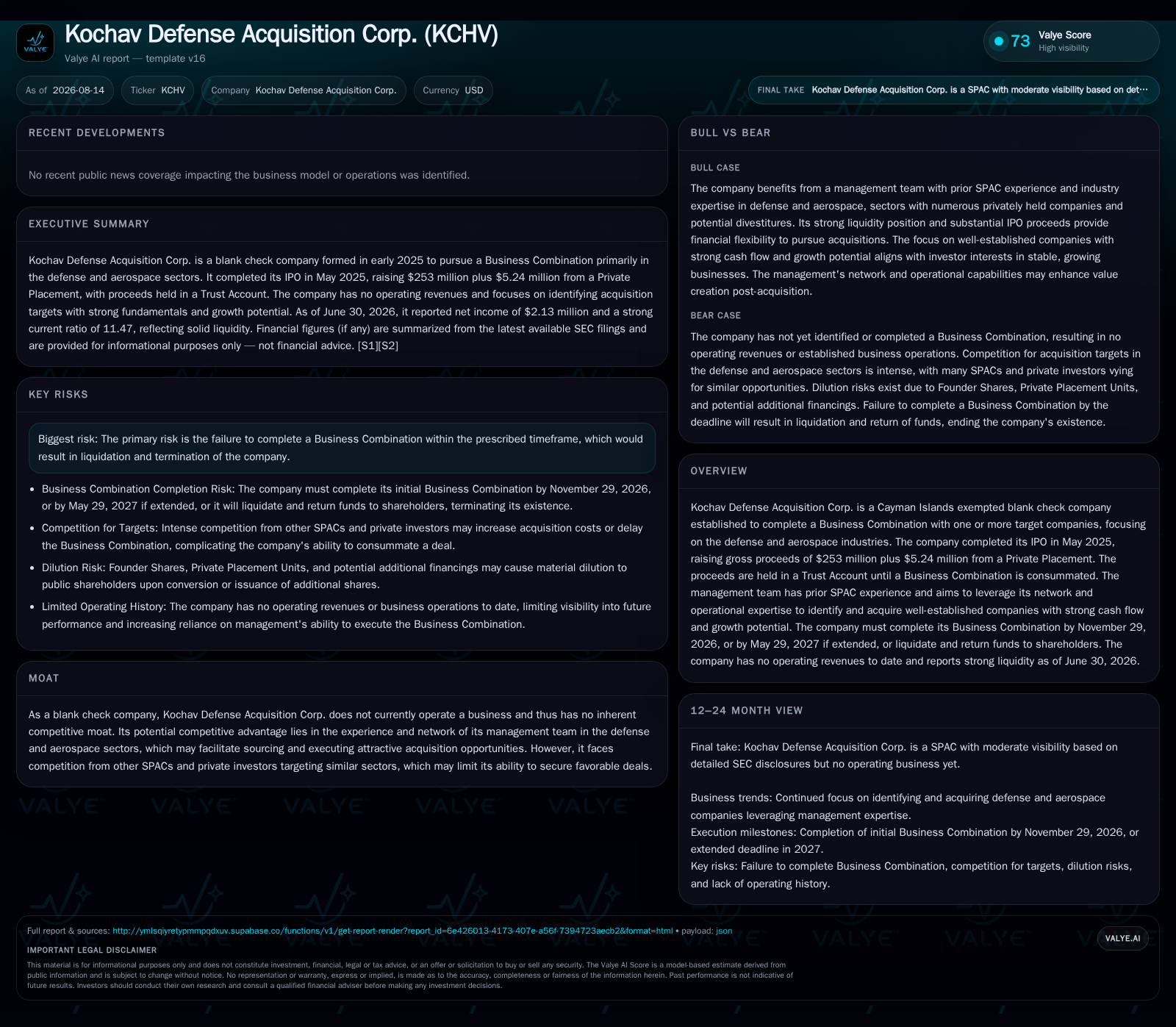
Kochav Defense Acquisition Corp maintains a robust trust account exceeding $253 million and shows no material changes in risk factors as of its August 13, 2026 quarterly filing. With an approaching deadline in November 2026 to complete a Business Combination and no announced targets yet, urgency mounts around closing a deal in the defense and aerospace sectors. The company’s experienced management team and targeted sector focus offer strategic advantages amid intense competition, but shareholder redemption risks and regulatory scrutiny remain key watchpoints. The next months are critical to determine whether Kochav can capitalize on its liquidity and sponsor expertise or face liquidation as a blank check vehicle.
Latest Quarter Status: Cash Ready but No Deal Yet Amid Deadline Pressure
Kochav Defense Acquisition Corp’s August 13, 2026 quarterly filing confirms the company's stable financial position with approximately $258 million held in its Trust Account following its May 2025 IPO and Private Placement combined proceeds [S2][F1]. This substantial liquidity underpins the company’s capacity to consummate an acquisition without immediate external financing. However, no announcements or disclosures indicate progress toward closing a Business Combination as of this filing date [S2]. The ticking clock is evident—Kochav has until November 29, 2026 (18 months post-IPO) to close a transaction unless shareholders approve a full extension to May 29, 2027 [S1]. This narrow window elevates execution risk since deal negotiations, due diligence, regulatory reviews especially within the targeted defense sector, and shareholder processes are time-intensive.
The combination of deep liquidity paired with persistent operational stasis highlights an urgent crossroads: while financial readiness is intact, failure to identify or secure terms for a suitable target imminently risks triggering liquidation protocols whereby the Trust Account funds would be returned pro rata after minimal expenses [S1]. Such outcomes characterize SPAC lifecycle dynamics where timing is as critical as capital availability.
SPAC Mechanics: Kochav’s Model of Value Creation Hinges on Target Execution Timing
As a blank check company formed under Cayman Islands law with no operating revenues pre-Business Combination, Kochav’s business model centers entirely on raising capital via its IPO—netting $253 million—and Private Placement—adding roughly $5.24 million—both locked into a Trust Account segregated specifically for acquisition use [S1]. This structure protects investor principal until shareholders approve an identified Business Combination target.
The Sponsor’s role is pivotal: Kochav’s executives leverage their defense and aerospace industry background to source targets aligned with market demand trends and valuation parameters. Their incentives align through Sponsor Promote structures granting them equity upon completion but may conflict with minimizing dilution for public shareholders once warrants vest post-de-SPAC transaction [S1].
The statutory Combination Period deadlines impose strict temporal constraints that compress negotiations and increase pressure on due diligence efficacy. Failure to complete a Business Combination by the deadline results in liquidation of the Trust Account funds less dissolution expenses—ensuring capital protection but ending sponsor upside potential [S1]. No progress disclosures at mid-2026 imply that while management remains active in pursuit, crystallizing an attractive merger opportunity under these pressures remains challenging.
Defense Sector Focus: Leveraging Industry Experience Despite Intense Competition for Targets
Kochav’s management team—chief executive officer Menachem Shalom and chief financial officer Asaf Yarkoni—brings prior SPAC experience fused with deep roots in defense and aerospace industries which constitute their focal sectors for acquisition targets [S1]. This curated focus aims to capitalize on middle-market companies attracted by emerging defense technologies amid geopolitical tailwinds supporting aerospace innovation budgets.
However, these sectors are simultaneously characterized by high due diligence thresholds driven by regulation (e.g., ITAR compliance), prolonged contracting cycles with governments, and formidable competition among SPACs, private equity firms specializing in aerospace-defense carve-outs, plus conventional IPO pathways targeting similar assets. These factors tighten deal flow availability particularly within the compressed timeline Kochav faces. The specialized nature may help establish some competitive moat through relationship networks but does not fully shield against broader market pressures.
Industry Comparisons: How Kochav Measures Against Other Aerospace-Defense SPACs and IPO Alternatives
In context, Kochav falls among the numerous defense-centric SPACs aiming to expedite compromises between middle-market visibility demands and investor alternative entry preferences. Prominent analogous cases include Social Capital Hedosophia Holdings known for efficient sponsor-driven deal execution leveraging broad capital access and industry ties. Contrastingly, Pershing Square Tontine Holdings exemplifies cautious investor sentiment toward large-scale SPACs facing delays amid complex merger negotiations.
Traditional aerospace IPO offerings usually undergo lengthier but more predictable due diligence processes with underwriting support that can command high valuations during bullish markets. However, heightened regulatory scrutiny post-2019 rules regarding PIPE structures has complicated some SPAC de-SPAC transactions despite faster timelines. Kochav must thus balance speed against thoroughness while navigating shareholder redemptions expected in such environments that dilute available funds relative to announced deal sizes.
This peer context emphasizes that while SPACs remain viable alternatives —particularly for companies seeking agility—execution discipline combined with aligned incentives between sponsors and investors becomes decisive for sustainable value creation.
Growth Path Dependencies: What Would Fuel Deal Completion and Post-Merger Success?
Successful completion depends foremost on identifying viable acquisition candidates fitting within Kochav's sector mandate whose valuation expectations harmonize with the funds guaranteed by unredeemed shares plus any PIPE commitments arranged concurrently with Business Combination announcements. The presence of a strong pipeline—cited by management broadly as driven by market backlog of companies constrained from traditional IPO routes—underpins optimism though actual target disclosures lag so far [S1]
Investor appetite also reflects broader macro themes favoring defense innovation amidst geopolitical tensions boosting government spend forecasts globally—tailwinds likely boosting exit valuations post-merger. PIPE financing sources often serve as critical adjunct capital enhancing deal certainty when simultaneous public shareholder redemptions threaten liquidity gaps.
Sponsor Promote dilution introduces post-merger ownership dilution reducing public float quality impacting secondary market liquidity potentially deterring some investors despite long-term upside hopes. Finally, reputational risk exists if announced targets underperform after combination eroding trust in sponsor capability complicating future fundraising efforts.
These risks interplay intensively given shrinking timeframe increasing need for precise execution leveraging both sector-specific savvy alongside standard de-SPAC process rigor.
What Next? Milestones Leading Up to Potential Business Combination or Liquidation Event
Attention turning toward identifiable milestones includes any forthcoming disclosures around initial Business Combination targets or ongoing deal talks expected—or necessary—to sustain plausible closure timelines [S2][S1]. Shareholder votes if extensions beyond November are proposed will markedly influence certainty levels around continuation versus wind-down scenarios.
Additionally monitoring potential regulatory filings reflecting defense contract clearances or governmental approvals will provide tangible progress signals for resolution timing consistency against statutory deadlines aligning investor expectations accordingly.
Failure to meet these markers will precipitate trust fund liquidations commensurate with legal corporate governance guidelines obligating return of investor capital minus dissolutive costs—which remains the ultimate fallback preserving principal albeit extinguishing sponsor upside potential outright.
'Financial Profile Discussion': Liquidity Buffer and Capital Structure Underpin Upcoming Moves
Kochav exhibits excellent liquidity health evidenced by Trust Account holdings approximating $258 million as of June 30, 2026 complemented by company current assets near $352 thousand against minimal current liabilities below $31 thousand yielding a current ratio exceeding 11x indicative of sound short-term solvency without operational cash flow generation obligations pre-business combination stage [F1][S2]
Operating losses prior to combination remain nominal reflecting administration-only expense profiles consistent with blank-check operational phases. This financial posture ensures runway endurance enabling management to pursue transactions unhindered by immediate monetary strain although inability to identify timely targets constrains eventual value-inflection realization horizons.
The capital structure preserves principal value barring liquidation outcomes pending definitive business combination consummation whereupon typical sponsor promote dilution alongside warrant exercises customarily reshape ownership percentages defining future profitability streams subject to post merger revenue growth trajectories inherent given combined entity standalone operations within high-barrier aerospace-defense verticals where ongoing contract awards drive cash flow expansion potential.
This foundational financial strength places Kochav advantageously relative to peers lacking sufficient trust assets but underscores reliance on execution efficacy rather than liquidity constraints moving forward under tight temporal windows.
This analysis is based exclusively on publicly available SEC filings as of August 13, 2026 ([S1], [S2]) supplemented by companyfacts data ([F1]) without speculation regarding undisclosed transactions or confidential pipeline details. Investors should closely monitor disclosed milestones relating to Business Combination announcements or shareholder votes that materially alter company trajectory beyond the snapshot herein.
Disclaimer: This is research-only, informational analysis and not investment advice. It may include AI-generated interpretation and general industry context. Always verify important details using primary sources.

Comments