
Oxley Bridge Acquisition Ltd Faces Going Concern Doubts Amid Search for Asian Consumer-Tech Target
As of mid-2026, Oxley Bridge Acquisition Ltd remains in the SPAC search phase with over $250 million in trust but mounting financing uncertainties.
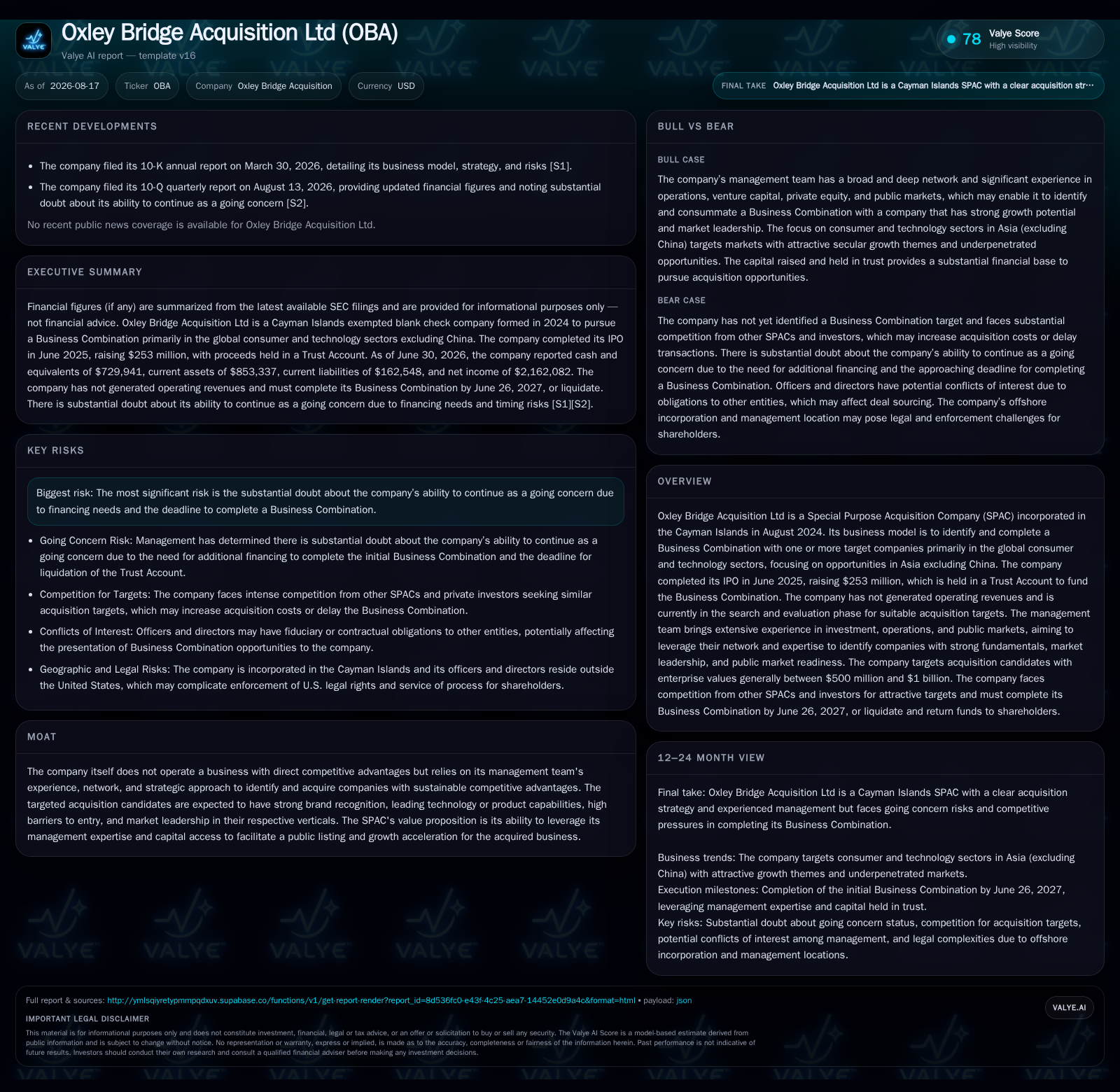
Oxley Bridge Acquisition Ltd (OBA), a Cayman Islands-based SPAC focused on consumer and technology businesses in Asia excluding China, completed its $253 million IPO in June 2025. Now approaching the midpoint of its 24-month deadline to consummate a business combination, the company has not yet identified a target and faces substantial doubt about its ability to continue as a going concern due to possible additional financing needs and regulatory deadlines. Its management team's experience is a key asset in sourcing deals, but the competitive SPAC market and shareholder redemption risk weigh on transaction prospects. With a current trust account balance near $730,000 and minimal operating expenses, OBA's next milestones will hinge on deal announcements, financing arrangements, and shareholder votes.
Recent Operating Update
Oxley Bridge Acquisition Ltd filed its latest quarterly report on August 14, 2026, reaffirming it has not yet consummated a Business Combination and continues seeking suitable private companies in the global consumer and technology sectors outside China for acquisition [S2]. The company reported $729,941 in cash and equivalents as of June 30, 2026, with current assets totaling approximately $853,000 against current liabilities near $163,000—yielding a robust current ratio of about 5.25x that signals conservative operating expense management but limited operational scaling [F1]. There are no reported operating revenues since OBA functions strictly as a blank-check company prior to closing an acquisition.
Crucially, management highlighted "substantial doubt" about the company's ability to continue as a going concern due to anticipated needs for additional financing to complete its initial Business Combination before the statutory deadline of June 26, 2027 [S2]. This assessment reflects risks around timing for deal-making within the finite Combination Period and potential equity dilution or debt issuance required to fund purchases beyond the IPO trust account proceeds.
Alongside financial updates, the company disclosed governance shifts effective July 16, 2026: Enrique Gonzalez was appointed to the Compensation Committee while Wee Leong Gan took chairmanship of the Audit Committee with Norma Chu joining it as member. These changes followed Jack Cho’s resignation from the Board but were stated as unrelated to any disputes or operation issues [S3]. This board restructuring could signal OBA's intent to optimize oversight ahead of potentially complex transaction negotiations.
Business Model Overview
OBA operates as a Special Purpose Acquisition Company (SPAC), purpose-built as a public shell entity that raises capital through an Initial Public Offering (IPO) by selling Units comprising one ordinary share and one-half warrant. The IPO in June 2025 generated gross proceeds of $253 million placed in a Trust Account managed by an independent trustee; these funds serve exclusively to finance an eventual acquisition or to be returned pro rata if no Business Combination occurs within two years [S1]
Revenue mechanics prior to a Business Combination are nil since OBA does not conduct commercial operations; value creation depends heavily on successfully identifying target companies that can benefit from swift access to U.S. capital markets via OBA’s public listing [S23]. Shareholders have redemption rights allowing them to cash out at approximately $10 per share upon transaction announcement or vote, introducing an element of liquidity risk that management must factor into deal structuring via PIPE financings or Sponsor contributions
Post-merger, the acquired company's shares will replace OBA’s public shares, providing shareholders with exposure to the combined entity's operating performance. Thus, OBA’s offering specifically monetizes Sponsor expertise, network access, and capital structuring ability rather than conventional product sales.
Management targets firms characterized by large addressable markets showing underpenetration particularly within Asia excluding China. Preferred businesses possess differentiated products or technology platforms demonstrating scalable unit economics compounded by strong customer retention metrics or recurring revenue streams [S6][S15]. The selective focus on consumer-facing or technology-enabled enterprises with market leadership ambitions supports competitive differentiation among numerous SPAC sponsors seeking deals in similar verticals
Industry Structure and Competitive Position
SPACs such as OBA occupy an upstream niche within capital markets where they act as acquisition vehicles connecting private companies to public investors without requiring an initial public offering under traditional underwriting processes. This hybrid model appeals particularly to growth companies seeking expedited paths to public status amid uncertain IPO windows.
Within this sector segment focusing on consumer technology firms in Asia ex-China—a region witnessing digital transformation acceleration—competition among SPACs has intensified alongside increasing investor appetite for exposure beyond China's strict regulatory environment. Peers include other Nasdaq-listed SPACs targeting similar geographies or thematic sectors but typically span varying capital bases; OBA’s $253 million trust positions it mid-scale relative to both larger mega-SPACs and small-cap blank-check vehicles.
Competitively, OBA’s value proposition rests significantly on its management team's blend of investment acumen and operational experience across venture capital, private equity, public markets, and enterprise building. This background offers potential acquirers tactical advantages in deal sourcing, execution diligence, post-merger integration support, and strategic scaling advice—a critical differentiation given many SPACs solely leverage sponsor financial capabilities without deep operational involvement [S6][S19].
However, rising SPAC formation rates elevate contestability for quality targets with attractive fundamentals. This competitive intensity elevates pricing pressures during negotiation phases and could force concessions impacting future shareholder dilution or transaction feasibility.
Growth Drivers
OBA’s growth prospects hinge entirely on successful identification and closing of one or more Business Combinations within the remaining window toward its June 2027 deadline. Key growth enablers include:
- Increasing private demand from Asia-based consumer tech companies seeking faster industrial scale-up coupled with access to U.S. public equity capital.
- Persistently strong investor interest supporting alternative public listing routes such as de-SPAC transactions over traditional IPOs given their relative speed and cost advantages.
- Management networks capable of delivering prioritized deal pipelines vetted for alignment with OBA’s strategic criteria related to unit economics durability and market differentiation.
- Innovative financing structures including PIPE investments enabling efficient capitalization beyond trust account limits while mitigating dilution concerns.
- Favorable regulatory clarification around SPAC disclosures helping restore investor confidence following past sector volatility.
These drivers align with broader structural trends favoring technology-enabled platform businesses expanding digital footprints amid regional economic diversification efforts across Asia excluding China. Such secular tailwinds improve odds that target candidates will exhibit sustainable competitive moats upon becoming publicly listed entities facilitated by OBA.
Risks and Watchpoints
The foremost risk is failure to consummate any Business Combination before expiration of the mandated Combination Period ending June 26, 2027; this would trigger liquidation protocols returning trust funds less expenses back to shareholders—effectively wiping out Sponsor equity contributions [S1][S2]
Dilution risk looms from multiple fronts: exercise of founder shares (allocated roughly at 20% ownership pre-merger), warrants outstanding from IPO units exercisable at $11.50 per share, plus potential PIPE financing equity issuances necessary if redemption rates are high or acquisition price surpasses trust balances [S23]. High redemption rates could cripple deal financing capacity if shareholders elect redemption en masse following Business Combination announcement.
Competition intensifies challenge in accessing competitively priced targets meeting OBA's criteria. Overpaying could harm post-merger valuation; passing on deals narrows options amid ticking clock pressures. Additionally, reliance on management expertise introduces execution risk since unexpected industry shifts or internal resource limits may impair negotiation capability.
Regulatory compliance risk remains salient given evolving SEC scrutiny tailored towards protecting public shareholders against certain conflicts seen in earlier SPAC waves—these include transparency mandates around Sponsor incentives and fee arrangements which might complicate deal approvals or prolong timelines.
Lastly, integration risk following closure is intrinsic whenever merging a private enterprise into a newly formed public vehicle—success depends heavily on aligning cultures, systems readiness for stringent reporting requirements including Sarbanes-Oxley controls preparation unique challenges highlighted by management’s advisory experience but never fully mitigating uncertainty.
What To Watch Next
Critical upcoming milestones center on:
- Announcements regarding selected acquisition targets: confirmation would materially alter valuation perception and eliminate some going concern doubts.
- Shareholder vote timing decisions or tender offer plans once a Business Combination agreement is filed publicly (with proxy materials including audited financials).
- PIPE financing commitments signaling external institutional support augmenting trust account proceeds necessary if redemptions are sizable.
- Redemption rate outcomes following any transaction disclosures which directly impact net available cash for deal funding versus obligations toward shareholders opting out.
- Potential requests for extension of Combination Period by shareholder vote should market conditions delay closing steps beyond original deadline.
- Continued board developments ensuring corporate governance frameworks adapt adequately ahead of complex transaction events.
Monitoring these markers will provide disclosure-based clarity on potential transaction execution feasibility balancing sponsor ambitions against investor protections mandated by regulation and market standards.
Financial Profile Discussion
Disclaimer: This is research-only, informational analysis and not investment advice. It may include AI-generated interpretation and general industry context. Always verify important details using primary sources.

Comments