
Beam Global Q2 2026: Revenue Beat Amid Continued Losses and Moderate Liquidity
Beam Global’s Q2 2026 results reveal stronger-than-expected revenue growth driven by solar-powered EV charging infrastructure, while net losses persist alongside moderate liquidity.
Beam Global reported Q2 2026 revenue exceeding analyst estimates, reflecting growing adoption of its patented, rapidly deployable solar-powered EV and autonomous vehicle charging products. Despite this operational progress, the company continues to incur net losses consistent with historical trends, highlighting ongoing challenges in reaching profitability. As of June 30, 2026, Beam Global maintained a current ratio of 1.46, indicating moderate liquidity but limited cash reserves. The business model centers on grid-independent infrastructure solutions supported by an expanding international reseller network, though customer concentration and capital needs remain key risks.
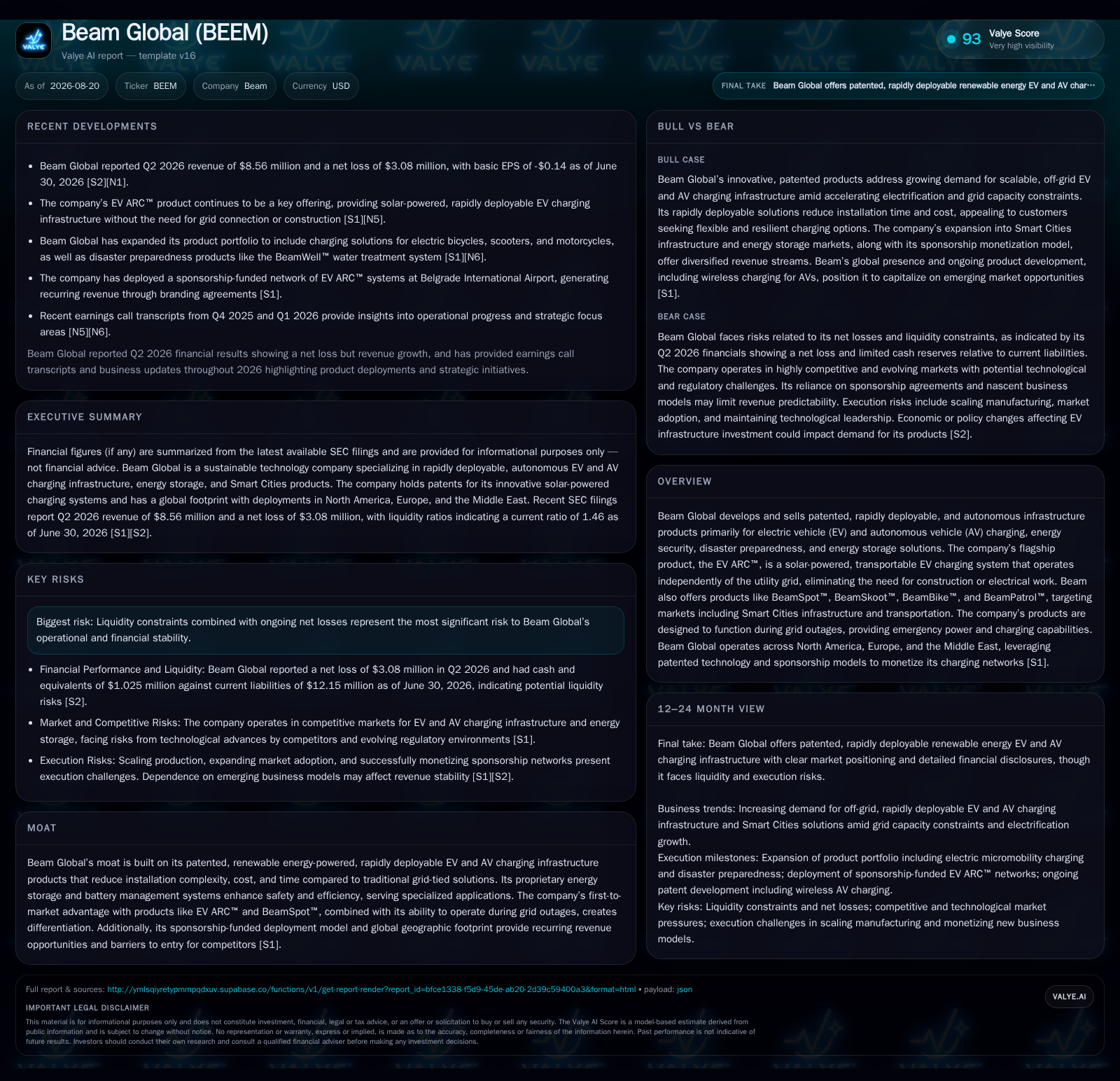
Beam Global’s Q2 2026 financial results, filed on August 19, 2026, demonstrate continued operational momentum with revenue surpassing analyst expectations, driven by the adoption of its patented, solar-powered electric vehicle (EV) and autonomous vehicle (AV) charging infrastructure [S2][S3][F1]. However, the company remains challenged by recurring net losses and a liquidity position that, while moderate, reflects constrained cash resources as of June 30, 2026.
Q2 2026 Operating and Financial Performance
In the quarter ended June 30, 2026, Beam Global reported revenue exceeding analyst estimates, indicating sustained market traction for its autonomous, solar-powered EV charging products [S2][S3]. This growth validates the company’s core business model, which centers on rapidly deployable, grid-independent infrastructure solutions that do not require traditional utility grid expansion. Despite this revenue growth, Beam Global continued to incur net losses consistent with its historical trend of recurring operating deficits [S2][S3].
From a liquidity perspective, the company’s balance sheet as of June 30, 2026, showed current assets of $17.68 million against current liabilities of $12.15 million, yielding a current ratio of 1.46 [F1]. Cash and equivalents stood at $1.025 million, indicating a limited liquidity buffer to support ongoing operations and capital needs [F1]. This moderate liquidity position constrains operational flexibility and capital allocation, underscoring the importance of future capital raises or improved cash flow generation.
Business Model and Market Positioning
Beam Global’s business model is built around patented technology enabling solar-powered, rapidly deployable EV and AV charging infrastructure that operates independently of the utility grid [S1]. This grid-independent design addresses market needs where traditional grid connection is either too costly, disruptive, or impractical. The company’s products include charging stations, energy storage systems, emergency power panels, streetlighting, and specialized power electronics tailored for smart city infrastructure.
The rapid deployment capability replaces the conventional, time-consuming, and expensive process of grid-tied electrical construction and installation with a turnkey hardware solution, which may reduce total ownership costs and installation lead times. Beam Global monetizes its charging networks through direct hardware sales and a sponsorship-funded deployment model, supported by an expanding international reseller and agent network covering regions including the U.S., Europe, the Middle East, Africa, and Australia [S1]. This geographic expansion could contribute to revenue diversification and localized sales support.
However, the company’s revenue remains concentrated among a few large customers, including government entities and commercial organizations, which poses customer concentration risk and potential revenue volatility.
Risks and Capital Needs
Despite operational progress, Beam Global faces structural challenges in achieving sustainable profitability. The company’s ongoing investments in product innovation, manufacturing capacity expansion across multiple global locations, and sales channel development continue to pressure margins and cash flow [S1][S2][F1]. The limited cash reserves and moderate current ratio as of June 30, 2026, highlight the company’s constrained liquidity position, which may restrict its ability to fund operations without additional capital [F1]. Furthermore, the reliance on a few large customers creates revenue concentration risk, which could materially impact financial results if any significant customer reduces orders or delays purchasing decisions.
Future capital raises may be necessary to sustain growth and operations. However, access to capital on favorable terms is uncertain and could result in dilution or restrictive covenants, affecting shareholder value and operational flexibility [S1].
Scenario Analysis and Investor Implications
A bull case is that Beam Global successfully scales its sponsorship-funded deployment model and leverages its international reseller network to achieve sustainable profitability within the next two to three years. This would require continued revenue growth that outpaces operating cost increases, diversification of the customer base to mitigate concentration risk, and access to capital on favorable terms [S1][S2]. Confirmation of this scenario would include improving quarterly margins, positive operating cash flow, and new large customer contracts or reseller partnerships.
The base case envisions steady revenue growth accompanied by ongoing net losses, necessitating periodic capital raises to fund operations [S2][F1]. In this scenario, the company maintains a stable but negative operating cash flow and manages customer concentration without significant losses. Indicators supporting this scenario would be consistent revenue beats with flat or slightly negative margins and occasional capital raises.
Conversely, a bear case involves worsening liquidity and customer losses leading to operational cutbacks or restructuring [S2][F1][S1]. This could result from losing major customers, failure to secure additional capital, or rising operating expenses without corresponding revenue growth. However, persistent net losses and limited liquidity underscore the structural challenges the company faces in achieving profitability and operational sustainability. Investors should closely monitor quarterly revenue and margin trends, operating cash flow, customer concentration shifts, and capital raising activities to assess Beam Global’s trajectory toward financial viability and growth.
Disclaimer: This is research-only, informational analysis and not investment advice. It may include AI-generated interpretation and general industry context. Always verify important details using primary sources.

Comments