
Protagenic Therapeutics Updates Clinical Timeline for PT00114 with IND Submission Targeted by Year-End
Protagenic Therapeutics aims to submit an IND for PT00114 by the end of 2026 and initiate Phase II trials in early 2027 amid liquidity challenges.
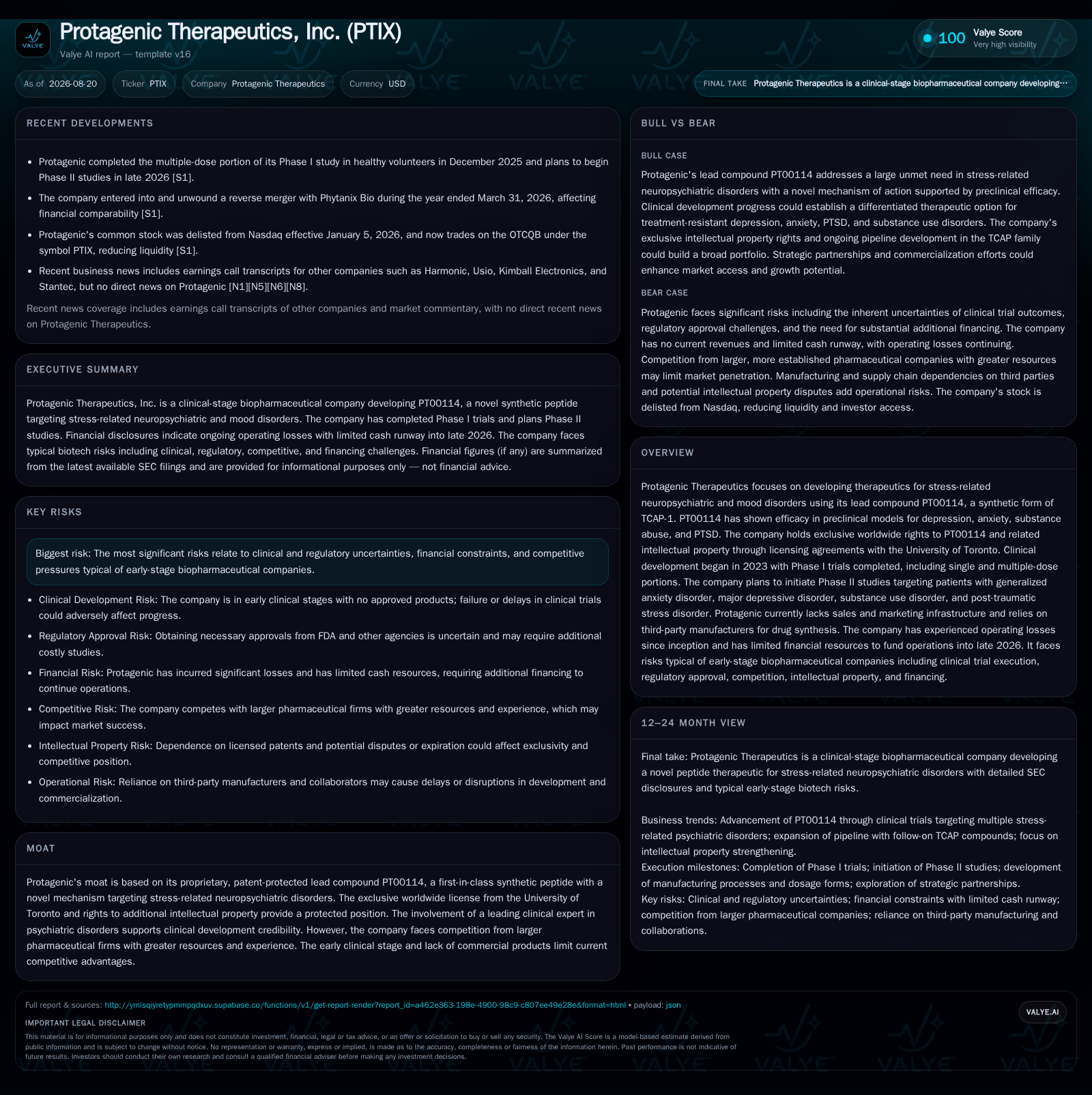
Protagenic Therapeutics is advancing its lead synthetic peptide PT00114 toward Phase II clinical trials for stress-related neuropsychiatric disorders. The company plans to submit its Investigational New Drug (IND) application before the end of 2026, targeting first patient dosing in the first half of 2027, contingent on FDA clearance and completion of required IND-enabling activities. However, as of June 30, 2026, Protagenic reported a current ratio of 0.66 and cash runway extending only into Q3 2026, raising concerns about its ability to finance upcoming clinical milestones without additional capital. The company has no product revenue and has incurred significant operating losses since inception, emphasizing the critical need for timely financing to sustain operations.
Clinical Development Progress and Milestones
Protagenic Therapeutics, Inc. is advancing its lead compound, PT00114, a synthetic peptide designed to address stress-related neuropsychiatric and mood disorders. The company plans to submit an Investigational New Drug (IND) application for PT00114 before the end of 2026, aiming to initiate Phase II clinical trials in the first half of 2027 [S3]. These timelines are contingent upon FDA review and clearance, as well as the completion of IND-enabling chemistry, manufacturing, and control (CMC), manufacturing, and nonclinical activities.
The clinical development program has progressed with the completion of the multiple-dose portion of the Phase I study in healthy volunteers in December 2025, following the announcement of single-dose results in May 2024 [S1]. Phase I data provide early safety and dosing insights essential for advancing PT00114 into Phase II studies, which will evaluate efficacy in patient populations affected by chronic stress-related psychiatric disorders. Achieving IND submission and initiating Phase II trials represent pivotal inflection points that could validate PT00114's clinical potential and significantly impact Protagenic's valuation [S3].
Financial Position and Liquidity Risks
As of June 30, 2026, Protagenic reported current assets of $709,871 and current liabilities of $1,072,614, resulting in a current ratio of 0.66, indicating that current liabilities exceed current assets [F1]. This liquidity position suggests constraints on the company's ability to meet short-term obligations without securing additional capital. The company's cash runway extends only into the third quarter of 2026, which is before the planned IND submission and Phase II trial initiation milestones [S2].
Protagenic has incurred significant operating losses since inception, with an accumulated deficit of $4,029,629 as of March 31, 2026 [S1]. The negative working capital, with current liabilities exceeding current assets and a current ratio of 0.66 as of June 30, 2026, underscores the critical need for timely financing to sustain operations and fund IND-enabling activities and clinical trials [F1].
Business Model and Competitive Positioning
Protagenic's business model centers on the development of PT00114, a first-in-class synthetic form of Teneurin Carboxy-terminal Associated Peptide-1 (TCAP-1), which modulates overactive stress responses through a novel mechanism of action. The company holds exclusive worldwide rights to PT00114 via a license agreement with the University of Toronto and is developing additional compounds within the TCAP family to build a diversified pipeline [S1].
Given the early clinical stage and absence of approved products, the company does not generate revenue and incurs substantial research and development expenses, resulting in ongoing operating losses.
Risk Factors and Operational Challenges
Protagenic faces several risks common to early-stage biopharmaceutical companies. The successful execution of its clinical development plan depends on timely IND submission and FDA clearance, which are subject to regulatory uncertainties. Delays in completing IND-enabling activities or in securing FDA approval could postpone Phase II trial initiation, impacting the company's development timeline and valuation [S3]. Other operational challenges include reliance on third-party manufacturers, which introduces risks related to supply chain and manufacturing scale-up. Additionally, clinical trial enrollment and regulatory approval processes are inherently uncertain and could affect development timelines and costs [S1].
Conclusion and Watchpoints
Protagenic Therapeutics is at a critical juncture, with its lead compound PT00114 progressing toward IND submission and Phase II clinical trials targeting stress-related neuropsychiatric disorders. These clinical milestones are essential for validating the compound's therapeutic potential and advancing the company's development pipeline [S3].
However, the company's current liquidity position, reflected in a current ratio of 0.66 as of June 30, 2026, presents a significant risk to the timely execution of its clinical plans [F1]. Without additional financing, Protagenic may face operational disruptions that could delay or suspend its IND submission and Phase II trial initiation.
Investors and stakeholders should closely monitor announcements regarding financing or strategic partnerships, FDA acceptance or feedback on the IND application, progress on IND-enabling activities, and updates on Phase II trial initiation and patient enrollment. These developments will be critical indicators of the company's ability to sustain its clinical development trajectory and realize the potential value of PT00114.
The base-case scenario assumes Protagenic secures additional capital in Q3 2026, enabling it to meet its planned clinical milestones [S3][F1]. Conversely, failure to raise funds or regulatory setbacks could delay development and negatively impact the company's prospects.
Overall, Protagenic's advancement of PT00114 underscores the promise of its novel therapeutic approach, but the company's near-term financial constraints highlight the importance of capital availability in supporting its clinical and operational objectives.
Disclaimer: This is research-only, informational analysis and not investment advice. It may include AI-generated interpretation and general industry context. Always verify important details using primary sources.

Comments