
Cogent Communications Q2 2026: Integration Challenges and Margin Improvement Amid Refinancing Risks
Cogent Communications' Q2 2026 results reveal ongoing revenue pressure from Sprint fiber network integration, margin gains, and significant refinancing challenges impacting capital allocation.
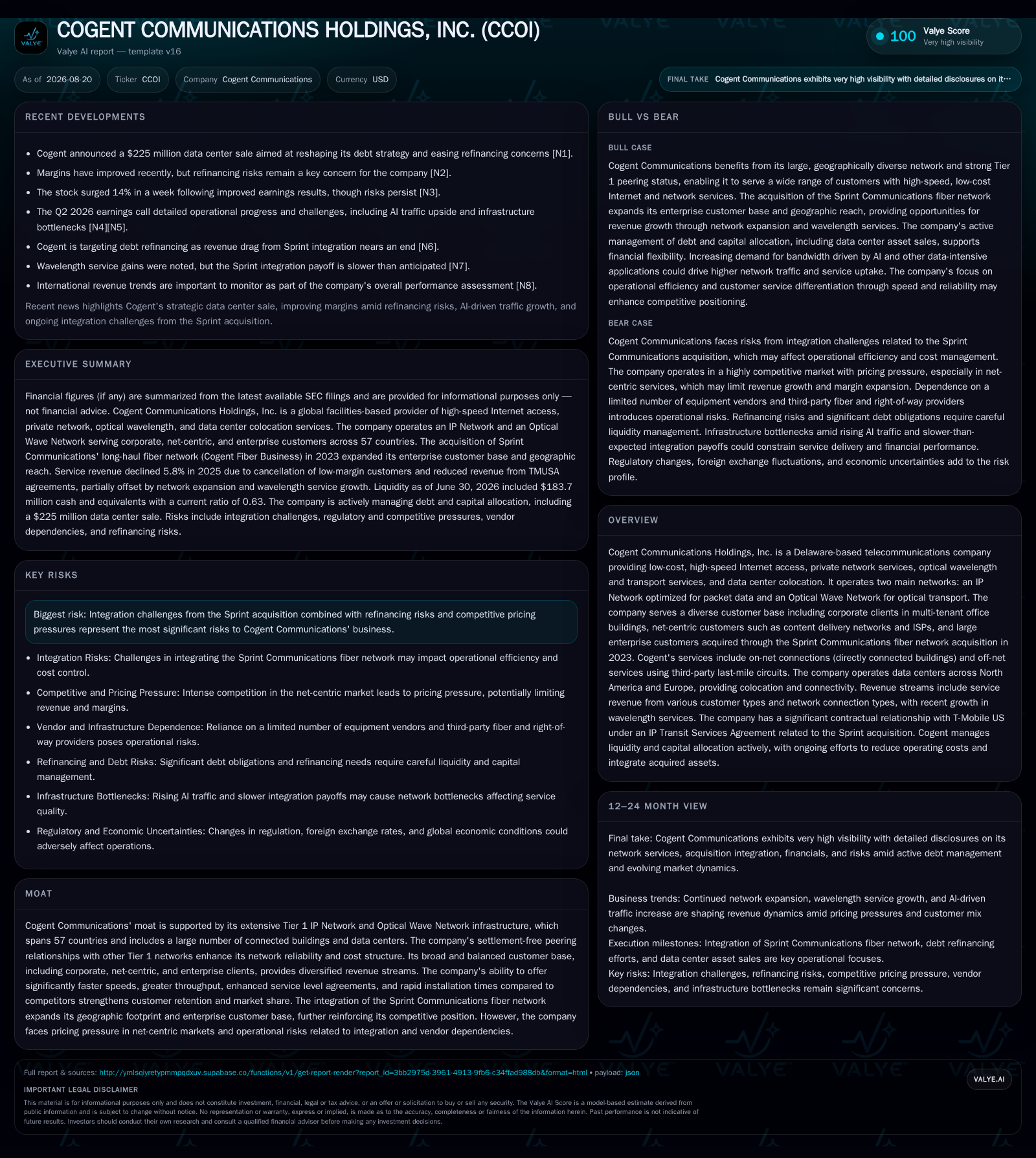
Cogent Communications' second-quarter 2026 financial results reflect continued revenue headwinds linked to the integration of the Sprint Communications fiber network acquired in 2023. Despite declining revenue, the company achieved operating margin improvement through cost management and operational efficiencies. However, liquidity remains constrained with a current ratio of 0.63 as of June 30, 2026, and material refinancing risks loom due to substantial debt maturities in 2027. These factors collectively influence Cogent's near-term profitability, cash flow generation, and capital allocation decisions.
Q2 2026 Operating Performance and Sprint Integration
Cogent Communications Holdings, Inc.'s Q2 2026 results demonstrate the continuing impact of integrating the Sprint Communications fiber network acquired in 2023. The company reported a decline in revenue during the quarter, attributable to the drag from this integration process [S2]. This acquisition, which added a substantial long-haul fiber network to Cogent's existing infrastructure, has introduced operational complexities that have slowed revenue growth. Despite the revenue headwinds, Cogent achieved an improvement in operating margins for the quarter. This margin enhancement is linked to effective cost management and operational efficiencies during the integration, as operating expenses grew more slowly than the decline in revenue [S2]. Such margin trends indicate that while top-line growth is challenged, the company is leveraging operational discipline to mitigate profitability erosion.
Capital Structure, Liquidity, and Refinancing Risks
Cogent's liquidity position as of June 30, 2026, reveals constraints, with current assets totaling $606.2 million against current liabilities of $959.6 million, resulting in a current ratio of 0.63 [F1]. This working capital deficit signals pressure on short-term financial flexibility. Compounding this challenge are substantial debt maturities scheduled for 2027 [S2][S4][S5]. These upcoming maturities present material refinancing risk, influencing Cogent's capital allocation decisions, including dividend policy and share repurchase activity. The company operates under debt covenants that restrict distributions and other payments, necessitating careful liquidity management and refinancing strategies to avoid potential capital structure distress. While Cogent has authorized a share repurchase plan, no repurchases occurred in the first half of 2026, reflecting prudent capital allocation during refinancing uncertainties [S2]. The refinancing risk is heightened by the need to secure favorable terms to manage interest costs and maturity profiles, especially given the integration-related cash flow pressures. The company’s ability to refinance its debt on commercially reasonable terms will be a critical factor in maintaining financial stability and supporting ongoing operations [S4][S5].
Business Model and Competitive Positioning
Cogent operates a broad Tier 1 IP and Optical Wave Network spanning 57 countries, serving a diversified customer base comprising corporate clients, net-centric customers such as content delivery networks and internet service providers, and large enterprises [S1]. This extensive network infrastructure supports a variety of high-speed internet services, including IP transit, private wavelength transport, and data center colocation. The company’s revenue is primarily recurring, driven by service agreements that leverage its network reach and service level commitments. Pricing is influenced by service level agreements and network coverage, while margins and cash flow depend on network scale, operational efficiencies, peering relationships, and synergies from integration activities. Cogent’s competitive advantages include its extensive fiber footprint and settlement-free peering arrangements, which reduce costs and enhance network performance. However, the company faces pricing pressures common in the commoditized bandwidth market and risks related to the integration of the Sprint acquisition, which could affect service delivery and customer retention. Q2 2026 results confirm that expected synergies have been delayed, with revenue declines persisting despite operational scale [S1][S2][N12]. However, the margin improvement observed suggests that cost controls and operational leverage are beginning to take effect, offering potential for margin recovery once integration costs stabilize [S2][N13].
One plausible positive scenario is that successful integration accelerates revenue growth and margin expansion, improving cash flow and easing refinancing risks [S2][S1][N12]. This would require stabilization or decline in integration costs, growth in revenue from the Sprint fiber network as planned, and favorable refinancing outcomes. Confirmation would come from sequential revenue growth, further margin expansion, and successful debt refinancing announcements. Such a scenario would enhance Cogent’s ability to invest in network expansion and potentially increase shareholder returns.
Conversely, a downside scenario involves persistent integration challenges causing prolonged revenue pressure and margin compression, coupled with refinancing difficulties leading to liquidity constraints and potential capital structure distress [S2][S4][F1][N3]. In this scenario, integration costs remain elevated, revenue continues to decline or stagnate, and refinancing attempts fail or occur at high cost. Confirmation would include negative revenue trends in subsequent quarters, widening operating losses, and deteriorating liquidity ratios. This outcome could force Cogent to curtail capital expenditures, reduce dividends, or seek dilutive financing, adversely impacting shareholder value.
Investors should closely monitor sequential revenue trends, operating margin developments, debt refinancing progress, liquidity ratios, and customer retention or new contract wins in upcoming quarters. These indicators will be critical in assessing whether Cogent can navigate integration headwinds and refinancing risks to restore growth and strengthen its capital structure. The company’s ability to manage these factors effectively will determine its trajectory in a competitive and capital-intensive industry.
While revenue growth is pressured, margin improvement signals operational resilience. The company’s diversified network and customer base provide a foundation for recovery, but refinancing execution and integration success remain key watchpoints for investors assessing future performance.
Disclaimer: This is research-only, informational analysis and not investment advice. It may include AI-generated interpretation and general industry context. Always verify important details using primary sources.

Comments