
D. Boral Acquisition I Corp’s Early-Stage SPAC Execution Highlights Management Expertise and Strategic Capital Deployment
Following its February 2026 IPO, D. Boral Acquisition I Corp demonstrates foundational capital integrity and taps deep management expertise as it initiates its search for a high-quality acquisition target.
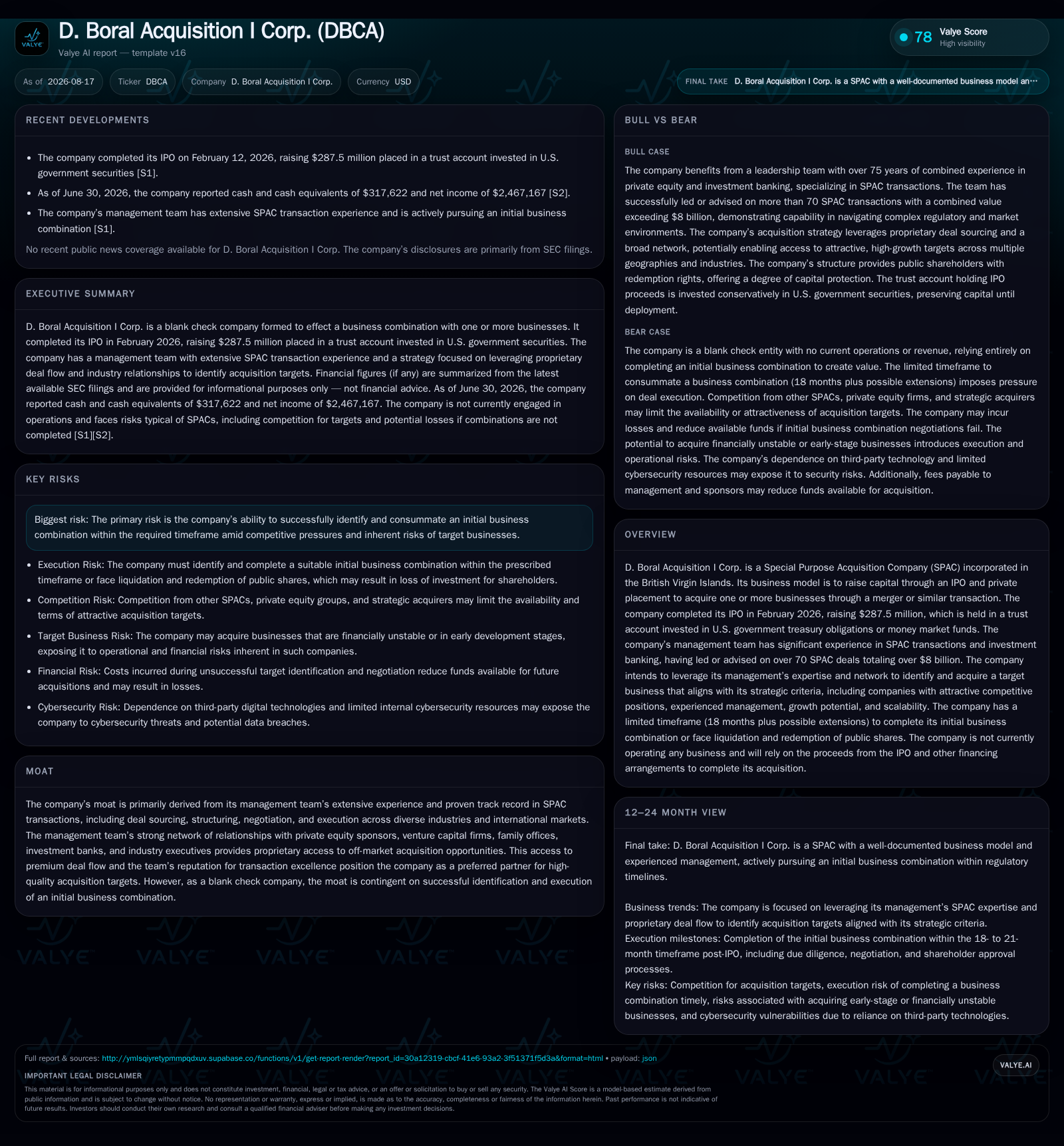
D. Boral Acquisition I Corp (DBCA), a British Virgin Islands-incorporated special purpose acquisition company, completed a $287.5 million IPO in February 2026, raising capital through units composed of Class A ordinary shares paired with half redeemable warrants. Its latest quarterly filing as of June 30, 2026 confirms the full trust account balance held predominantly in low-risk U.S. treasury instruments, preserving liquidity ahead of its initial business combination. The seasoned management team, having participated in over 70 prior SPAC transactions exceeding $8 billion in aggregate value, leverages proprietary networks to source attractive acquisition opportunities while navigating the typical SPAC time constraints and market competition. The primary near-term focus remains disciplined deal pipeline development and successful execution within regulatory timeframes.
IPO Success Establishes Capital Base for Targeted Acquisitions
D. Boral Acquisition I Corp consummated its initial public offering on February 12, 2026, issuing 28.75 million units including full exercise of the underwriters’ overallotment option at $10 per unit for total gross proceeds of $287.5 million [S1][S9]. Each unit comprised one Class A ordinary share (par value $0.0001) coupled with one-half of one redeemable warrant exercisable at $11.50 per share. Alongside the IPO, the company completed a private placement of an additional 200,000 units to its Sponsor at the same price without underwriting commissions. This arrangement is typical for SPAC structures aiming to align sponsor economics through units that combine equity with future warrant dilution potential
The legal incorporation as a British Virgin Islands business company situates DBCA favorably for cross-border deal structuring flexibility while mandating compliance with both U.S. securities regulations and BVI law [S1]. The net IPO proceeds were placed in a segregated trust account exclusively invested in short-duration U.S. Treasury obligations and qualified money market funds designed to preserve capital imminently available for a de-SPAC transaction without exposing the company to undue market or credit risk [S1][S4]. This conservative cash deployment strategy is critical given the regulatory scrutiny around investment company status that intensifies with prolonged fund holding periods.
As of the June 30, 2026 quarter-end date reported in their latest SEC filing on August 14, the trust account balance and cash equivalents total approximately $317.6 million according to XBRL financial data—a figure consistent with the original capital raise plus accrued interest—indicating minimal cash burn or deployment ahead of an acquisition step [F1]. This liquidity stability underpins DBCA’s positioning as it launches active pursuit of target businesses.
Trust Account Integrity and Capital Deployment Strategy
DBCA's strict adherence to maintaining trust funds in low-risk instruments underscores an industry-standard approach minimizing volatility exposure prior to consummation of an initial business combination. The legal structure restricts investing outside direct government securities or narrowly defined money market instruments meeting SEC Rule 2a-7 standards preventing classification as an investment company under the Investment Company Act—an outcome that could materially complicate investor protections and regulatory compliance [S1][S4].
Importantly, management reserves discretion to hold funds entirely in cash or interest-bearing demand deposits if increased risk from holding treasury securities is perceived—demonstrating proactive regulatory risk mitigation common among leading SPACs [S4]. The trustee overseeing these assets is Continental Stock Transfer & Trust Company ensuring independent administration consistent with fiduciary requirements.
This capital preservation strategy means operating losses prior to a de-SPAC transaction are confined roughly to administrative and professional fees paid by non-trust cash resources such as IPO sponsor contributions or interest earned distributions—a standard feature limiting dilution risk before deployment [S1]
Management Experience as Competitive Advantage in Deal Sourcing
The core moat DBCA touts lies in its leadership’s substantial expertise navigating the complexities of SPAC lifecycle transactions globally. The team collectively accounts for over seventy completed SPAC transactions valued at more than $8 billion across North America, Europe, Asia, and emerging markets—a breadth that aids both deal sourcing leverage and nuanced execution amid varying regulatory regimes and market conditions [S13]
Competitive advantage emanates from cultivated relationships spanning private equity sponsors, venture capital firms, family offices, investment banks, and operating executives delivering an exclusive pipeline beyond typical auction processes seen by many competitors [S14]. This access is supported by proprietary quantitative screening tools layered with qualitative judgment honed through rigorous deal negotiation history.
Executives include those with prior success managing business combinations through tumultuous market phases and intricate cross-border arrangements reflecting adaptability—a key asset given today's volatile issuer appetite for alternative public listing vehicles like SPACs [S16]. Their well-documented ability to secure strategic capital partnerships further broadens accessible financing sources desirable for structuring complex deals potentially involving PIPE investments or forward purchase agreements once targets are identified [S14].
Challenges Ahead: Deadlines, Redemption Rights, and Market Environment
Despite these strengths, DBCA confronts foundational risks intrinsic to the SPAC model structure as framed by their own disclosures. Under existing articles of association filed alongside the IPO documentation, DBCA has an initial maximum window of eighteen months from closing—extendable optionally by three months at sponsor discretion—to complete its business combination or face mandatory shareholder redemption triggering possible liquidation scenarios limiting sponsor investment upside [S1][S2].
Failure within this timeframe would obligate returning most shareholders’ capital from trust holdings less expenses accrued during search attempts—a harsh constraint pressuring rapid yet disciplined deal origination cycles [S20]. Additionally, redemption rights exercised by public shareholders post-announcement dilute available funds for acquisition financing thereby reducing flexibility when competing against other well-capitalized buyers pursuing similar targets [S20].
Further complicating the environment is market volatility affecting both stock performance post-deal as well as institutional investor appetite influenced by broader macroeconomic conditions—a challenge shared industry-wide but notable given recent heightened regulatory attention on transparency and disclosure practices surrounding SPAC transactions.
Strategic Focus on Deal Pipeline Quality and Target Screening
Operationally post-IPO through second quarter filings reveal DBCA’s management has promptly initiated a structured target identification process leveraging both classical diligence methodologies—interviews with incumbent management teams and suppliers—and deeper assessments customized for cross-border sector exposures aligned with internal expertise domains [S1][S14][S24].
The emphasis on companies fitting specific criteria such as strong competitive positions, demonstrable revenue growth trajectories or profitability potential reflects prudent prioritization eliminating ill-suited prospects early [S18]. Concurrently noted is intent to capitalize on scalability factors across geographies enhancing long-term post-combination value creation probability often favored by public investors seeking growth narratives beyond saturated domestic markets
Management projects ongoing funnel refinement driven by their sponsor's robust network channels promising higher quality proprietary deal flow than peers reliant solely on intermediaries or public auctions—a differentiation point bearing observation during future milestone disclosures [S14].
What Investors Should Watch Next: Milestones Toward Business Combination
Looking ahead, quarterly updates remain crucial windows into progress toward announcing definitive merger agreements or candidate selections demonstrating substantive advancement toward de-SPAC completion within mandated timelines [S2]. Investors should monitor:
- Disclosures detailing specific target evaluations passed key diligence thresholds indicating readiness for term sheet negotiations.
- Indications whether shareholder votes will be solicited or tender offers conducted impacting timing precision.
- Potential PIPE financing announcements supplementing acquisition consideration capacity or supporting post-merger capitalization optimization.
- Updates on any extensions sought extending statutory deadlines reflecting either favorable negotiation leverage or challenges encountered.
- Redemption rate reports signaling investor sentiment important for gauging capital retention risks affecting deal feasibility.
Given management's superior track record relative to peer sponsors verified by historical completion rates exceeding average de-SPAC success ratios alongside active governance oversight via indemnity agreements protecting directors/officers interests aligned with shareholders’, DBCA’s trajectory promises attentive monitoring balancing confidence tempered by structural contingencies typical within blank-check vehicles [S19][S25].
This analysis synthesizes disclosures up through DBCA's Q2 2026 report emphasizing its status as an emergent yet seasoned participant operating within established SPAC frameworks whose ultimate value realization hinges critically on executing timely and high-quality business combinations utilizing experienced management acumen combined with disciplined stewardship over capital resources.
Disclaimer: This report is for informational purposes only and does not constitute investment advice or a research view regarding any security or company mentioned herein.
Disclaimer: This is research-only, informational analysis and not investment advice. It may include AI-generated interpretation and general industry context. Always verify important details using primary sources.

Comments