
DSwiss Strengthens Turnkey ODM/OEM Moat Amid Liquidity Challenges
DSwiss’s Q2 2026 results highlight ongoing liquidity pressures while reaffirming its core strength in turnkey manufacturing and Asia-Pacific distribution.
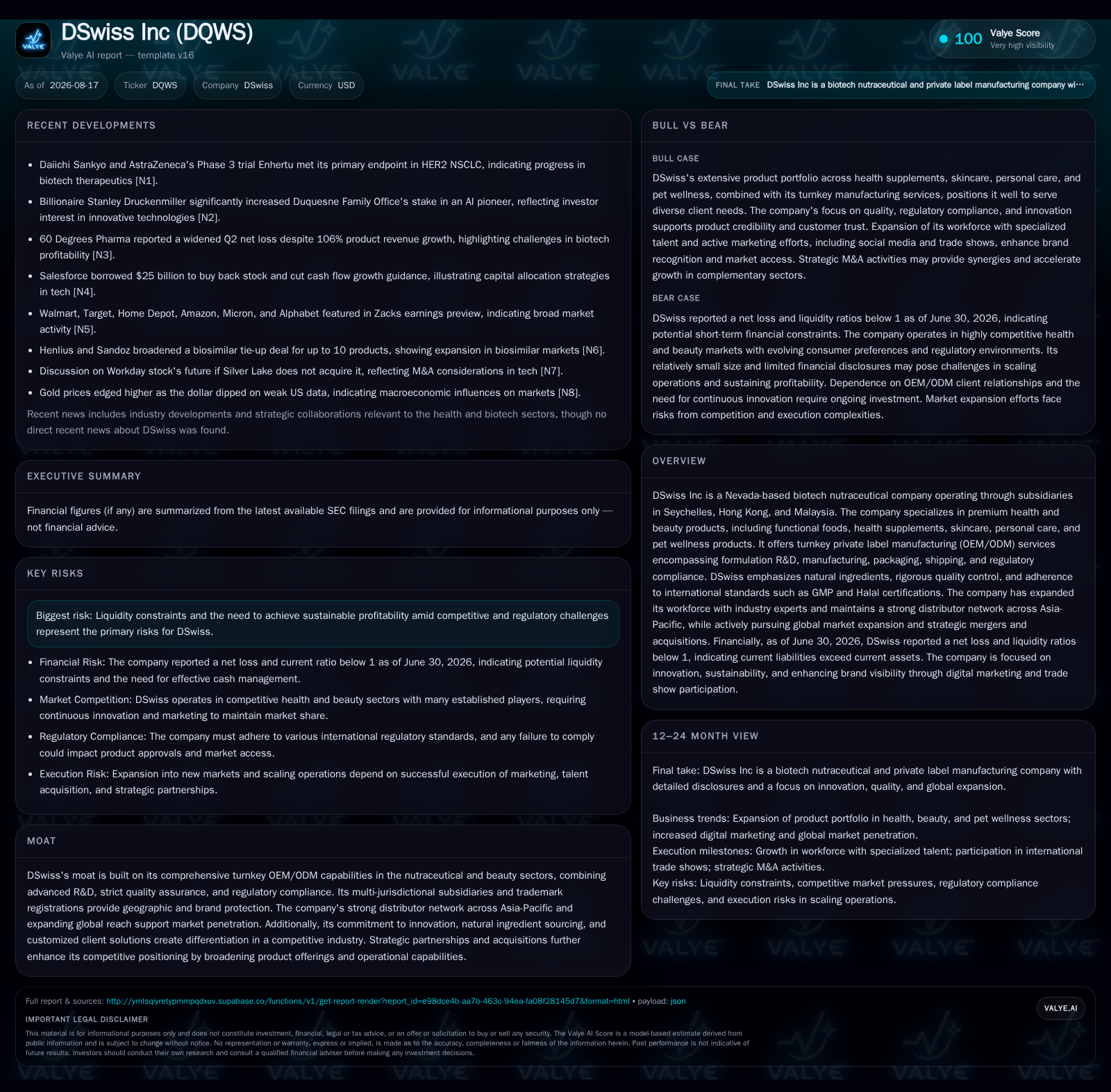
In its latest quarterly filing, DSwiss Inc reports persistent liquidity strain with a current ratio below one and continued net losses, underscoring the financial challenges facing this smaller biotech nutraceutical player. However, the company’s comprehensive OEM/ODM offering, rooted in natural ingredient sourcing and stringent regulatory compliance across multiple jurisdictions including GMP and Halal certifications, remains a key competitive advantage. DSwiss’s strong distributor network across the Asia-Pacific region and strategic focus on growth through innovation, e-commerce, and acquisitions position it well to capitalize on rising global demand for premium health and beauty products. Key risks include its liquidity profile, regulatory complexities, pricing pressure, and regional concentration that investors should monitor closely.
Q2 Operational Update Highlights Persistent Liquidity Pressure and Strategic Initiatives
DSwiss Inc's latest Form 10-Q filed August 14, 2026 [S2] presents a clear picture of ongoing liquidity constraints. The company reported cash and equivalents of approximately $258 thousand as of June 30, 2026 [F1], while its current assets of $334 thousand fall short of current liabilities totaling $425 thousand. This yields a current ratio of just 0.79 [F1], highlighting working capital deficits that restrict operational flexibility. The filing does not indicate significant debt refinancing or new capital infusion steps immediately available to relieve these pressures.
Management has acknowledged these financial headwinds but continues to pursue growth through enhanced marketing efforts emphasized in earlier annual disclosures [S1]. A strategic shift towards targeted social media campaigns and leveraging established e-commerce platforms aims to build product visibility and brand awareness within key Asia-Pacific markets. This indicates an attempt to balance investment in top-line expansion against the imperative to conserve cash — a delicate act in light of net losses persisting into recent periods [F1]. This liquidity snapshot underscores the contested path DSwiss faces: scaling its business with limited financial runway while competing in a demanding nutraceuticals landscape.
End-to-End OEM/ODM Model Rooted in Natural Ingredients and Quality Certifications Fuels Differentiation
At the heart of DSwiss’s operational model lies a comprehensive OEM/ODM service platform covering formulation R&D through manufacturing, packaging, shipping, and regulatory compliance [S1]. This turnkey approach enables brand owners to outsource complex product development cycles to a single partner capable of delivering finished goods efficiently. By controlling proprietary formulas incorporating natural ingredients — a highly prized attribute during increasing consumer demand for clean-label products — DSwiss secures differentiation against commoditized suppliers.
The company’s commitment to rigorous quality assurance is supported by international certifications such as GMP (Good Manufacturing Practices) and Halal accreditation verified by Malaysian authorities [S1]. These certifications serve dual functions: they enhance customer trust in product safety and efficacy while acting as entry barriers that protect pricing power against lower-quality competitors. Such credentials are critical in the health supplements and skincare segments where regulatory scrutiny is intense. Compared to peers like Intercos Group — a leader in cosmetics OEM/ODM — DSwiss's blend of biotech-driven formulations with certified natural ingredient sourcing represents a niche positioning enhancing client retention potential.
Regulatory Compliance and Multi-Jurisdictional Certifications Enable Market Access Barriers in Asia-Pacific
Navigating multi-jurisdictional regulatory environments constitutes both a challenge and advantage for DSwiss. Its subsidiaries operate under Seychelles (holding), Hong Kong (trading), and Malaysia (manufacturing/R&D), each imposing differing requirements [S1]. The company maintains expert regulatory specialists who prepare documentation for authorities such as Malaysia's Ministry of Health (MOH) and Halal certification bodies [S1]. This capability translates into higher regulatory approval success rates — a KPI reflecting product time-to-market efficiency critical in fast-evolving health sectors.
Regional certification complexity further strengthens market access barriers that competitors must overcome to enter or scale within lucrative Asia-Pacific markets. This layered compliance infrastructure supports DSwiss’s pricing discipline by validating product quality beyond simple end-customer branding claims. Comparable multinational service providers like Lonza Group emphasize similar cross-border certification strategies underscoring their importance in global ingredient sourcing and specialty manufacturing contexts.
Leveraging Distribution Network Breadth as a Critical Growth Enabler Across Diverse Product Categories
DSwiss has developed an extensive distributor network across Asia-Pacific facilitating efficient delivery across multiple product segments including functional foods, health supplements, skincare products, personal care items, and pet wellness lines [S1]. This geographic reach underpins order fulfillment lead times instrumental for private label client satisfaction—a key factor influencing client retention rates.
However, this regional concentration introduces potential geopolitical risks including currency volatility affecting margins as well as supply chain vulnerabilities linked to local disruptions. While Herbalife Nutrition Ltd similarly leverages dense distributor ecosystems globally for broad market penetration in health supplements, DSwiss remains more regionally focused which creates both opportunities for deep local market knowledge but also risk exposure should regional economic or political conditions deteriorate.
Growth Catalysts: Innovation Pipeline, E-Commerce Expansion, and Acquisitions Bolstering Platform Relevance
Beyond geographic expansion efforts spotlighted via marketing enhancements [S1], DSwiss is actively investing in its innovation pipeline targeting next-generation biotech formulations particularly within pet wellness alongside traditional health supplements. The company's R&D activities aim to reduce product development cycle times offering clients faster-to-market solutions which address shifting consumer trends toward functional benefits coupled with natural ingredients.
Further supporting growth is the accelerated deployment of digital sales channels including social media-driven campaigns designed to elevate emerging brand adoption amongst younger demographics understanding online engagement metrics is crucial here due to relatively new e-commerce channel reliance [S1]
Strategic mergers remain part of this growth narrative with past acquisitions expanding operational scale especially within Malaysia-based biotechnology segments [S1]. However integration risks persist as rapid expansion can strain already limited liquidity resources common among smaller private label OEM/ODMs competing against larger consolidated peers.
Headwinds Ahead: Liquidity Constraints, Pricing Pressure, Regulatory Complexity, and Regional Concentration Risks
Competitive pricing pressure from larger incumbents or lower-cost producers could compress gross margins undermining profitability despite product differentiation efforts tied to certifications. Moreover, evolving multi-market regulations increase compliance costs requiring sustained investments into documentation updating—as evidenced by their emphasis on specialist regulatory teams—raising operating expense ratios.
Geographic concentration in Asia-Pacific enhances speed-to-market advantages but increases vulnerability from localized macroeconomic disruptions or policy shifts potentially impacting import/export dynamics or distributor stability.
What Investors Should Monitor Next: Milestones and Operational Signals Through Late-2026
Investor focus over coming quarters should pivot toward concrete operational KPIs shedding light on execution progress: regulatory approval success rates will indicate how efficiently DSwiss navigates compliance hurdles impacting revenue ramp timing; private label client retention rates will reflect customer satisfaction amid competitive alternatives; quality control pass rates serve as bellwethers for consistent production excellence mitigating recall or reputational risks; order fulfillment lead times reveal supply chain robustness tied directly to distribution network efficacy.
Additionally monitoring digital marketing campaign performance metrics including social media driven sales conversions can provide early insight into top-line traction from new channels established per management commentary [S1]. Lastly any updates regarding integration outcomes from recent acquisitions would signal management's ability to leverage scale benefits while controlling costs—a factor critical given stretched liquidity noted in Q2 disclosure.
Financial Profile Discussion: Liquidity Challenge Overshadows Operational Improvements
As of June 30, 2026, DSwiss held $257,989 in cash equivalents against current liabilities exceeding current assets ($425,394 vs. $333,976), resulting in a current ratio of approximately 0.79 indicative of working capital deficits undermining short-term solvency [F1]. Persistent net losses further strain equity reserves necessitating either capital raises or operational margin improvements to sustain business continuity [S2].
The tight liquidity situation constrains discretionary spending potentially delaying R&D investments or limiting marketing reach despite management's stated priority on digital channel development [S1]. This financial context frames all growth ambitions within the reality that efficient cash management alongside measurable improvement in core operating KPIs must manifest soon for long-term viability.
This analysis reflects facts from the company's most recent quarterly filing dated August 14, 2026 [S2], supplemented by its annual filing dated March 31, 2026 [S1], combined with contemporaneous balance sheet data [F1] without speculative inference beyond documented disclosures. It integrates industry context from established sector frameworks without extrapolating unsupported company-specific claims. No investment advice is offered herein.
Disclaimer: This is research-only, informational analysis and not investment advice. It may include AI-generated interpretation and general industry context. Always verify important details using primary sources.

Comments