
Nu-3 Development and Capital Structure Shaping Lakewood-Amedex’s Antimicrobial Biotech Trajectory
Lakewood-Amedex advances its lead Nu-3 program amid strategic financial restructuring and reinforced clinical data supporting its novel antimicrobial approach.
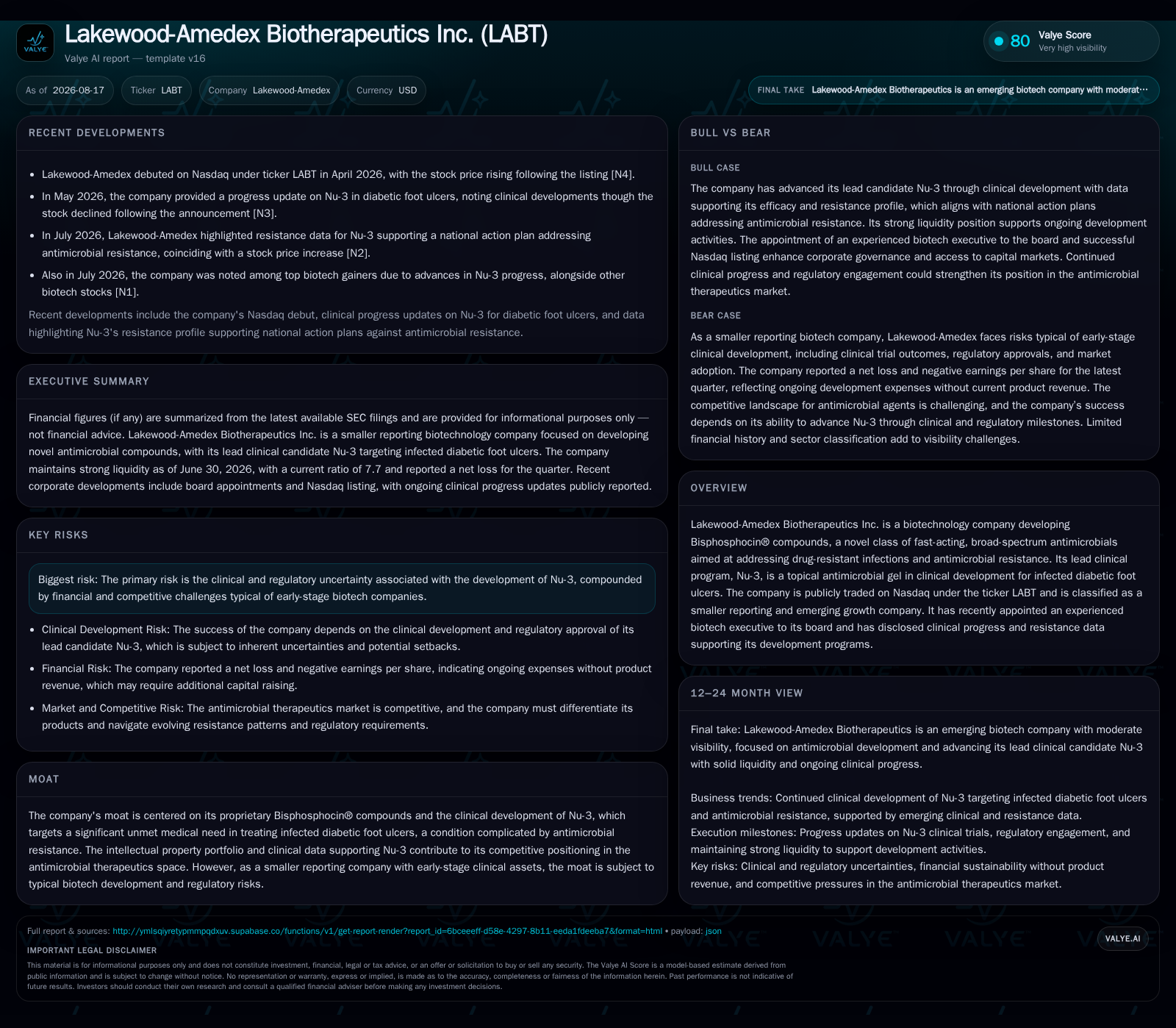
Lakewood-Amedex Biotherapeutics’ August 2026 quarterly filing highlights progress in the clinical development of Nu-3, a topical antimicrobial gel targeting infected diabetic foot ulcers, supported by updated resistance data reinforcing its therapeutic rationale. The company completed a 1-for-10 reverse stock split in June 2026 to maintain Nasdaq compliance, and reports a solid liquidity position with $2.58 million in cash and a current ratio of 7.7 as of June 30, 2026. With ongoing operating losses typical for an emerging biotech, the company’s trajectory depends on trial enrollment pace, regulatory milestones, and capital management amid the broader challenges of antimicrobial resistance and funding constraints.
Recent Operating Update: Nu-3 Clinical Advancement Supported by Resistance Data
Proprietary Bisphosphocin® Platform Underpins Competitive Positioning
At the core of Lakewood-Amedex’s innovation strategy is its Bisphosphocin® compound class characterized by fast-acting broad-spectrum antimicrobial activity. The company holds patent protection over these compounds, providing intellectual property barriers that could establish a competitive moat in an increasingly crowded antimicrobial landscape challenged by resistance [S3]. This platform’s novelty supports differentiation from existing therapies and potential regulatory incentives for addressing drug-resistant infections. However, as is common among clinical-stage biotechs, this advantage's longevity depends on successful trial outcomes and subsequent regulatory approvals which carry inherent developmental risks.
Capital Structure Adjustment Enhances Market Compliance
In June 2026, the company implemented a 1-for-10 reverse stock split unanimously approved by its board to reduce share count from approximately 17.5 million to about 1.75 million shares outstanding [S9], [S10]. This move was primarily aimed at maintaining Nasdaq listing compliance by increasing the per-share price to meet minimum thresholds—a common challenge for emerging growth biotechs facing low share prices. The adjustment also facilitates improved market perception and may ease future financing efforts.
Financial Position: Solid Liquidity Amid Operating Losses
As of June 30, 2026, Lakewood-Amedex held $2.58 million in cash and cash equivalents with total current assets of about $4.85 million against current liabilities under $0.63 million—yielding a robust current ratio near 7.7 that signals strong short-term liquidity [F1]. Despite these positive liquidity indicators, the company reported an operating loss close to $3.79 million during the period reflecting continuous investment in research and development activities essential for advancing Nu-3 through clinical phases. This financial profile underscores an ongoing need to secure additional capital either via equity raises or partnerships to sustain operations beyond the near term.
Market Context: Addressing Antimicrobial Resistance Through Topical Therapeutics
The rising global burden of antimicrobial resistance places pressure on healthcare systems to develop novel agents effective against resistant pathogens especially in localized infections like diabetic foot ulcers where treatment failure can have severe consequences including amputations. Lakewood-Amedex’s focus on a topical delivery mechanism offers advantages by concentrating drug exposure at infection sites while potentially reducing systemic toxicity risks—a meaningful differentiator within this therapeutic category [N2], [S3]. Such alignment with public health priorities may facilitate expedited regulatory pathways or incentive programs.
Operational Priorities: Trial Enrollment and Endpoint Achievement Critical
Successful advancement toward regulatory submissions will depend heavily on meeting key operational KPIs such as patient recruitment pace adhering to protocol timelines and attainment of safety/tolerability alongside efficacy endpoints defined for each clinical phase [S2], [S11]. Efficient execution minimizes timeline risks and capital consumption while maximizing value creation potential. Conversely, any delays or failure to meet endpoints could extend development timelines or necessitate further resource commitments.
Growth Drivers: Strategic Partnerships and Pipeline Expansion Potential
Beyond its lead program targeting iDFU indications, Lakewood-Amedex aims to leverage its Bisphosphocin® platform through partnering or licensing arrangements that could provide non-dilutive funding sources while expanding commercial reach into additional drug-resistant infection markets [S3]. Such collaborations are pivotal for smaller biotechs lacking late-stage development infrastructure or commercialization capabilities.
Key Risks: Clinical Uncertainty, Regulatory Hurdles, Funding Needs
Lakewood-Amedex faces typical early-stage biotechnology risks including potential clinical trial setbacks or delays; evolving regulatory standards particularly relevant for novel antimicrobials; intellectual property challenges amid competitive innovation; manufacturing scale-up complexities ahead of commercialization; and limited cash runway requiring prudent capital management or timely financing [S2]. Additionally, emerging resistance mechanisms against new agents remain an overarching scientific threat that could impact long-term viability absent robust clinical validation.
What Investors Should Monitor Next
Upcoming quarters will be critical as interim or final data from Nu-3 trials become available—these readouts will inform regulatory submission feasibility and investor confidence. Concurrently, tracking cash burn relative to liquidity reserves will indicate whether additional financing is imminent. Board-level developments such as new partnerships or asset acquisitions may also serve as catalysts influencing valuation ahead of commercial milestones [S2], [S3].
Financial Profile Discussion
Lakewood-Amedex reported ending Q2 2026 with approximately $2.58 million in cash resources alongside current assets totaling about $4.85 million versus liabilities under $0.63 million—a strong liquidity position reflected in a current ratio near 7.7 [F1]. Operating losses totaled roughly $3.79 million during this period due to sustained R&D expenses fundamental to advancing clinical programs but reflective of no product-generated revenues yet. The recent reverse stock split supports market compliance which may facilitate future capital raises necessary to extend runway unless milestone-driven revenue streams materialize through partnerships or licensing.
This analysis synthesizes recent SEC filings and event disclosures highlighting Lakewood-Amedex Biotherapeutics’ progress advancing its novel topical antimicrobial candidate Nu-3 amid strategic corporate actions designed to maintain Nasdaq listing status and preserve financial flexibility essential for ongoing clinical development within a challenging sector focused on combating antimicrobial resistance.
Disclaimer: This article provides an analytical perspective based solely on publicly disclosed filings and reputable news sources without offering forward-looking investment advice or research views regarding Lakewood-Amedex Biotherapeutics Inc.
Disclaimer: This is research-only, informational analysis and not investment advice. It may include AI-generated interpretation and general industry context. Always verify important details using primary sources.

Comments