
Cyber Enviro-Tech Consolidates Capital Structure to Advance Sustainable Remediation Platforms
August 2026 quarterly filings detail CETI's debt restructuring efforts amid its transition from pilot projects toward commercial technologies in environmental remediation.
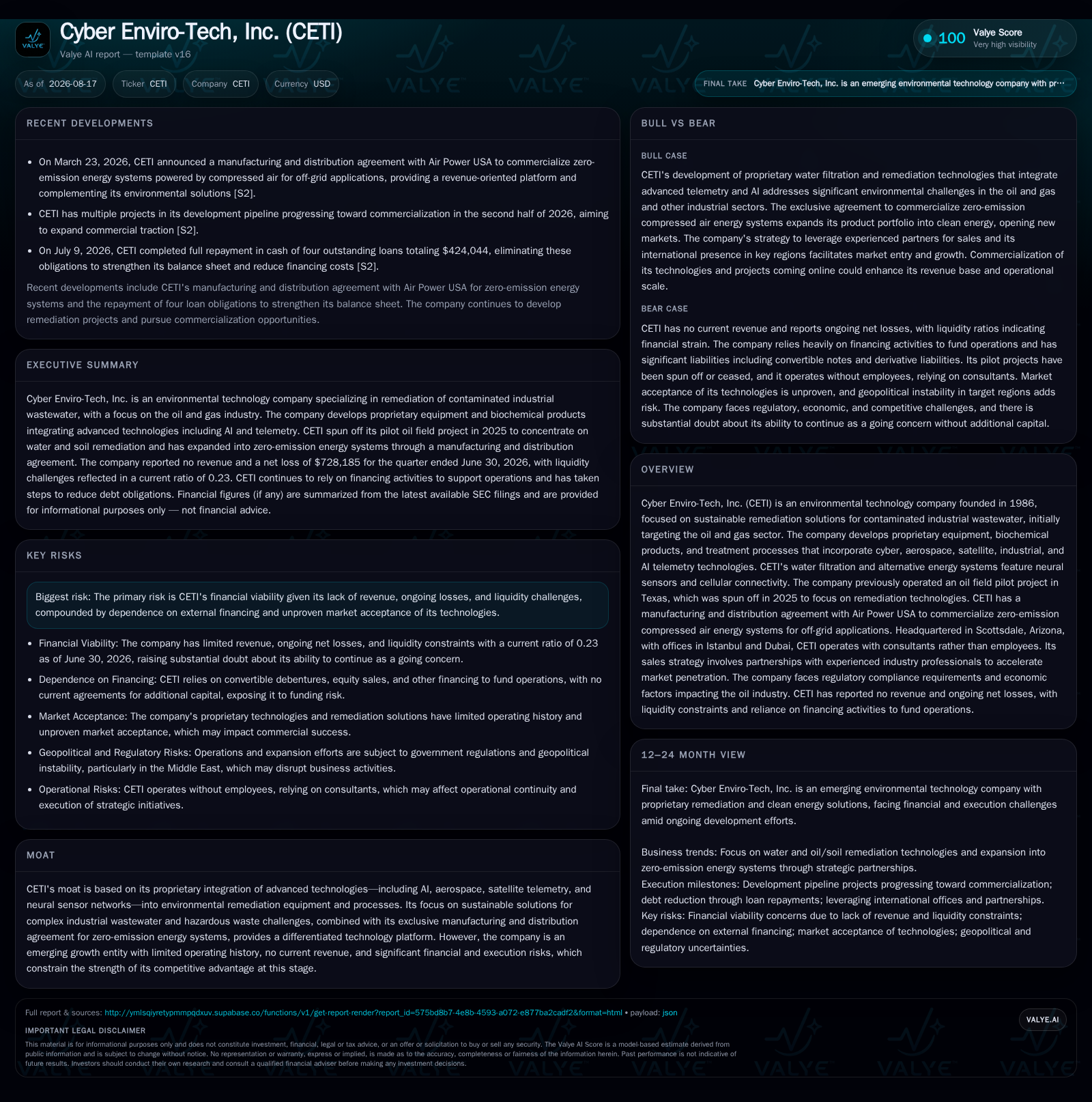
Cyber Enviro-Tech, Inc. (CETI) reported significant non-cash expenses related to convertible debt restructuring in its latest quarterly report, reflecting a strategic effort to simplify and reduce costly financing. The company is an early-stage environmental technology firm integrating AI, telemetry, and neural sensor technologies into proprietary industrial wastewater and hazardous waste remediation processes. While CETI is still pre-revenue and faces typical growth and financial risks for emerging firms, it has established a manufacturing and distribution agreement for zero-emission energy solutions that could broaden its commercial footprint. The firm’s progress hinges on successful pilot-to-commercial transitions amid complex sales cycles and ongoing capital constraints.
Debt Restructuring Milestone Shapes Near-Term Viability
In its Q2 2026 filing dated August 14, Cyber Enviro-Tech disclosed a marked increase in other non-cash expenses driven by fair value remeasurement and losses related to convertible debt restructuring activities undertaken during the quarter [S2]. Management describes these measures as deliberate attempts to reduce reliance on high-cost institutional financing through convertible commercial notes, including retiring over $500,000 of such debt so far in 2026 [S3]. Despite the accounting charge inflating reported losses by approximately $264,000 versus Q2 2025, management clarifies these do not reflect operating performance deterioration but structural improvements in capital cost efficiency.
Nonetheless, the company's liquidity profile remains strained with only $6,796 in cash and equivalents against $3.45 million of total debt at end-June 2026 [F1]. These financial stress points heighten execution risk given CETI’s absence of revenue-generating operations or stable positive cash flow sources. The company’s recently effective S-1 registration may provide some flexibility for raising equity capital but has not yielded share issuance as of mid-August 2026 [S18].
Synthetic Moat: Integrating AI, Telemetry and Sensors in Industrial Wastewater Solutions
CETI positions itself distinctively within environmental technology through the integration of advanced cybernetics including aerospace-grade telemetry, artificial intelligence controls, neural sensors embedded in proprietary biochemical treatment products, and industrial filtration machinery targeting complex contamination challenges prevalent in oil and gas wastewater streams [S1], [S2]. By combining these technologically intensive modules within systems designed for environmentally sustainable remediation—specifically hazardous waste disruption—CETI aims to differentiate from commodity-style competitors lacking such sensor-driven operational intelligence.
This approach harnesses real-time monitoring capabilities using satellite telemetry networks coupled with cellular connectivity for system oversight. While the sector traditionally experiences slow adoption due to lengthy qualification processes and conservative customers in highly regulated industries, early benefits could materialize through enhanced process uptime reliability and documentation supporting regulatory compliance—a potential source of switching incentives once fully field-proven.
However, CETI remains nascent with limited commercialization history beyond pilot projects; thus its moat is synthetic at this stage pending technology validation via scaled deployments.
Market Structure Challenges in Scaling Pilot Deployments Toward Commercial Breakthroughs
The company’s evolution reflects strategic narrowing from broader upstream oilfield operations—symbolized by its Alvey Ranch Oil Field pilot project spun off in October 2025—towards focused remediation technology deployment both domestically and internationally (Middle East markets targeted) [S1], [S8]. This spin-off indicates an intent to shed capital-intensive assets not aligned with core growth ambitions.
CETI’s water filtration systems have modular designs intended for adaptation across multiple contaminated water use cases globally including meat packing facilities and municipal water sources; however, no ratified customer contracts are reported as of June 22, 2026 despite consultant-led market engagement efforts [S13], which testifies to the complexity of B2B procurements compounded by regulatory approvals typical in environmental infrastructure.
Environmental technology vendors characteristically face protracted sales cycles due to technical verification requirements, customer pilots needing extended monitoring periods, and significant upfront capital commitments by customers—all factors that add uncertainty before revenue scales sufficiently. The shutdown of the CETI Axenic commercial laundry water remediation operation December 2025 aligns with this market selectivity pressure driving focus towards scalable niches.
Strategic Partnership as a Channel Lever: Air Power USA Collaboration
Augmenting its environmental remediation portfolio is CETI’s manufacturing and distribution alliance signed March 2026 with Air Power USA for zero-emission compressed air energy systems served primarily for off-grid industrial applications requiring clean power generation without fuel consumption or emissions [S12], [S15]. This arrangement provides a complementary revenue platform potentially accelerating commercialization timelines relative to core remediation products still proving their technical field viability.
Such synergy expands CETI's solution scope into sustainable infrastructure beyond water treatment alone—important given sector peers like FuelCell Energy operate alternative energy platforms addressing similar themes—with the added value proposition of deployment simplicity due to compressed air technology.
Nevertheless, this channel remains early stage without confirmed revenue or documentation of initial deployments through mid-2026; successful realization depends on securing pilot contracts possibly from emerging markets where low-carbon energy solutions are incentivized.
Growth Potential Fueled by Regulatory Pressure and Emerging Market Demand
CETI operates within a broader industry context defined by intensifying regulatory oversight on industrial wastewater discharge limits alongside rising corporate ESG mandates favoring sustainable remediation investments at industrial sites nationally and abroad [S1], [S20]. These drivers structurally expand the addressable market for technologies promising zero emissions combined with effective hazardous waste treatment.
The company strategically maintains offices in Istanbul and Dubai alongside Scottsdale headquarters to capitalize on infrastructure growth trajectories in these regions where water scarcity issues drive demand for innovative filtration technologies. Additionally, sizeable government incentives for clean technology adoption may facilitate funding for pilot demonstration projects crucial for establishing technology credibility.
However, industry incumbents like Evoqua Water Technologies or Xylem Inc., possessing larger installed bases and proven product reliability present formidable competitive pressure necessitating that CETI accelerate milestones around product efficacy validations and customer acquisition pipeline development.
Risks Linked to Capital Intensity and Sales Cycle Length
At June-end 2026 CETI employed no full-time employees but retained seven consultants functioning as development resources while pursuing sales opportunities—a sign of lean operational structure driven by capital conservation imperatives but also indicative of lower internal capacity for execution momentum [S19]. Further risks stem from potential delays in obtaining required regulatory approvals or technical validations necessary for predictable sales cycles typical within B2B pollution control tech procurement environments.
Future Catalysts: Financing Milestones, Technology Adoption Signals, and Regulatory Updates
Looking ahead into late 2026 several key developments bear watching. First is progress against plans announced mid-2026 around leveraging the Air Power USA partnership’s manufacturing capacity for initial off-grid energy system deployments which could establish modest recurring revenue streams if executed successfully [S12]. Next is any ratification of contracts resulting from ongoing consultant-led market engagement initiatives targeting verticals such as municipal water or meat processing industries that would signal early commercial validation absent so far.
Financially critical will be CETI’s ability to access incremental capital following the July-effective S-1 registration enabling share issuances up to ten million shares at predetermined pricing levels—a necessary move given cash burn trends exceeding net financing inflows during H1’26 exacerbated by interest expense rises linked to new convertible instruments issued earlier this year [S18]. Lastly monitoring regulatory developments relevant to wastewater discharge standards across US states and Gulf region countries may materially impact prospective customer urgency.
Financial Profile Discussion
Operationally, reduced general administrative expenses (~54% decline Y/Y) suggest efforts toward cost containment; however lack of top-line revenues sustains negative cash flows requiring frequent interim financings evidenced by Series convertible notes payable influxes totaling above half a million dollars net during H1’26 only partially offsetting outflows from operations totaling roughly $700k within same period [S18]. This mismatch highlights continuing dependency on external capital markets accessibility impairing long-term sustainability absent definitive commercial traction or sizeable equity infusion events.
Given continuing going concern qualifications expressed by independent auditors reflecting historical liquidity challenges alongside minimal business scale metrics such as absence of sustained contract revenues or backlog figures available publicly,[F1] CETI remains an archetypal early-stage environmental technology firm balancing innovation promise against financial fragility while executing a critical transformation away from legacy oilfield projects toward diversified sustainable remediation platforms backed by differentiated technological capabilities.
Disclaimer: This is research-only, informational analysis and not investment advice. It may include AI-generated interpretation and general industry context. Always verify important details using primary sources.

Comments