
NewHold Investment Corp IV’s SPAC Trajectory: Capital Integrity and Merger Prospects Under Scrutiny
The latest quarterly filing confirms a robust liquidity foundation as NewHold Investment Corp IV advances through its critical de-SPAC phase.
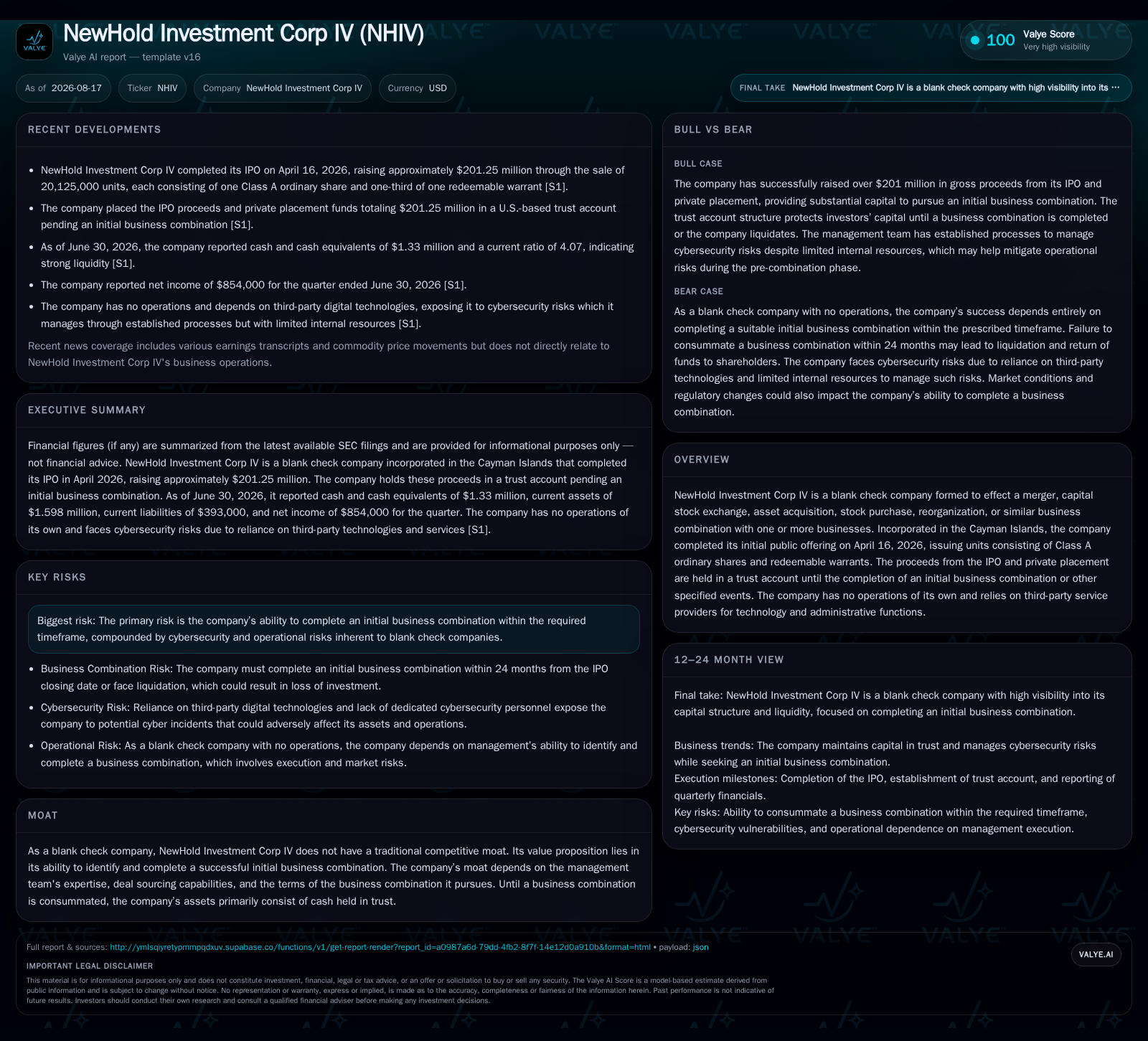
NewHold Investment Corp IV, a Cayman Islands-based blank check company, completed its IPO in April 2026, raising over $201 million through units combining Class A shares and redeemable warrants. Its August 2026 10-Q reveals strong liquidity with cash primarily held in trust amid minimal operating expenses. The company remains under time pressure to consummate an initial business combination within the prescribed two-year window while navigating shareholder redemption rights and cybersecurity risks characteristic of SPACs. Management changes and structural features underscore the reliance on sponsor expertise and capital structure management as NHIV seeks to execute a value-accretive merger.
Leveraging the Latest Quarterly Filing: Clarity on Capital Status and Operational Readiness
NewHold Investment Corp IV’s most recent quarterly filing dated August 14, 2026 provides foundational financial clarity during this pivotal pre-merger stage. The company reported holding $1.33 billion in cash and equivalents as of June 30, 2026 [F1], which principally represents the proceeds of its initial public offering (IPO) and private placements placed into a trust account under trustee custody. This substantially shields these assets from operational use or creditor claims before completing a business combination or liquidation event mandated under SPAC protocols.
The trust-account backed cash forms a major liquidity cushion supporting ongoing administrative functions and deal exploration without immediate revenue inflows. Current assets stood at $1.60 billion against relatively modest current liabilities of $393 million for a current ratio above 4.0 [F1], signaling strong short-term solvency and minimal immediate liquidity risk. Consistent with other early-stage blank check companies, NHIV incurs administrative operating expenses attributable mainly to corporate governance, regulatory compliance, legal fees, and sponsor service agreements—totaling an operating loss of roughly $619,000 in Q2 [F1]. Notably, the reported net income was positive at $854,000 due largely to non-operating items.
This financial snapshot underscores that NHIV retains robust capital integrity essential for advancing merger discussions while managing fixed burn rate challenges until consummation of its de-SPAC transaction.
Decoding NHIV's SPAC Model: Fundraising Mechanics and Share Structure Nuances
NHIV follows the standard Special Purpose Acquisition Company model by raising capital through an IPO issuance of units composed of one Class A ordinary share plus one-third redeemable warrant exercisable at $11.50 per share [S3],[S9]. The IPO closed on April 16, 2026 yielding gross proceeds exceeding $201 million including full exercise of underwriter over-allotments [S9]. Complementing this public offer were private placement units sold simultaneously to sponsors including NewHold Industrial Technology IV LLC and BTIG LLC for approximately $6.4 million at IPO unit price parity without underwriting discounts [S12],[S14].
Funds are held in a U.S.-based trust account managed by Continental Stock Transfer & Trust Company as trustee; these funds are restricted from use except for limited tax payments or post-business combination activities. This preserves investor capital from dilution or misappropriation before merger approval. However, warrant exercise rights introduce potential future dilution risks common across SPACs following de-SPAC transactions.
Sponsor arrangements include indemnity agreements protecting directors and officers while operational oversight is managed via administrative services contracts consistent with industry standards [S13]. This framework emphasizes dependency on sponsor expertise for successful deal sourcing and execution.
Competitive Context: Positioning Within the Broader SPAC Ecosystem
Compared to larger SPACs such as Pershing Square Tontine Holdings (with multi-billion dollar raises), NHIV’s approximately $200 million capital raise places it among mid-tier SPACs targeting specialized sectors or technology themes. This scale implies moderate leverage when negotiating with potential targets but also intensifies the need for precise target selection to maximize capital efficiency.
Sponsor pedigree remains crucial; established sponsors often possess extensive deal pipelines and underwriting experience leading to higher likelihoods of timely business combinations within regulatory deadlines (typically within two years). Newer entrants like NHIV face challenges compounded by evolving SEC regulations since 2023 that increase disclosure requirements and operational complexity.
Market demand for alternative public market access sustains interest in SPACs broadly; however, competition among SPAC vehicles can compress transaction premiums and heighten diligence efforts required to secure accretive deals.
Timeline Pressures: Navigating Time-to-Merger Risks
NHIV has a statutory deadline typically set at two years post-IPO close (April 16, 2026) to complete an initial business combination or face liquidation obligations [S2]. The ticking clock imposes urgency on management's outreach efforts to identify suitable private companies for acquisition or merger.
Failure to complete a transaction within this timeframe results in returning funds held in trust—less any permitted expenses—to shareholders, which caps investor returns at trust values and diminishes sponsor incentives.
Consequently, management must balance thorough due diligence with efficient deal-making to meet regulatory timelines while preserving shareholder value.
Shareholder Redemption Rights: Balancing Capital Availability with Investor Protections
Shareholders have redemption rights allowing them to redeem shares for their pro-rata portion of trust assets prior to any business combination closing. While these rights protect investors from unfavorable deals, they also pose execution risk by potentially reducing available acquisition capital if redemptions exceed anticipated levels.
Although no material redemptions have been disclosed so far, precedent within the SPAC sector shows significant redemptions can lead to renegotiations or jeopardize transaction viability if capital falls below target thresholds.
Managing this dynamic requires sponsors to structure deals attractive enough to minimize redemptions while accounting for dilution effects stemming from warrant exercises post-merger.
Regulatory Environment and Cybersecurity Considerations
Since early 2023, SEC enforcement has intensified around SPAC disclosures related to conflicts-of-interest, valuation practices especially concerning warrants, and governance standards [S2]. These developments increase compliance costs and lengthen preparatory phases ahead of deal announcements
Additionally, NHIV acknowledges cybersecurity risks inherent due to reliance on third-party digital infrastructure without dedicated internal security teams—a common vulnerability among blank check companies [S2],[S19]. While incident response plans are established reporting to the board periodically, resource constraints limit proactive defense capabilities.
Market volatility remains an external factor influencing investor appetite toward speculative investment vehicles like SPACs; fluctuations may affect warrant exercises and shareholder sentiment impacting merger feasibility.
Financial Profile Discussion: Solid Liquidity Backdrop Amid Typical Operating Expenses
The latest quarter evidences that NewHold Investment Corp IV maintains substantial liquidity with approximately $1.33 billion held primarily in trust accounts alongside a current ratio exceeding 4x reflecting strong short-term solvency [F1]
Operating losses around $619,000 align with expected administrative overhead absent commercial operations but remain sustainable given cash reserves provide ample runway for continued search activities without external financing pressures or covenant constraints [F1]
A positive net income figure driven by non-operating income suggests some incidental gains but does not materially impact core profitability outlook pre-merger [F1]
Overall financial stewardship appears prudent emphasizing capital preservation until deployment opportunities materialize through successful de-SPAC execution.
This analysis relies exclusively on public filings through August 2026 without projecting specific transaction outcomes or investment research views. NewHold Investment Corp IV faces typical SPAC risks including timing uncertainty for mergers, shareholder redemption variability, heightened regulatory scrutiny, cybersecurity vulnerabilities tied to third-party reliance, and competitive pressures within an evolving market environment.
Disclaimer: This is research-only, informational analysis and not investment advice. It may include AI-generated interpretation and general industry context. Always verify important details using primary sources.

Comments