
Irenic Acquisition Corp. Advances SPAC Lifecycle with Strong Trust Account and Controlled Admin Costs
Irenic Acquisition Corp., a Cayman Islands-based SPAC, has solidified its capital base through IPO and over-allotment exercise, maintaining a robust trust account and fixed administrative expenses as it pursues a Business Combination within regulatory deadlines.
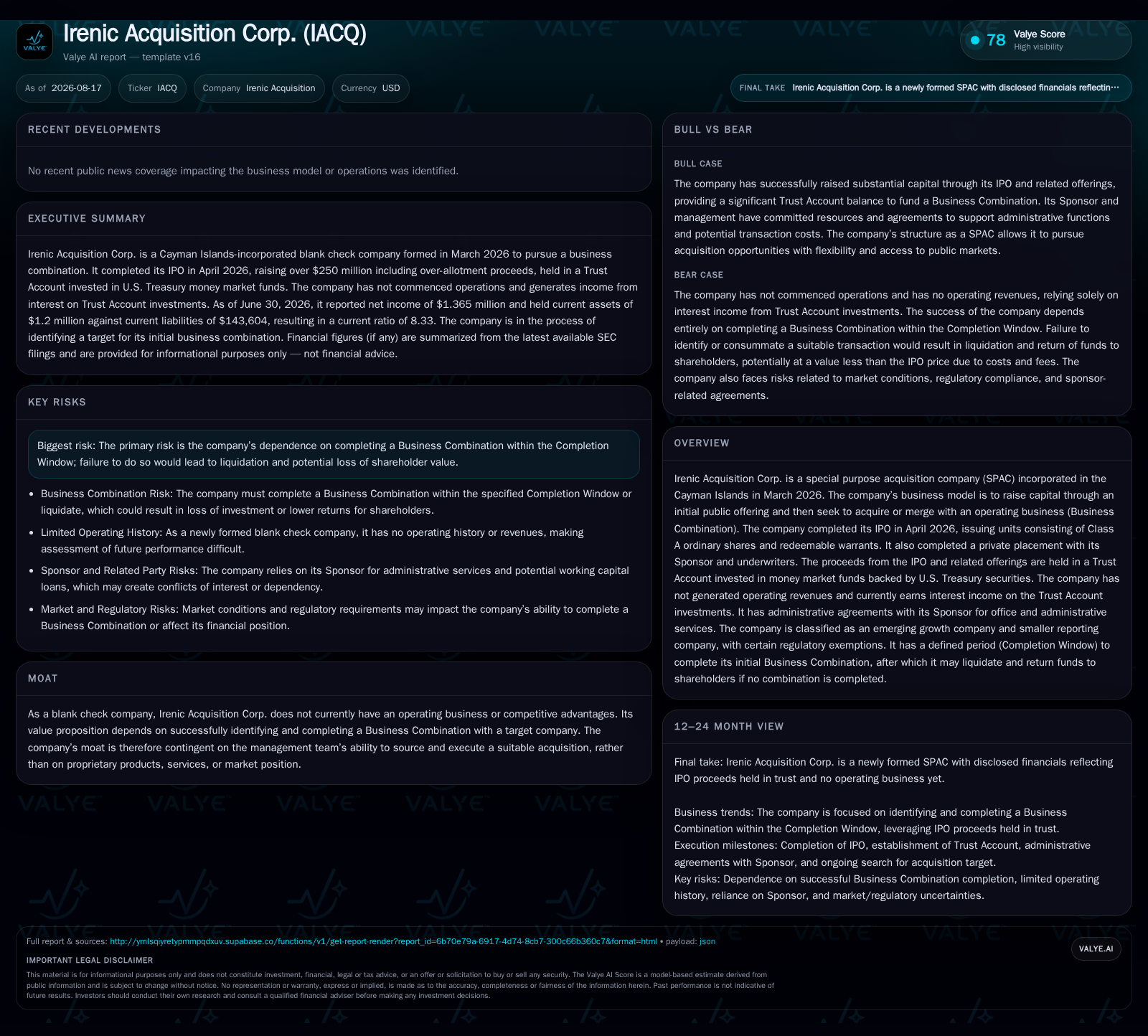
Since its March 2026 inception, Irenic Acquisition Corp. completed an IPO with partial over-allotment exercise by May 2026, securing capital held in a trust account exceeding $1.19 million as of June 30. The company incurs fixed monthly administrative fees payable to its Sponsor for essential services until a Business Combination or liquidation occurs. Operating without commercial revenues, Irenic’s interim income derives from interest on trust funds, positioning it to focus on identifying and executing a qualifying Business Combination within the mandated timeframe.
Recent Operating Update
Irenic Acquisition Corp., incorporated in the Cayman Islands in March 2026 as a Special Purpose Acquisition Company (SPAC), advanced its early operational phase by completing an initial public offering (IPO) in April 2026. The underwriters exercised nearly all of their 45-day Over-Allotment Option by early May 2026, adding approximately 3.25 million units beyond the base offering amount at the IPO price less commissions [S2]. This additional capital injection strengthens Irenic's financial runway for pursuing potential acquisition targets.
Concurrently, starting April 27, 2026, Irenic entered into an Administrative Services and Indemnification Agreement with its Sponsor and affiliated management entity Irenic Capital Management LP. This agreement imposes a fixed monthly fee of $20,000 covering office space and administrative services until either consummation of a Business Combination or liquidation occurs [S2]. These controlled costs represent the primary ongoing expense during the pre-combination phase.
Absent commercial operations or revenue streams typical of operating companies, Irenic's interim earnings derive solely from interest accrued on capital held in its trust account [F1]. The trust account balance stood at approximately $1.19 million as of June 30, 2026, invested conservatively in money market instruments backed by U.S. Treasury securities to preserve principal while generating predictable interest income consistent with SPAC regulatory requirements
Business Model Overview
Irenic’s business model aligns with the standard SPAC archetype: raising capital through issuance of units composed of Class A ordinary shares combined with redeemable warrants during an IPO and private placements. Capital raised is placed into a segregated trust account earning interest until deployment proceeds via a Business Combination transaction targeting private companies seeking public market access without undergoing traditional IPO processes.
Investors benefit from Redemption Rights allowing pro-rata redemption of shares for trust account value if they disapprove of proposed merger terms, introducing variability in available deal capital upon closing. Warrants exercisable post-merger at $11.50 per share provide potential upside but also risk dilution depending on exercise volumes and shareholder decisions [S3].
The fixed monthly administrative fee payable to the Sponsor ensures ongoing operational support and access to experienced deal-sourcing capabilities but represents a steady cash outflow diluting net income prior to any transaction completion [S2]
Industry Structure and Competitive Positioning
As a blank-check vehicle operating within the SPAC sector, Irenic functions as an intermediary facilitating capital formation between public investors and private companies seeking liquidity events outside traditional IPO frameworks. Its competitive positioning depends heavily on sponsor reputation and network quality which influence deal flow access and investor confidence.
Peers such as Pershing Square Tontine Holdings and Social Capital Hedosophia illustrate how sponsor track records affect subscription demand for units at IPO stages and valuation dynamics for warrants pre- and post-Business Combination execution. Irenic’s status as an Emerging Growth Company under JOBS Act provisions affords transitional accounting benefits but places heightened importance on sponsor alignment due to potential dilution risks inherent in warrant structures [S2] [S3].
Growth Drivers
Irenic’s growth trajectory is contingent upon successfully identifying and closing an accretive Business Combination within the regulatory timeframe. Key growth enablers include:
- Capital Strength: Successful IPO plus substantial Over-Allotment Option exercise provides sufficient financial runway to pursue competitive acquisition opportunities without immediate funding constraints [S2].
- Trust Account Stability: Approximately $1.19 million held in secure money market investments generates reliable interest income funding administrative expenses before transaction closure [F1].
- Experienced Sponsor: The Sponsor’s industry relationships may facilitate access to proprietary deal flow or advantageous negotiation positions.
- Interest Rate Environment: Rising rates could enhance interest earnings on trust funds, improving net income margins during pre-combination periods.
- Regulatory Framework: Clarity regarding SPAC governance supports investor participation by reducing structural uncertainties.
These drivers can be tracked via KPIs such as time remaining in completion window (typically two years from IPO), redemption rates upon merger announcement indicating shareholder confidence, ratio of interest income to administrative expenses reflecting cash flow sustainability, and warrant valuation trends signaling market expectations.
Risks and Watchpoints
Principal risks stem from failing to consummate a qualifying Business Combination within mandated deadlines, triggering liquidation which returns trust assets minus expenses to shareholders—often below expected equity value—eliminating upside potential.
Additional watchpoints include:
- Sponsor Execution Risk: Reliance on Sponsor’s ability to source attractive targets amid intense competition among numerous SPACs.
- Dilution Risk: Warrants exercisable at fixed prices may dilute equity stakes post-merger; redemption rights can reduce deal proceeds available.
- Regulatory Changes: Potential shifts impacting merger approval processes or disclosure requirements could delay transactions or raise compliance costs.
- Market Sentiment Volatility: Speculative nature of SPAC mergers exposes shareholder decisions to fluctuations impacting redemption behavior and warrant pricing.
- Limited Operational History: Absence of commercial performance data prior to combination restricts empirical assessment of execution capability.
Monitoring forthcoming disclosures about target evaluations or merger progress will be critical indicators of evolving risk profiles.
What To Watch Next
Key developments likely to influence Irenic’s trajectory include:
- Public announcements regarding engagement with prospective acquisition targets or definitive agreements signaling progress toward transaction closure.
- Updates on Sponsor-related arrangements including founder share distribution mechanics or modifications to administrative agreements reflecting post-merger roles.
- Redemption election rates following proxy distributions which directly affect available capital for completing mergers.
- Market activity around warrant trading volumes and valuations providing insight into investor sentiment toward deal prospects.
- Quarterly financial updates revealing trends in interest income relative to administrative cost burn rates informing sustainability ahead of combination deadlines.
As of August 2026 filings, operational infrastructure remains intact with no disclosed combination candidates yet; continued scrutiny across these parameters remains warranted [S2][S3]
Financial Profile Discussion
At quarter-end June 30, 2026, Irenic reported current assets totaling approximately $1.20 million primarily comprising cash equivalents maintained in the trust account following IPO proceeds including over-allotments exercised shortly after the offering date [F1][S2]. Current liabilities stood near $143,600 mainly reflecting accrued administrative expenses such as sponsor fees payable under contract arrangements resulting in an elevated current ratio of roughly 8.33—indicating strong short-term liquidity absent near-term funding pressures [F1].
Net income for the period was positive at approximately $1.37 million driven largely by interest income earned on trust balances offset by recurring administrative expenses totaling about $40,000 over two months ($20k monthly fee), consistent with typical SPAC cost structures prior to active investment deployment [F1][S2]. Operating losses reflect setup costs rather than sustained business activities typical for blank-check entities awaiting Business Combinations [F1].
No debt is reported on the balance sheet reducing financial risk ahead of transactional milestones; maintaining conservative cost control aligned with stable interest income generation supports financial resilience during this preliminary stage.
Ongoing evaluation of these financial metrics alongside operational updates will be essential to assess whether resources are effectively positioned for successful transaction execution or if liquidation risks are increasing.
This analysis is provided for informational purposes only and does not constitute investment advice or research views regarding securities mentioned herein.
Disclaimer: This is research-only, informational analysis and not investment advice. It may include AI-generated interpretation and general industry context. Always verify important details using primary sources.

Comments