
Cartesian Growth Corp II Faces Critical Deadline Amid Trust Account Depletion and Nasdaq Delisting
As a SPAC with no operating revenues, Cartesian Growth Corp II’s viability hinges on completing a business combination by August 2026.
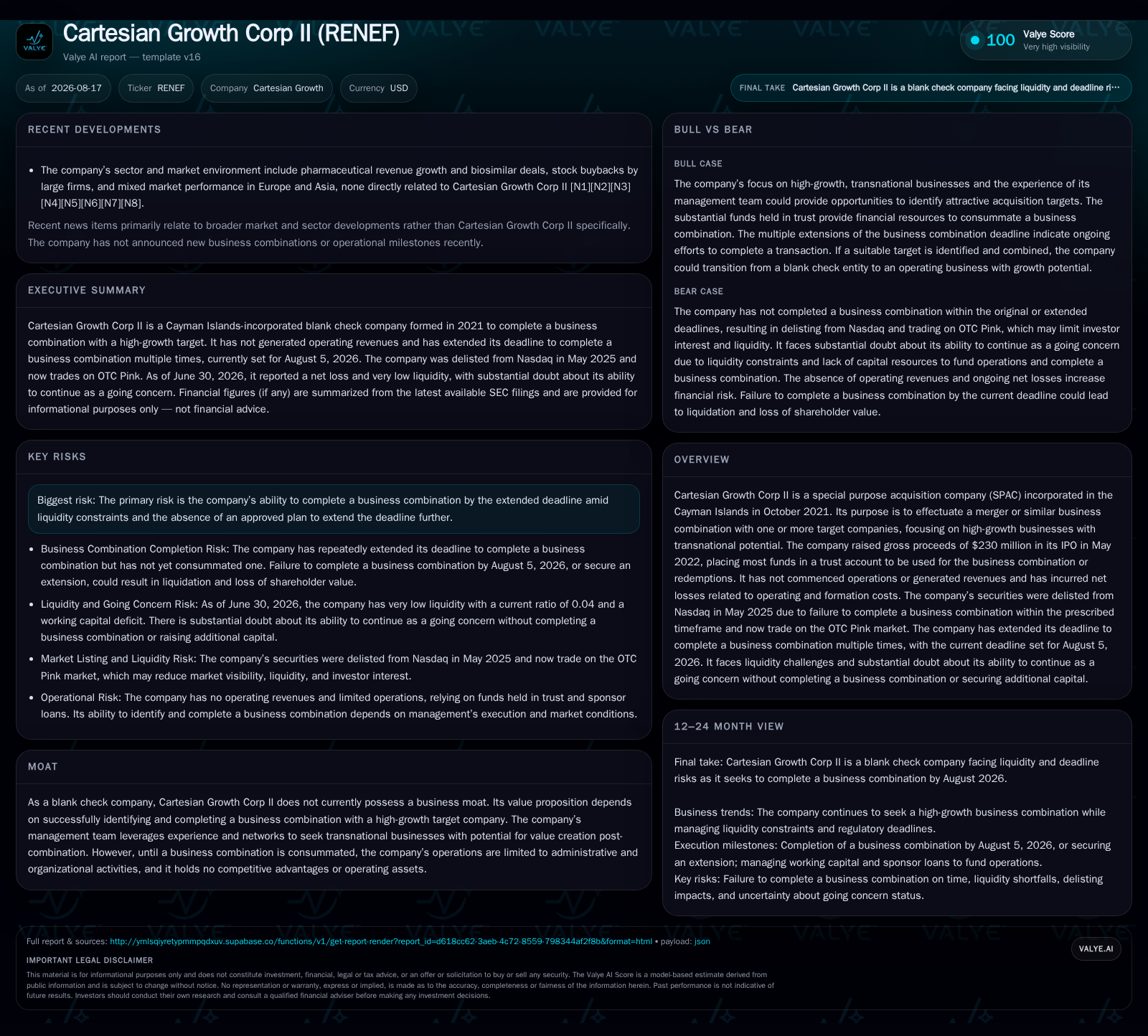
Cartesian Growth Corp II (Ticker: RENEF) operates as a Special Purpose Acquisition Company (SPAC) with the mission to identify and merge with a high-growth private company. Since its $230 million IPO in May 2022, the company has not completed a business combination, leading to its Nasdaq delisting in mid-2025 and trading on OTC Pink. Its trust account balance has significantly eroded due to multiple deadline extensions and related costs. The SPAC now faces a final deadline of August 5, 2026, to consummate a transaction or face liquidation risks amid severe liquidity constraints and no current extension plan. The path forward depends heavily on the sponsor’s ability to secure an acquisition partner and manage investor redemptions before expiry.
Recent Operating Update: Deadline Pressure and Trust Account Status
Cartesian Growth Corp II (RENEF), incorporated as a Cayman Islands exempted company in October 2021, issued units through an IPO in May 2022 raising gross proceeds of $230 million [S1]. These proceeds were placed largely into a trust account earmarked for consummating a business combination. However, Cartesian Growth has yet to complete such a transaction nearly four years post-incorporation.
Failing to meet its initial three-year deadline for merger completion on May 5, 2025 led to delisting from Nasdaq and subsequent trading on the OTC Pink market starting May 13, 2025 [S1][S27]. Since then, the company has secured shareholder approval for multiple deadline extensions culminating in the latest extending the merger deadline to August 5, 2026 [S27].
Financially, this delay precipitated erosion of trust account funds primarily utilized to fund redemptions by public shareholders exercising their rights upon each extension and accrued operating expenses. The trust account balance declined approximately from $84.6 million at December 31, 2024, to about $37.9 million a year later—a nearly halving of available merger capital [S1][S26]
Furthermore, Cartesian Growth's operating landscape remains constrained by low current assets ($236,200) vis-à-vis significant current liabilities ($6.13 million) including promissory note debt totaling $4.2 million as of June 30, 2026 which yields a perilous current ratio of roughly 0.04 signaling imminent liquidity stress if not resolved [F1]
Business Model: Blank Check Entity Dependent on De-SPAC Transaction Success
As a pure Special Purpose Acquisition Company (SPAC), Cartesian Growth Corp II does not engage in commercial operations or generate revenues prior to executing its business combination. Its core function is raising capital via an IPO to finance acquisition efforts targeting high-growth businesses with transnational appeal — leveraging management’s expertise and network for value creation potential post-merger [S1][S5].
Monetization occurs only after merging or acquiring such target companies; until then, all capital resides segregated in trust accounts awaiting deployment or returned to shareholders upon failure events.
The SPAC structure includes key financial instruments such as redeemable Class A ordinary shares accompanied by public warrants offering optionality for future equity participation—anticipated contributors to dilution depending on deal execution dynamics and investor redemption behavior[S1][S26].
Importantly for RENEF, operating costs are limited but consistent — monthly administrative fees paid to sponsor affiliates ($10,000/month), legal due diligence expenses, insurance premiums and professional services-related outlays persistently consume available cash outside the trust account which stood at roughly $162K at end-2025 [S1][S26]. These fixed overheads do not scale with activity but steadily reduce runway absent successful transaction fees or alternative financing.
Industry Context and Competitive Position: Typical SPAC Challenges Illustrated
SPACs such as Cartesian Growth operate at the nexus of public investors seeking growth exposure and private companies pursuing speedier public listings than traditional IPO routes enable. However, incomplete deal execution coupled with prolonged deadlines typically signal underlying difficulties — either in target identification, valuation agreement or financing — compounded by evolving regulatory scrutiny tightening sponsors’ obligations
RENEF’s experience is emblematic: multiple deadline extensions elongate uncertainty and accelerate trust fund depletion via investor redemptions—a mechanism that protects shareholder capital but limits available cash for acquisitions.
Unlike higher-profile peers who execute transactions expeditiously or integrate sizable PIPE financings to bolster deal economics and creditworthiness, Cartesian Growth's lack of announced definitive agreements until recently places it behind many peers that successfully transitioned from blank-check shell to operating entity within mandated timelines.
Growth Drivers: Potential Unlock Hinges on Business Combination Closure
The principal growth catalyst lies outside Cartesian Growth’s direct control: successfully identifying and closing on a transformational acquisition opportunity remains critical. Recent disclosures confirm progress toward an agreement with InoBat AS—a Norwegian private limited company—as prospective business combination candidate [S3][S14]. This potential transnational deal aligns strategically with management’s stated focus.
Should this combine materialize within the extended timeframe:
- The company would acquire operating revenues formerly absent,
- Unlock pipeline funding including deferred underwriting commissions,
- Gain access to equity markets outside OTC,
- Potentially improve liquidity position through investor PIPE participation or sponsor capital injections.
Furthermore leveraging sponsor networks can expedite follow-on acquisitions or growth execution post-de-SPAC enabling some degree of operational scaling previously unattainable.
However these drivers hinge critically on contract closure timelines given looming expiration of restructuring authorizations.
Risks and Watchpoints: Imminent Deadline Plus Capital Constraints Raise Existential Stakes
Foremost risk persists around failure to consummate any initial business combination before August 5, 2026 amid scarce liquidity resources. Due diligence costs alongside scheduled repayments on approximately $4.2 million promissory notes strain minimal remaining working capital [$236K] heightening default risk absent sponsor advances [F1].[S16] Management explicitly states no approved plans exist currently for any further deadline extensions nor committed bridge financing beyond present obligations.
Investor redemption rates can accelerate uncontrollably if confidence wanes—each additional redeemed Class A share reduces cash held back into trusts thereby constricting merger purse size.
Dilution risk also stems from outstanding warrants exercisable under specified conditions; protracted delay could incentivize exercises under unfavorable scenarios diluting pre-combination share capital [S1][S26]. Regulatory changes impacting disclosure standards or de-SPAC transaction rules could pose additional legal hurdles affecting timing or feasibility.
Finally adverse macro factors—market volatility volatility driven by geopolitical developments referenced broadly—and competition from better-funded or established SPAC sponsors may limit acquisition opportunities or increase cost of capital necessary for consummation [S27]. These dynamics intensify risk profile dramatically compared with historically high-performing de-SPAC counterparts.
What To Watch Next: Milestones Around Business Combination Closure And Financial Markers
Investors will vigilantly track:
- Formal signing of definitive merger agreements with InoBat AS or alternative targets,
- Shareholder meeting outcomes related to Merger approvals,
- Updates on PIPE funding commitments bolstering transaction liquidity,
- Changes in redemption rates quantifying shareholder confidence,
- Sponsor loan extensions or new capital infusions indications,
- Quarterly financial disclosures detailing burn rate trajectories,
- Trading activity shifts reflective of renewed market interest following positive execution news.
Delays beyond August will likely trigger liquidation processes per SPAC governance impinging significantly on investor recoveries. Conversely timely closures could catalyze relief rally shifting asset into operating enterprise domain enhancing medium-term prospects.
Financial Profile Discussion
y to cover immediate liabilities without external cash support [F1],
- Lack of committed financing alternatives beyond existing sponsor notes adds material liquidity constraints moving forward [S16].
These financial stresses underline precarious standing requiring urgent resolution through merger closing or recapitalization mechanisms traditionally employed in SPAC lifecycle transitions.
This report synthesizes publicly filed SEC documents along with industry-standard valuation frameworks applicable for Special Purpose Acquisition Companies (SPACs). It refrains from speculative assertions absent direct disclosure mandates strict reliance on referenced filings prevents unsupported forecasts or endorsements.
Disclaimer: This is research-only, informational analysis and not investment advice. It may include AI-generated interpretation and general industry context. Always verify important details using primary sources.

Comments