
Samos Energy Acquisition Corp Q2 2026: IPO Proceeds Held in Trust Amid Operating Loss and Low Liquidity
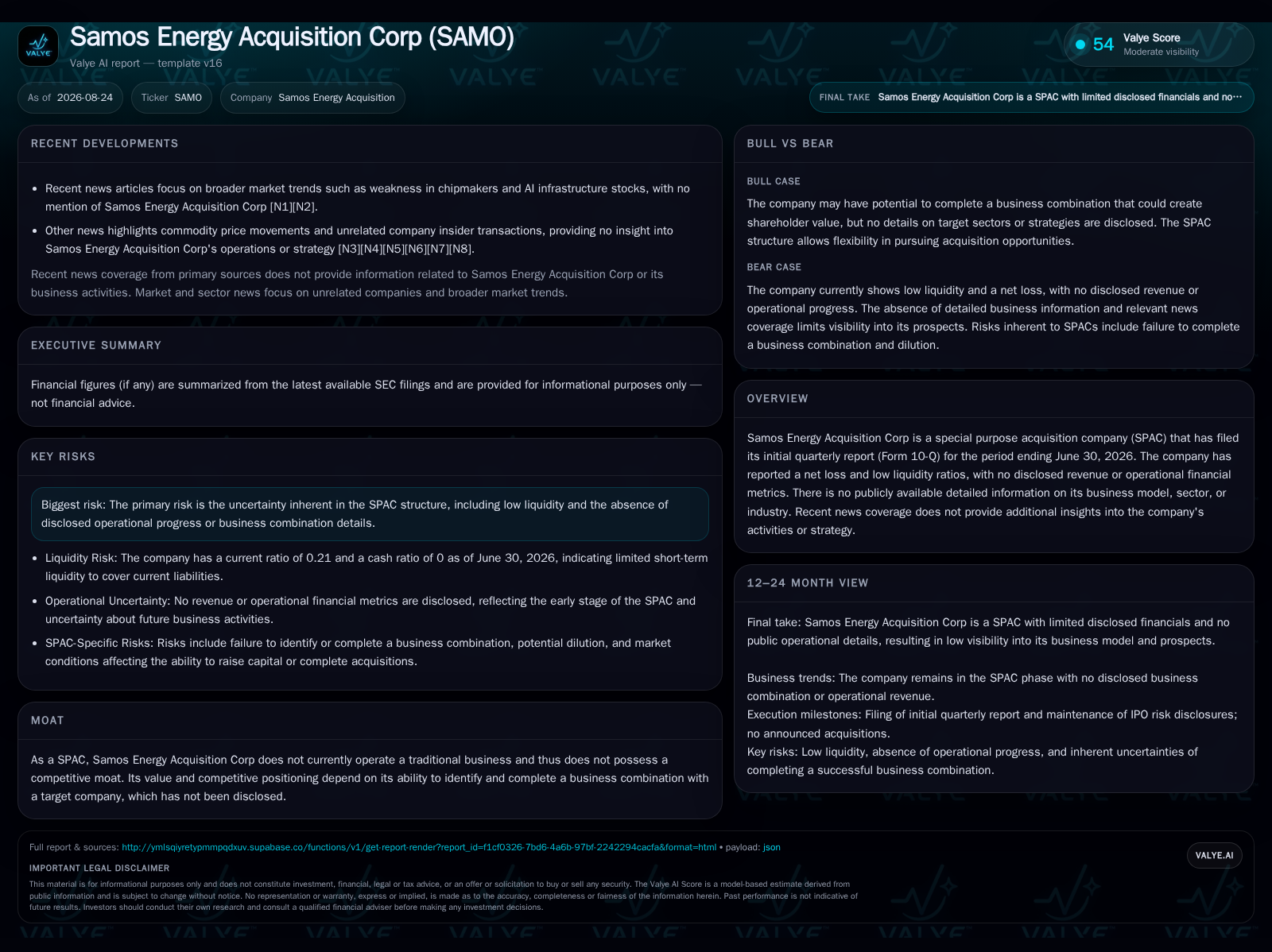
Samos Energy Acquisition Corp filed its initial quarterly report showing a net loss, no operating revenue, and $230 million held in a trust account as it remains a SPAC.
Samos Energy Acquisition Corp's Q2 2026 Form 10-Q confirms its status as a special purpose acquisition company (SPAC) with no operational business or revenue. The company reported a net loss for the quarter and holds $230 million of IPO proceeds in a segregated trust account. Balance sheet data indicate low liquidity outside the trust, with current liabilities exceeding current assets, underscoring potential constraints before completing a business combination. The SPAC’s future hinges on successfully identifying and closing a transformative acquisition.
Samos Energy Acquisition Corp remains a special purpose acquisition company (SPAC) without an identified business combination as of Q2 2026. The company reported a net loss for the quarter ended June 30, 2026, with no disclosed operating revenue or operational financial metrics, consistent with its pre-combination status [S2]. This reflects the typical financial profile of a SPAC prior to completing a business combination, incurring administrative and other non-operating expenses without generating operating cash flow.
As of July 13, 2026, $230 million of IPO proceeds, net of underwriting discounts and commissions, were placed in a trust account managed by Continental Stock Transfer & Trust Company as trustee [S3]. These funds are segregated and restricted, serving as the primary financial backing for shareholder value until a business combination is consummated. The trust account balance represents the capital raised from investors that will be deployed to acquire a target company.
Outside the trust account, the company’s liquidity position appears constrained. Current assets were reported at $62,580 as of March 31, 2026, and current liabilities were $304,473 as of June 30, 2026 [F1]. The trust account funds, totaling $230,000,000 from the IPO and Private Placement Warrants proceeds, are held separately and not included in the current assets reported on the balance sheet [S3]. This separation means that while the trust account secures capital for acquisition purposes, it does not provide liquidity for day-to-day operations or transaction-related expenses. The company must rely on its limited current assets or raise additional capital to fund administrative costs and due diligence activities.
Samos Energy Acquisition Corp operates under the standard SPAC framework, raising capital through an initial public offering by selling units consisting of one Class A ordinary share and one-half of one warrant. The proceeds from these sales, totaling $230 million including deferred underwriting discounts and commissions, are held in the trust account until the company identifies and completes a business combination with a private operating company [S3]. Until a business combination is completed, the SPAC generates no operating revenue or cash flow and incurs net losses due to administrative expenses. The investment thesis hinges on the company’s ability to successfully identify, negotiate, and close a transformative acquisition that converts the SPAC into an operating entity with revenue-generating capabilities.
The $230 million held in trust represents the primary asset supporting shareholder value. However, the absence of operational cash flow and the limited liquidity outside the trust highlight the financial constraints faced by the company before a deal is closed. This dynamic underscores the importance of timely and effective deal execution to unlock value for investors.
The risk factors disclosed in the IPO prospectus remain unchanged as of Q2 2026, emphasizing the ongoing risks inherent in the SPAC model [S2]. Key risks include failure to complete a business combination within the required timeframe, potential shareholder redemptions that could reduce the trust account balance, and market volatility affecting deal valuations and investor sentiment.
The company’s low liquidity outside the trust account further compounds these risks, as it may limit the ability to cover operating expenses or transaction costs necessary to consummate a business combination [S3]. Confirmation of a successful transition from a SPAC to an operating entity would come from announcements of definitive business combination agreements, subsequent filings showing acquisition completion, and the emergence of operational revenue.
Bear Scenario: Failure to complete a business combination within the mandated timeframe would lead to liquidation and return of trust account funds less expenses, resulting in a loss of investment value due to fees and expenses incurred during the SPAC’s life [S2][S3][F1]. Indicators confirming this scenario include announcements of liquidation plans, absence of deal announcements by deadlines, and market price declines reflecting liquidation risk.
Base Scenario: Samos completes a business combination within the next 12 months, deploying trust account funds to acquire an operating company, transitioning from a SPAC to an operating entity. The $230 million held in the trust account represents the primary asset backing shareholder value [S3], but current liabilities exceeding current assets outside the trust indicate limited liquidity for operating expenses or deal-related costs. The company’s value and future prospects are closely tied to the successful execution of a business combination.
Bull Scenario: Successful completion of a business combination leads to operational revenue growth and improved financial metrics, enhancing shareholder value. Confirmation would include announcements of definitive agreements, completion filings, and subsequent quarterly reports showing revenue and profitability improvements.

Comments