
FB Bancorp Q2 2026: Modest Net Loss Amid Stable Cash Position and Board Transition
FB Bancorp reported a small net loss in Q2 2026 alongside a strong liquidity position and a board member retirement, highlighting operational stability amid limited profitability.
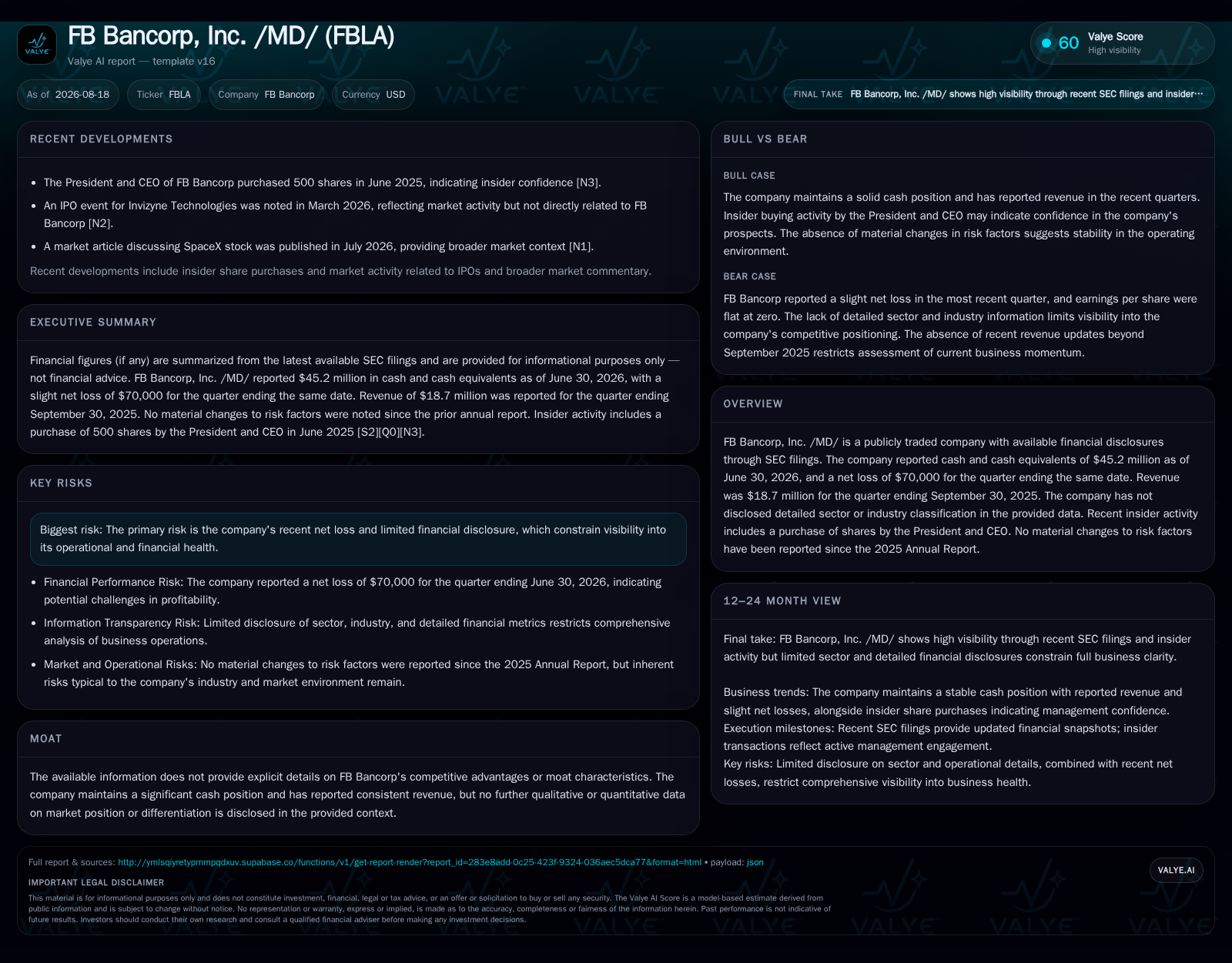
In the quarter ended June 30, 2026, FB Bancorp, Inc. recorded a net loss of $70,000 while maintaining $45.2 million in cash and cash equivalents. The company’s liquidity remains solid despite near-term profitability challenges. Additionally, a board member retired in late July 2026 in accordance with company guidelines, reflecting routine governance changes. No new risk factors were disclosed, and recent insider share purchases by the President and CEO provide further context for investor monitoring.
FB Bancorp, Inc. reported a modest net loss for the quarter ended June 30, 2026, while holding a substantial cash and cash equivalents balance of $45.2 million as of the same date [S2][F1]. In the context of regional banking, maintaining liquidity is important due to regulatory capital requirements and the need to manage funding and credit risks. FB Bancorp’s preservation of cash balances despite limited profitability occurs within an operating environment where expense control and revenue generation are ongoing challenges. The company’s business model centers on providing banking and financial services, including deposit accounts, loans, and related financial products, with revenue primarily generated from interest income on loans and investment securities, as well as fees from deposit accounts and other services [S1]. Profitability and cash flow depend on net interest margin, loan performance, fee income, and operating expenses.
A recent governance development occurred with the retirement of Dr. Stephen W. Hales from the Board of Directors effective July 29, 2026 [S3]. This departure was in accordance with the company’s director guidelines and was not due to any disagreement with management or the board. Such routine board turnover is common in regional banks and generally signals orderly governance rather than strategic disruption. Investors should monitor any subsequent board appointments or changes that might influence the company’s strategic oversight or risk management.
No material changes to risk factors were reported in the Q2 2026 filing compared to the prior 2025 Annual Report [S2]. This stability in risk disclosures suggests that FB Bancorp has not identified new significant threats in its operating environment recently. However, as with all regional banks, ongoing risks include credit quality deterioration, interest rate fluctuations affecting net interest margins, and liquidity management during economic uncertainties. The banking sector’s key performance indicators typically include net interest margin, loan growth, credit quality, deposit stability, and capital ratios, all of which can be influenced by both structural factors such as regulatory environment and cyclical factors like economic growth [S1].
Insider activity also provides context for investor consideration. The President and CEO recently purchased shares, indicating insider buying activity. While this does not confirm strategic direction or operational improvement, it is a data point that some investors may consider when monitoring company developments.
Looking ahead, the base scenario for FB Bancorp is continued stable liquidity supported by its cash reserves, with ongoing challenges in returning to profitability in the near term. This scenario is plausible given the small net loss and strong cash balance, which indicate operational losses are manageable but persistent, with no evidence of immediate turnaround [S2][F1]. Confirmation of this scenario would come from future quarterly filings showing similar small net losses alongside steady cash balances and no material changes in risk factors or capital structure. Conversely, a bear case would involve widening operational losses and emerging liquidity pressures if profitability does not improve or if unexpected cash outflows occur. This scenario is plausible if revenue declines or expenses increase, or if asset quality deteriorates, leading to increasing net losses and declining cash balances [S2][F1].
Key watchpoints for investors include subsequent quarterly net income or loss trends to assess the trajectory of profitability, cash and cash equivalents balances to monitor liquidity, any further board or management changes that could signal strategic shifts, and updates to risk factors or capital allocation plans. These indicators will be critical to understanding whether FB Bancorp can navigate its current operational challenges while maintaining financial stability.
Routine governance changes and steady risk profiles add to the picture of an institution managing its current environment without significant upheaval. However, the limited near-term profitability highlights the importance of monitoring operational performance and liquidity closely, given the competitive and regulatory pressures typical in the regional banking sector.

Comments