
SIM Acquisition Corp. I’s SPAC Progress Hinges on Telecom-Logistics Merger Deadline Extension
The company extended its business combination deadline while negotiating acquisition terms with a telecom-logistics target amid persistent liquidity challenges.
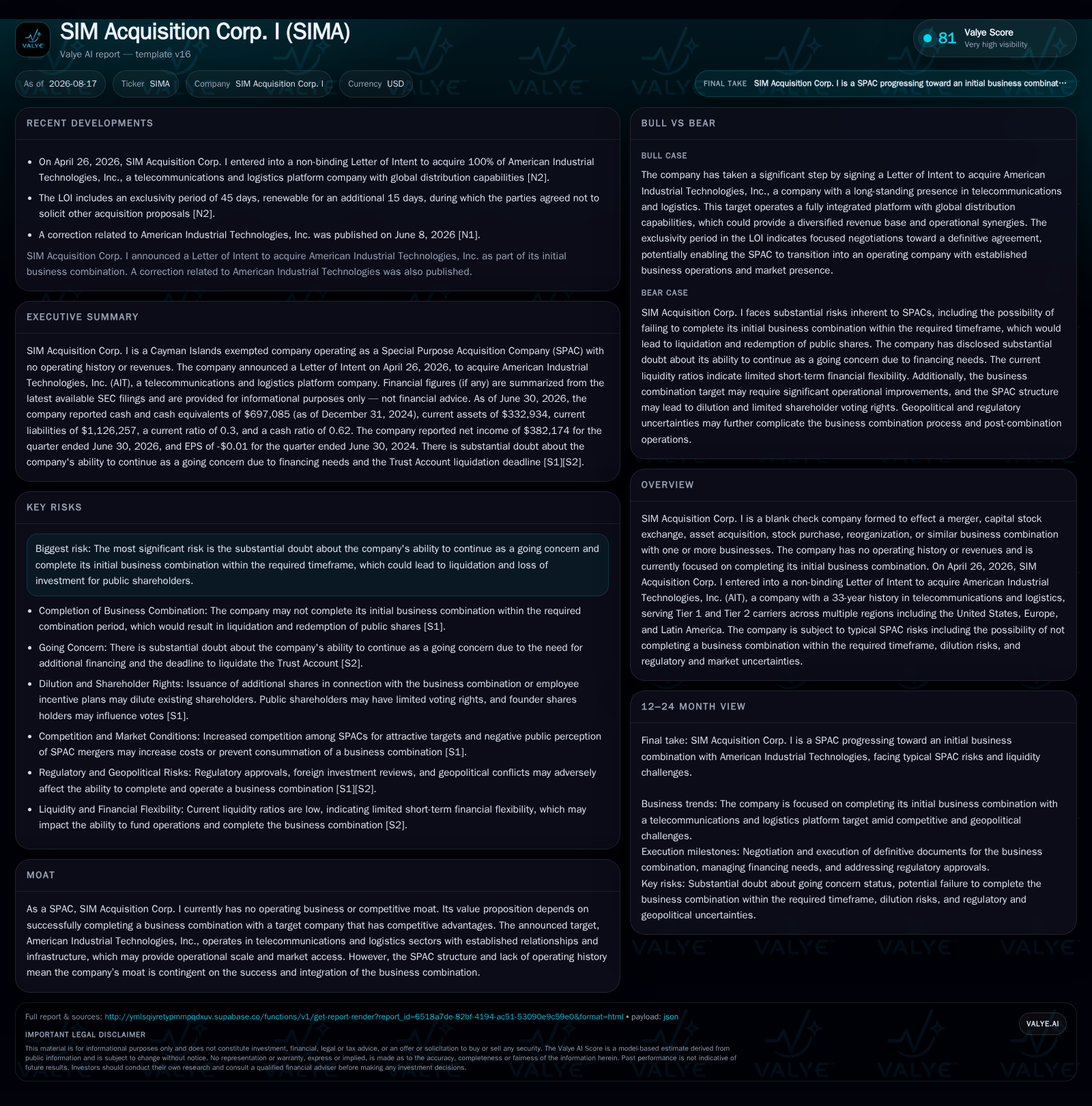
SIM Acquisition Corp. I remains focused on completing an initial business combination to transition from a blank check company to an operating public entity. As of August 2026, it has entered a non-binding agreement to acquire American Industrial Technologies, a telecom and logistics business with established carrier relationships across multiple regions. The company secured shareholder approval in May 2026 to extend its merger deadline by one year to July 2027, reflecting the complexities of finalizing deal terms and arranging financing. Significant public shareholder redemptions during the extension vote have reduced its cash resources and increased execution risk. The target offers operational scale in stable sectors, but success depends on timely transaction closure, securing additional capital, and effective post-merger integration.
Recent Operating Update and Extension of Combination Deadline
The latest quarterly filing dated August 14, 2026 confirms that SIM Acquisition Corp. I continues as a Special Purpose Acquisition Company (SPAC) without operating revenues or commercial activities [S2]. It remains fully dedicated to completing an initial business combination by its mandated deadline. Originally set for July 11, 2026 following its IPO in July 2024, shareholders approved an extension pushing this deadline to July 12, 2027 at a May 7, 2026 extraordinary general meeting [S22]. This extension indicates ongoing negotiations with the announced target require additional time due to deal complexity.
Alongside the extension vote, substantial shareholder redemptions occurred with approximately $242 million worth of public shares redeemed at about $10.79 per share [S22]. This sizable cash outflow reduces funds available in the trust account for acquisition purposes and increases reliance on remaining shareholders and potential PIPE investors to finance the transaction.
Business Model: Pure SPAC Dependent on Successful Deal Closure
SIM Acquisition Corp. I embodies the classic blank check company model: it raised capital through an IPO without any operating business or revenue streams [S1]. Its entire enterprise value depends on identifying and executing a merger or acquisition (business combination) that transforms it into an operating public company.
Before consummation, there are no customers or products; monetization derives solely from managing capital held in trust accounts, handling shareholder redemptions at deal time, founder share incentives tied to post-combination upside, warrant exercises potentially diluting shareholders, and securing PIPE financing as supplemental equity.
Economic value creation depends critically on negotiating favorable acquisition terms acceptable to shareholders [S7]. The announced non-binding Letter of Intent (LOI), signed April 26, 2026, commits SIMA toward acquiring American Industrial Technologies (AIT), subject to definitive agreements [S12].
Industry Structure and Target Company Strategic Fit
American Industrial Technologies (AIT), SIMA’s current exclusive acquisition target under LOI discussions, has nearly three decades of operational history in telecommunications manufacturing, logistics distribution, and connected device ecosystems across the U.S., Europe, and Latin America [S19]. Its customer base includes Tier 1 and Tier 2 carriers—large regional or multinational telecom providers—characterized by relatively stable contract flows but competitive pressures driven by technology upgrades and regulation.
AIT operates integrated Third-Party Logistics (3PL) and Fourth-Party Logistics (4PL) services supporting global distribution networks leveraging long-standing industry relationships [S19]. Transitioning from shell exposure into this operating telecom-logistics platform via de-SPAC offers structural benefits including geographic diversification and vertical integration.
Telecom infrastructure markets exhibit moderate growth tied closely to carrier capital expenditure cycles. Post-combination success will rely substantially on operational excellence, scale economies, and maintaining or expanding carrier contracts amid competition from specialized logistics providers and equipment vendors.
Growth Drivers
The primary growth driver is successfully completing the business combination within the extended timeline [S22]. Closing this transaction would convert SIMA from a speculative capital vehicle into an operating company anchored in telecommunications supply chain services.
Post-merger growth opportunities for AIT include leveraging existing carrier relationships for cross-selling expanded manufacturing logistics offerings integrated with connected device platforms; geographic expansion especially in Latin America where network upgrades are accelerating; and benefiting from rising bandwidth demand fueled by emerging technologies such as 5G.
Additional tailwinds arise from sustained investor interest in alternative public listing routes beyond traditional IPOs—a dynamic driving many SPAC formations—and enhanced governance practices demanded by institutional investors post-combination.
Risks / Growth Constraints
A key risk flagged in recent filings is SIMA’s "going concern" uncertainty due to liquidity pressures exacerbated by substantial redemptions reducing trust account balances available for acquisitions [S2]. Without successful PIPE financing or sponsor contributions—potentially difficult under current market conditions—the ability to complete any deal diminishes over prolonged negotiations.
Dilution presents material risk given founder shares typically represent around 20% pre-merger ownership; warrants exercisable above IPO prices ($11.50); plus potential equity discounts implicit in private placements or negotiated deals [S1]. Public shareholders have limited voting power over founder shares; thus majority opposition among publics may not block deals if founders vote affirmatively.
Regulatory scrutiny has intensified around SPAC disclosures adding further execution risk [S1]. Market skepticism following high-profile SPAC failures or mispriced combinations may deter quality targets or impose valuation hurdles.
Post-closing integration risks are significant given AIT’s multinational operations spanning legacy systems; failure here could erode anticipated synergies critical for sustainable free cash flow generation.
What To Watch Next
Key upcoming milestones signaling progress include:
- Signing definitive agreements formalizing AIT acquisition beyond LOI stage [S12];
- Filing proxy/registration statements detailing merger economics;
- Shareholder votes approving the transaction amid scrutiny over redemption rights;
- Redemption rates at closing reflecting investor conviction;
- Securing PIPE private equity investments essential for funding;
- Potential amendments or further deadline extensions indicating timeline realism;
- Operational updates demonstrating scalable integration post-closing.
These indicators reveal both legal compliance status and management’s effectiveness in converting strategic intent into executable outcomes while sustaining market confidence vital for liquidity support.
Financial Profile Discussion
Disclaimer: This is research-only, informational analysis and not investment advice. It may include AI-generated interpretation and general industry context. Always verify important details using primary sources.

Comments