
DISCIPLINED GROWTH ACQUISITION Corp’s Capital Foundation and De-SPAC Timeline Under Review
DGAC recently completed its IPO and placed proceeds into trust, now focusing on identifying a business combination within NYSE timeframe constraints.
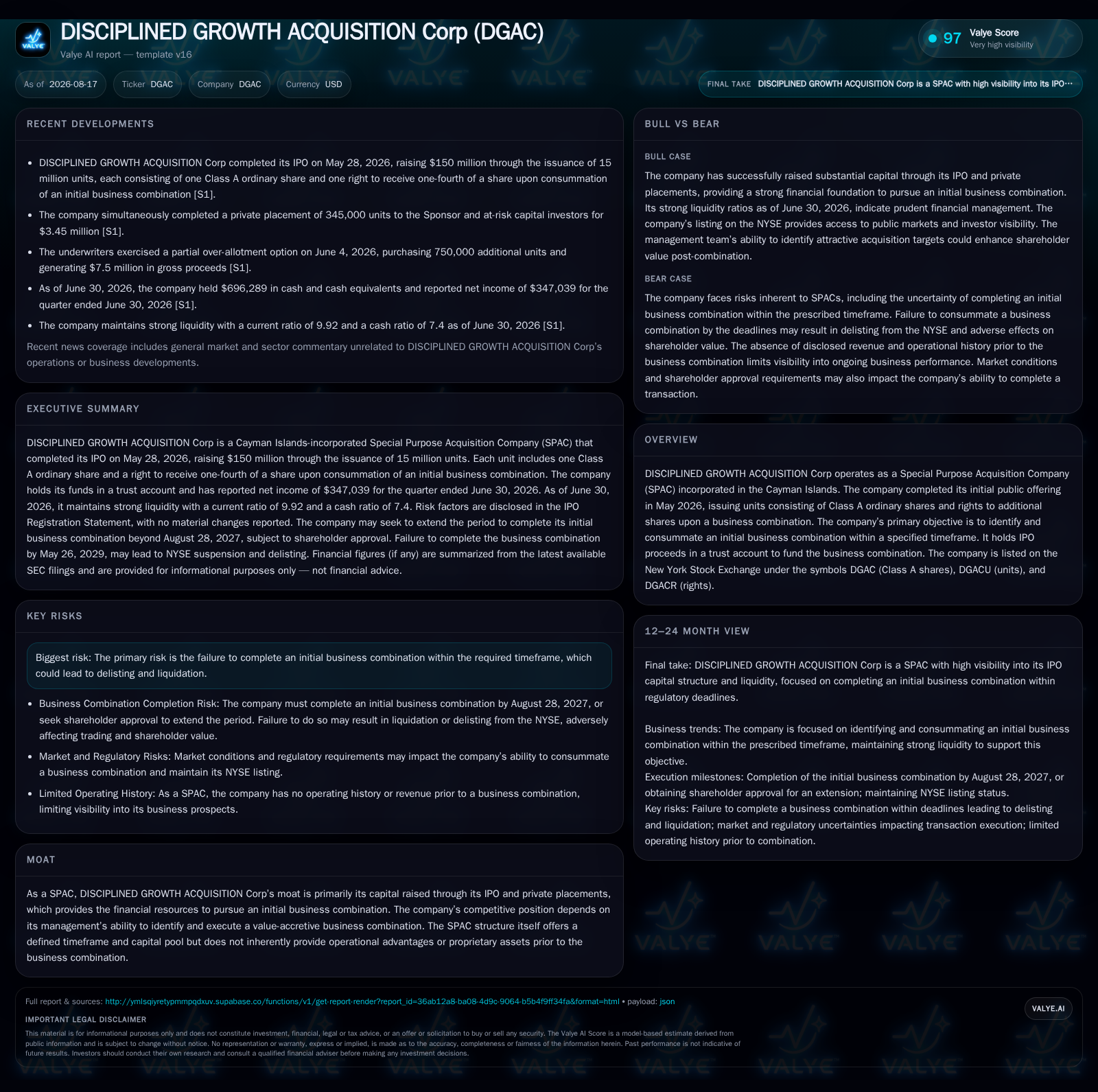
DISCIPLINED GROWTH ACQUISITION Corp (DGAC) is a Cayman Islands-incorporated SPAC that priced its IPO in May 2026, raising approximately $158 million including the over-allotment option. The IPO units comprise Class A ordinary shares paired with rights convertible post-business combination. The proceeds are held in a trust account to secure funds for the intended initial business combination, which must be completed by August 28, 2027, or potentially extended to May 26, 2029 subject to shareholder approval. DGAC recently enabled separate trading of shares and rights to increase liquidity and investor flexibility. The company remains within its mandated timeframe with no material updates to risk factors but faces typical SPAC risks including redemption risk, deal sourcing challenges, and regulatory compliance. Its ability to consummate an attractive business combination within the window will largely determine its future trajectory.
Recent Operating Update
DISCIPLINED GROWTH ACQUISITION Corp (DGAC) filed its latest quarterly report on August 14, 2026, marking its first substantial operational update since completing its initial public offering in late May 2026. The IPO raised gross proceeds of $150 million through issuance of 15 million units priced at $10 per unit. These units—each composed of one Class A ordinary share and one right convertible into one-fourth of a Class A share following an initial business combination—represent the core financial foundation supporting DGAC’s search for a suitable target company [S6], [S14]. Additionally, the underwriters exercised partial over-allotment options resulting in total gross proceeds increasing to approximately $158.3 million after private placements alongside sponsor participation [S15], [S16].
Importantly, the entire net proceeds (minus permitted expenses) were deposited into a U.S.-based trust account managed by Odyssey Transfer and Trust Company. As of June 30, 2026, the trust balance reported was approximately $696 thousand in cash equivalents, augmented by nominal current assets and minimal liabilities indicating robust liquidity with a current ratio close to 10x—a typical characteristic for SPACs in their pre-acquisition phase ensuring capital preservation until deployment [F1], [S2].
A critical recent structural evolution occurred on July 17, 2026: DGAC enabled separate trading of the Class A ordinary shares and rights previously bundled together as Units [S17]. This separation increases investor flexibility by allowing independent valuation and trading of these components on the New York Stock Exchange under symbols DGAC (shares) and DGACR (rights), respectively. The original composite Units continue trading under DGACU for holders electing not to separate—providing multiple instruments to accommodate varying investor preferences ahead of consummating a de-SPAC transaction
Business Model Overview
As a Special Purpose Acquisition Company, DGAC’s business model is straightforward yet highly dependent on execution. The SPAC raised capital from public investors through an IPO combined with private placements via Sponsor and associated at-risk investors. The monetization channel is not operational revenue but rather deployed capital aimed at acquiring or merging with a private operating company—thereby effectuating that company’s transition to public markets without undergoing a traditional IPO process.
Revenue drivers in this model predominantly reflect gains from an ultimately successful business combination rather than ongoing operations during the shell phase. Investors buy into DGAC’s story based on management's experience and promise to identify compelling targets. Operational costs are limited pre-merger, reflected chiefly in underwriting fees, administrative expenses, legal costs related to deal due diligence, and small overheads—all funded via non-trust cash.
DGAC's strategic strength lies principally in quantitative measures such as capital raise size allowing meaningful dealmaking capacity ($158+ million), alignment from sponsor units incentivizing meticulous acquisition screening, and flexible security structuring (unit composition plus rights trading) enhancing liquidity options for shareholders before target announcement or vote.
Industry Context and Competitive Position
SPACs generally compete indirectly against traditional IPOs and other alternative listing routes such as direct listings or private equity fund exits. Within this niche intermediary space lie several peer vehicles like Pershing Square Tontine Holdings or Churchill Capital known for sizable raises or high-profile sponsors. While DGAC is relatively new with limited performance history owing to its May-2026 IPO timing, it conforms broadly to common industry mechanics: capital raised upfront held securely pending deployment against acquisition due diligence.
The defining competitive determinants amidst peers include:
- Size and quality of capital base: DGAC's nearly $160 million positions it as modestly sized vis-à-vis some mega-SPACs but adequate for middle-market targets.
- Sponsor pedigree and pipeline access: Current disclosures formalize management appointments but abstain from detailing proprietary deal sourcing advantages as would require specific evidentiary backing.
- Timing discipline: Maintaining progress within NYSE-mandated deadlines protects listing status unlike many peers facing trimming timelines or extensions reducing sponsor optionality.
- Structural features like separate trading rights optimize investor demand elasticity compared with standard unit-only models.
DGAC thus reflects typical mid-tier SPAC profile intact but will need to demonstrate tangible pipeline milestones soon to preserve investor confidence amid increasingly vigilant regulatory scrutiny impacting SPAC valuations broadly.
Growth Drivers
Growth prospects hinge on three connected vectors:
- Deal Execution: Successfully identifying and closing an accretive business combination generates immediate value uplift enabling transition beyond pure shell status toward operating entity participation.
- Investor Appetite: Rising enthusiasm around alternative public listing paths supports SPAC market buoyancy; improved trading granularities via separated securities may attract broader institutional participation.
- Regulatory Environment: Regulatory clarity around SPAC disclosures reduces execution uncertainty—this natural maturation enhances willingness among private targets to engage with SPAC sponsors like DGAC.
This deadline currently stands at August 28, 2027 but can be extended subject to shareholder vote up until May 26, 2029 under strict conditions.
Shareholder redemptions also pose potential dilution threats if large-scale opt-outs post transaction announcement drain acquisition capital availability below thresholds necessary for closing deals without refinancing inducements such as PIPE financing arrangements (not yet evidenced here).
Further risks revolve around possible regulatory shifts targeting increased transparency or stricter ARRC accounting rules that could heighten compliance costs or affect valuation metrics tied into merger terms. Besides macroeconomic volatility impacting private company valuations greatly influences both bidder appetite among SPAC sponsors including DGAC as well as final negotiation outcomes.
Management conflicts possibly emerge given incentives tied up with founder shares originally brokered cheaply but convertible at favorable rates post-merger—although indemnity structures appear routinely established here securing fiduciary responsibilities [S20].
Finally absence so far of any announced target introduces uncertainty; tracking any forthcoming SEC disclosures about deal progress will be essential monitoring markers going forward.
What To Watch Next
Investors should keenly track:
- Announcements or filings disclosing selection or negotiation stages with potential initial business combination candidates,
- Shareholder voting solicitations related either directly to transactions or extensions of the combination period,
- Redemption percentages if any shareholder votes have taken place post-announcement should those arise,
- Security price trends reflecting market sentiment towards split share/right trading introduced July '26,
- Any PIPE financing arrangements disclosed concomitant with deal signing indicating third-party institutional support,
- Management commentary updates on outreach efforts towards sectors or valuation bands targeted by DGAC,
- Compliance milestones particularly filings evidencing formal amendments extending deadlines if applicable,
- Changes in trust account balances stemming from any authorized expense payments or partial fund releases ahead of merger closure.
Financial Profile Discussion
Disclaimer: This is research-only, informational analysis and not investment advice. It may include AI-generated interpretation and general industry context. Always verify important details using primary sources.

Comments