
Tri Pointe Homes Leverages Geographic and Product Diversity Amid Market Volatility
Q2 2026 results reveal inventory impairments offset by expansion in financial services and geographic footprint.
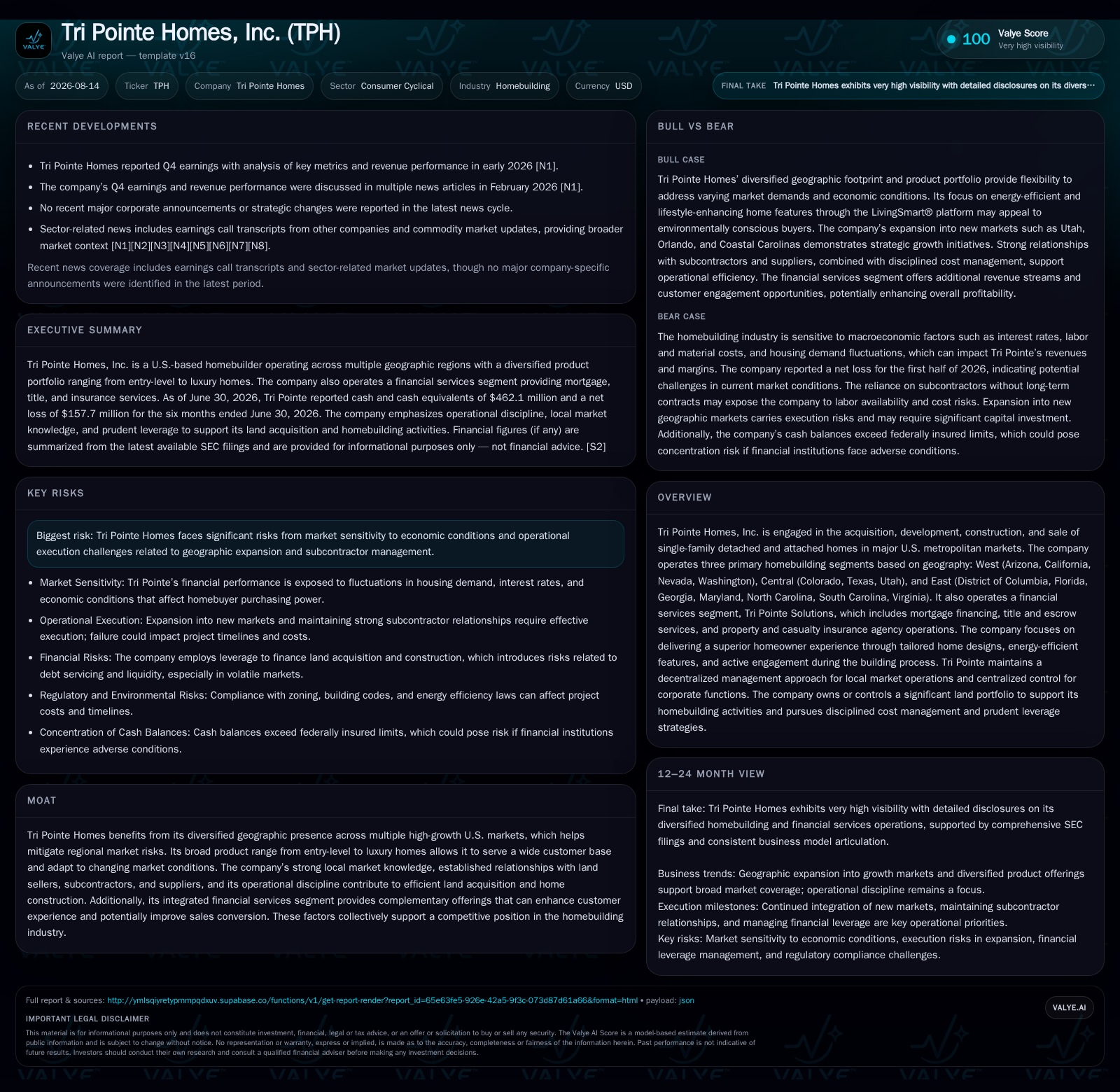
Tri Pointe Homes reported Q2 2026 operating challenges including $19.7 million of real estate inventory impairments and land option abandonments, reflecting ongoing market headwinds. Despite these charges, the company expanded its geographic reach with Coastal Carolinas operations and continued growing its integrated financial services segment, Tri Pointe Advantage, enhancing customer closing experience. Its diversified presence across West, Central, and East U.S. regions and broad product mix provide some resilience amid cyclical housing demand fluctuations and interest rate sensitivity. Monitoring land acquisition discipline and backlog trends will be key to assessing durability of recovery.
Latest Operating Update Highlights
In its Q2 2026 filing dated August 13, Tri Pointe Homes disclosed an increase in real estate inventory impairments and land option abandonments totaling $19.7 million for the quarter, up from $13.1 million a year earlier [S2]. These charges signal selective asset write-downs consistent with current housing market volatility and tighter demand conditions. The company attributes some of this impairment to elevated land option abandonments, which rose markedly compared to prior periods, indicating cautious land positioning during uncertain pricing dynamics.
Alongside its core homebuilding operations spanning single-family detached and attached homes across thirteen states plus D.C., Tri Pointe operates an integrated financial services arm under "Tri Pointe Advantage," offering property and casualty insurance agency services that facilitate transaction closings [S2]. This subsidiary's revenue is embedded within the consolidated financial services segment. The integration aims to enhance buyer convenience, improve closing efficiency, and potentially boost sales conversions by bundling ancillary home purchase services.
The company further expanded geographically in April 2024 into the Coastal Carolinas region (South Carolina and Georgia), illustrating an ongoing strategic push into high-growth southeastern U.S. markets alongside established presence in the West (Arizona, California, Nevada, Washington) and Central (Colorado, Texas, Utah) segments [S1]. This multi-region approach dilutes exposure to single-market downturns inherent in residential real estate.
Business Model Nuances
Tri Pointe primarily generates revenue from home sales—developing residential communities through land acquisition followed by construction and sale of homes targeting a range from entry-level through luxury segments. Revenue is impacted by number of homes closed/sold, average selling prices influenced by product mix shifts toward upscale models or value-oriented offerings, and timing/distribution of deliveries (subject to seasonality).
Integrated financial services derive incremental margin streams from mortgage origination facilitation, title/escrow processing, and insurance sales—elements that complement the physical home sale by reducing buyer friction points while optimizing the customer journey.
A decentralized operational structure empowers local teams familiar with individual markets’ regulatory environment, labor pool constraints, and consumer preferences while maintaining centralized oversight for corporate governance and financial control [S1]. This hybrid model aims at agility in inventory acquisition decisions alongside standardized risk management.
Seasonality weighs heavily on working capital requirements since customer orders predominantly occur during H1 each year; inventories thus build through Q2-Q3 ahead of peak delivery seasons typically shifting into Q3-Q4 quarters [S1]. This dynamic intensifies capital intensity mid-year with impacts on liquidity management
Industry Context & Competitive Position
Homebuilding is a cyclical sector tightly correlated to macroeconomic factors such as mortgage interest rates influencing affordability and household formation trends driving demand growth. Tri Pointe competes among national peers like D.R. Horton (broad geographic scale), Lennar Corporation (integrated financial capabilities), Toll Brothers (luxury focus), PulteGroup (product innovation emphasis), and KB Home (entry-level tilt). Compared to these peers, Tri Pointe’s strength lies in its multi-region diversification combined with a wide product spectrum that allows responsive adjustments to fluctuating regional economies or consumer preferences.
The company faces typical industry headwinds including subcontractor labor shortages impacting construction timelines and cost inflation pressures on raw materials—though recent filings do not disclose detailed cost escalations or mitigation strategies explicitly [S1]. Land acquisition discipline remains pivotal; excessive capital tied up or misaligned buy-ins can pressure margins given price volatility at this stage.
Furthermore, inventory impairment trends bear watching as they directly reflect asset quality assessment under changing demand conditions; elevated cancellations or discounting indicate potential margin compression risks.
Growth Drivers
Growth is anticipated from continued geographic expansion targeting fast-growing metropolitan areas with favorable demographic tailwinds—population influxes combined with employment gains underpin sustainable housing need increases.
Product innovation focusing on energy-efficient homes resonates with evolving consumer expectations around sustainability while providing differentiation versus commoditized builds.
The Tri Pointe Advantage integrated financial services platform strengthens buyer conversion rates by simplifying ancillary transaction processes (insurance policy issuance at closing), improving customer satisfaction scores which historically correlate with referral business—a key channel for volume growth.
Government incentives aimed at first-time homebuyers or low-to-moderate income groups could further stimulate entry-level housing demand where Tri Pointe holds competitive ground.
Risks & Execution Watchpoints
Demand sensitivity remains elevated due to economic cycles; rising interest rates constrain affordability directly impacting buyer traffic especially at entry-level price points.
Operational risks center on subcontractor performance variability—delays or quality issues can inflate build costs or extend delivery schedules adversely affecting recognized revenue timing.
Land acquisition mistakes—overpaying or buying off-trend locations—pose impairment risk that materializes through forced write-downs as seen recently.
Seasonality introduces working capital spikes requiring prudent liquidity buffer management; failure here can lead to constrained construction starts or delivery bottlenecks.
Regulatory changes at local/state levels regarding zoning or building codes could increase compliance costs or restrict project approvals presenting hurdles for selective community launches.
What To Watch Next
Key indicators include backlog levels representing homes under contract but not yet closed—providing forward visibility into revenue pipeline.
Cancellation rates monitor buyer confidence; an uptick signals weakening demand which would pressure pricing power.
Average selling price trajectory informs on product mix shifts between lower-priced models versus luxury/upscale housing instrumentation impacting margins positively or negatively.
Financial service segment growth rates relative to total closings shed light on cross-selling efficacy enhancing overall profitability.
Monitoring impairments in future quarterly reports will indicate if current market softness extends or stabilizes post-midyear inventory revaluation adjustments.
Financial Profile Discussion
As of June 30, 2026, Tri Pointe held approximately $28.3 million in cash and cash equivalents supporting operational needs amidst seasonal working capital demands [S2]. Total liabilities including debt obligations stood at about $291.5 million against total assets of roughly $921 million, reflecting moderate leverage [S2].
Cash flow from operations turned negative over the first half of 2026 primarily due to net loss of approximately $151 million compounded by non-cash stock compensation settlement reversals partially offsetting impairment charges [S2]. This reflects typical cyclicality associated with timing differences around community starts versus closings coupled with market-driven markdowns.
The company's credit facilities include Revolving Credit Facilities modified recently expanding term loans up to $450 million facilitating capital flexibility amid investment needs concentrated on land acquisition and community development projects [S4], [S26].
Close attention should be paid to how future cash flow generation recovers as backlog converts amid potential margin pressures from construction inflation and sales discounts triggered by competitive dynamics.
This analysis synthesizes publicly available SEC filings including Q2 2026 Form 10-Q updates alongside annual Form 10-K disclosures to assess Tri Pointe Homes’ operational trajectory within a complex homebuilding market environment requiring balance between geographic diversification, land discipline, operational efficiency, and integrated service innovation. It objectively evaluates current headwinds without prognosticating outcomes or investment advice.
Disclaimer: This is research-only, informational analysis and not investment advice. It may include AI-generated interpretation and general industry context. Always verify important details using primary sources.

Comments