
Tenon Medical Navigates Commercializing Multi-Platform SI Joint Fusion Amid Low Penetration and Liquidity Constraints
Tenon Medical’s strategic multi-product approach targets unmet clinical needs in sacroiliac joint fusion but faces challenges scaling adoption and sustaining liquidity.
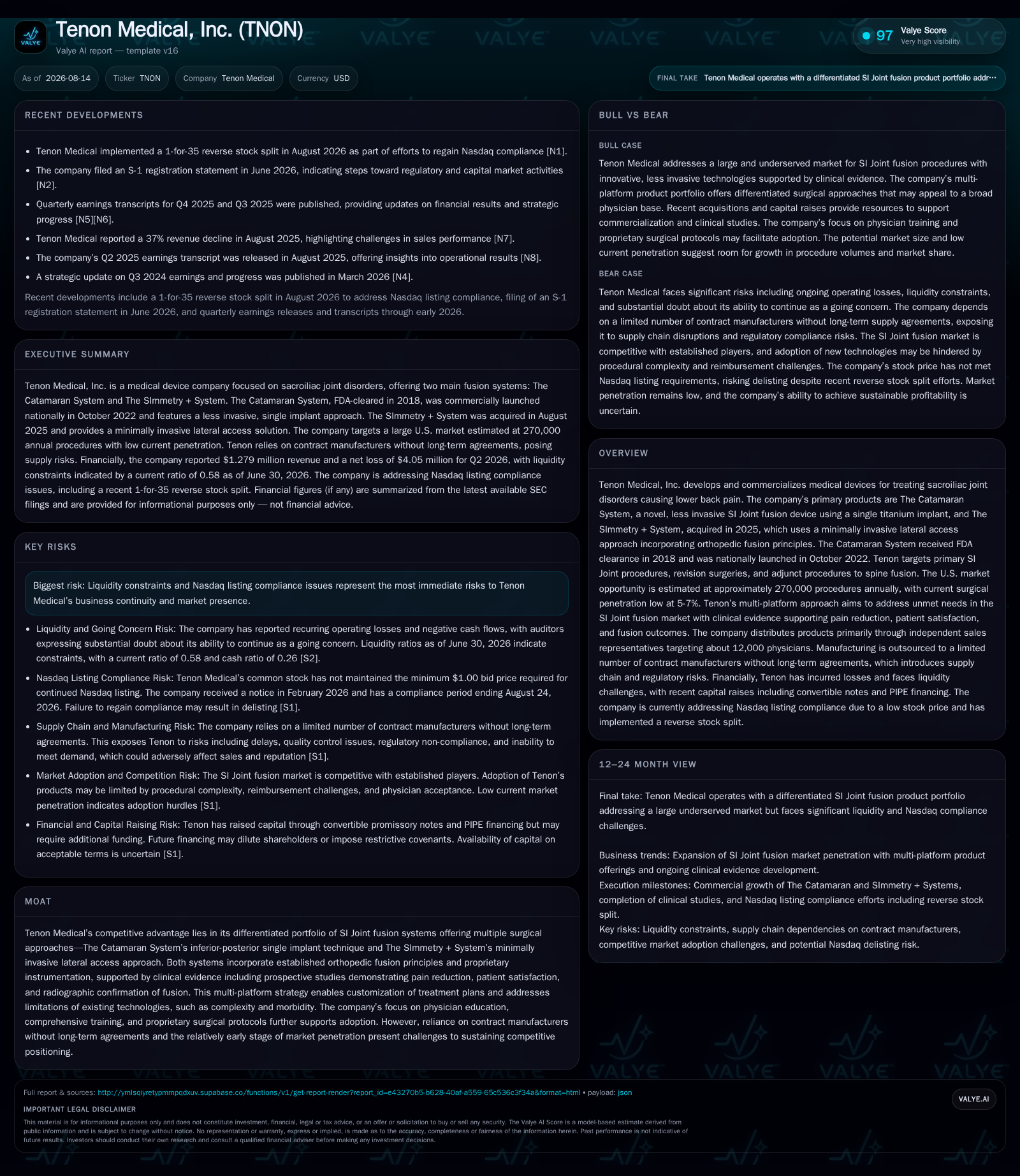
Tenon Medical, Inc. recently reported its second quarter 2026 results, highlighting continued efforts to commercialize two distinct sacroiliac joint (SI Joint) fusion systems focused on a largely untapped market. The company’s core products—the Catamaran System and the newer SImmetry + System—offer differentiated minimally invasive surgical options supported by clinical evidence. Despite this, Tenon is constrained by low procedural penetration in a market with roughly 270,000 eligible U.S. cases annually and ongoing liquidity challenges reflected in a sub-1.0 current ratio and modest cash reserves as of mid-2026. Regulatory compliance, physician training, and reliance on contract manufacturing also represent key operational risks. Going forward, milestones to watch include physician adoption metrics, clinical study outcomes, and managing Nasdaq listing compliance.
Recent Operating Update
Tenon Medical released its financial results for Q2 ended June 30, 2026 via Form 10-Q on August 13, providing the latest operational snapshot during ongoing commercial development efforts for its sacroiliac joint fusion devices [S2][S3]. The firm continues pressing commercialization post-national launch of The Catamaran System in October 2022 and integration of The SImmetry + System acquired in August 2025 [S1]. A recent reverse stock split (1-for-35) was also implemented in early August reflecting attempts to comply with Nasdaq’s minimum bid price rules [N1].
Business Model
Tenon Medical operates within the orthopedic implant segment focusing narrowly on sacroiliac joint (SI Joint) disorders, major contributors to lower back pain affecting a substantial yet underpenetrated patient population. Their revenue primarily derives from direct sales of implant systems to hospitals and surgical centers performing SI Joint fusion procedures.
The Catamaran System offers a proprietary single titanium implant designed for minimally invasive inferior-posterior access with an open-cell design utilizing autologous bone grafting—features aimed at reducing procedural morbidity relative to existing approaches [S1]. This platform targets three product use cases: primary SI Joint fusions, revision surgeries for failed implants, and adjunctive fusion simultaneous to spine fusion constructs. It received FDA 510(k) clearance in 2018 and expanded indications in March 2025.
The laterally accessed SImmetry + System complements this by applying classical orthopedic fusion principles including decortication, bone graft placement, rigid fixation across the SI Joint—all aiming for true biological fusion [S1]. By maintaining two distinct surgical approaches within its portfolio backed by clinical evidence demonstrating pain reduction and radiographic fusion confirmation, Tenon attempts to customize treatment options responsive to physician preferences.
Revenue is driven by product sales volume aligned with procedure counts plus pricing levels negotiated through contracts with hospital purchasers or distributors. Adoption depends heavily on surgeon training programs which Tenon invests in extensively—addressing proficiency challenges that influence device uptake given the specialized instrumentation and nuanced surgical technique required. Retention of physician champions and acquisition of new surgeon users form critical operating levers.
Selling through a direct salesforce supplemented by independent representatives permits reach into diverse hospital customers across the U.S., but scale remains limited by low overall surgical penetration in the addressable patient base.
Industry Structure and Competitive Position
Within the broader orthopedic medical device market, sacroiliac joint fusion represents a niche yet growing sector characterized by competition among specialist firms like SI-BONE and larger spinal implant players such as Globus Medical. Market dynamics include:
- Strict regulatory oversight requiring FDA clearances with claims substantiated by robust clinical data
- Physician preference shaped by product efficacy, ease of use, instrumentation quality, and post-operative outcomes
- Hospital purchasing influenced by demonstrated reimbursement feasibility
- Innovation trend toward minimally invasive techniques reducing patient recovery time and complications
Tenon’s dual-platform model differentiates versus competitors often focused on single surgical techniques or implants. By offering both the novel single implant Catamaran approach alongside the more classical SImmetry + system with lateral access, Tenon aims to address surgeons’ heterogeneous needs.
However, compared with peer companies established longer or possessing diversified orthopedic portfolios (e.g., Stryker), Tenon's scale is smaller with correspondingly less bargaining power over suppliers or payors.
Reliance on contract manufacturers without binding long-term agreements presents supply chain vulnerability which could threaten ability to meet growing procedural demand if commercial traction improves materially [S1][S4].
Growth Drivers
Key growth vectors center on increasing awareness among healthcare providers regarding SI Joint pathology diagnosis coupled with rising acceptance of minimally invasive surgical solutions offering superior patient outcomes relative to conservative treatments:
- Expansion of trained clinicians able to perform procedures using Tenon’s systems directly influences device utilization rate—a critical KPI reflective of commercial progress.
- Positive publication of clinical studies confirming pain relief efficacy and fusion durability bolsters surgeon willingness to adopt new implants.
- Incremental FDA clearances enabling additional indications or product iterations can unlock further procedural segments.
- Patient outreach campaigns designed to educate concerning treatment options may indirectly elevate referral volumes supporting procedure growth [S23].
- Improved reimbursement policies enhance economic viability for hospitals undertaking these elective surgeries.
- Acquisitions like that of SiVantage/SIMPL Medical adding synergistic technology platforms deepen product breadth potentially attracting broader clinician interest.
Despite these drivers, underlying surgical penetration remains low—between 5%–7% estimated against nearly 270,000 eligible U.S. procedures annually—highlighting significant room for structural demand expansion if barriers like training duration or reimbursement uncertainties are overcome [S1].
Risks and Constraints
Tenon's most salient risks cluster around liquidity stress alongside regulatory exposure:
- Financial runway is narrow given cash balances slightly above $1.6 million against current liabilities near $8.3 million as of June 30; current ratio at a precarious 0.58 signals acute short-term funding risk absent capital inflows or curtailment of spend [F1].
- Convertible promissory notes issued in March totaling approximately $5.2 million principal provide bridge financing but mature in September (with option for extension), underscoring near-term refinancing dependency [S1].
- Nasdaq compliance breaches due to share price volatility necessitate share consolidations (reverse splits) risking shareholder dilution perceptions while management addresses listing eligibility [N1][S16].
- Outsourced manufacturing dependent on third-party contract facilities not yet inspected by FDA introduces potential compliance uncertainty that could disrupt supply chains or trigger enforcement actions if standards fall short [S12][S13].
- Strict laws prohibit unapproved ‘off-label’ promotion; inadvertent transgressions could attract regulatory fines or injunctions impacting marketing efforts directly influencing sales momentum.
- Competitive forces pressing pricing pressure may compress margins while slower-than-expected physician adoption limits sales ramp [S26].
- Litigation risk including patent infringement claims common in orthopedics can divert resources even absent merit [S17].
What to Watch Next
Monitoring several indicators will shed light on execution trajectory:
- Reported number of physician training sessions completed and active surgeons using Tenon's devices offer leading insight into market penetration progress.
- Publication of peer-reviewed clinical outcomes substantiating device safety/efficacy will inform acceptance hurdles.
- Sales trends segmented by primary vs revision vs adjunct procedure categories signal product mix evolution.
- Updates on fulfillment capability including new contract manufacturer arrangements indicate supply reliability.
- Nasdaq communications regarding equity maintenance especially after reverse stock split provide liquidity health gauge.
- Potential follow-on equity or debt raises expected before September maturity of convertible notes reveal capital strategy viability.
Financial Profile Discussion
As of June 30, 2026 Tenon reported cash and equivalents at approximately $1.68 million against $8.31 million in current liabilities resulting in a current ratio below unity at ~0.58—highlighting tight liquidity conditions that constrain operational flexibility without additional funding or cost reductions [F1]. This financial snapshot aligns with previously disclosed ongoing operating losses stemming from investments ramping commercial infrastructure including salesforce deployment and physician education programs combined with R&D spending related to product enhancements [S1].
The company’s capital structure reflects recent issuance of senior convertible promissory notes aggregating around $5.2 million principal in March 2026 which include original issue discounts and potential conversion features at discounted prices relative to prevailing stock valuations—a form consistent with bridge financing prevalent among small-cap medical device firms seeking runway extension while pursuing sales scale-up [S1]
Given these constraints alongside Nasdaq compliance requirements enforced via reverse stock split actions in August 2026 designed to regain minimum bid price thresholds signaling fragile equity market access risk—maintaining funding sources remains vital to prevent disruptions affecting product commercialization timelines or key operating initiatives such as physician training scale acceleration [N1][S16]
Overall cash burn rate implied by quarterly disclosures coupled with limited available capital suggests priority remains securing additional equity infusion or partnering arrangements to sustain business continuity beyond later half of calendar year unless revenue accelerates significantly from current levels.
Conclusion
Tenon Medical positions itself uniquely within the orthopedic implant market through a multi-platform strategy addressing sacroiliac joint fusion needs via differentiated minimally invasive surgical technologies each rooted firmly in orthopedic fusion principles supported by clinical evidence. While this approach offers meaningful advantages against entrenched competitors reliant on singular techniques it faces significant headwinds stemming from low overall market penetration presently constraining revenue scale.
Substantial operational risks spanning liquidity adequacy amid persistent losses alongside FDA regulatory scrutiny and supply chain dependencies elevate execution complexity common among emerging orthopedics device companies focused on narrow indications requiring intense physician education commitment converging into slow procedural adoption curves.
Going forward investor attention should remain tightly focused on tangible patient volume growth signals driven by physician training expansion accompanied by cumulative clinical results improving confidence alongside successful navigation of financial markets ensuring survival runway over next twelve months.
Disclaimer: This is research-only, informational analysis and not investment advice. It may include AI-generated interpretation and general industry context. Always verify important details using primary sources.

Comments