
Cheetah Net Executes Strategic Pivot to Logistics and Industrial Trading Post-Vehicle Exit
Following the exit from parallel-import vehicle sales, Cheetah Net is reshaping its business through logistics expansion and industrial equipment trading amid geopolitical uncertainties.
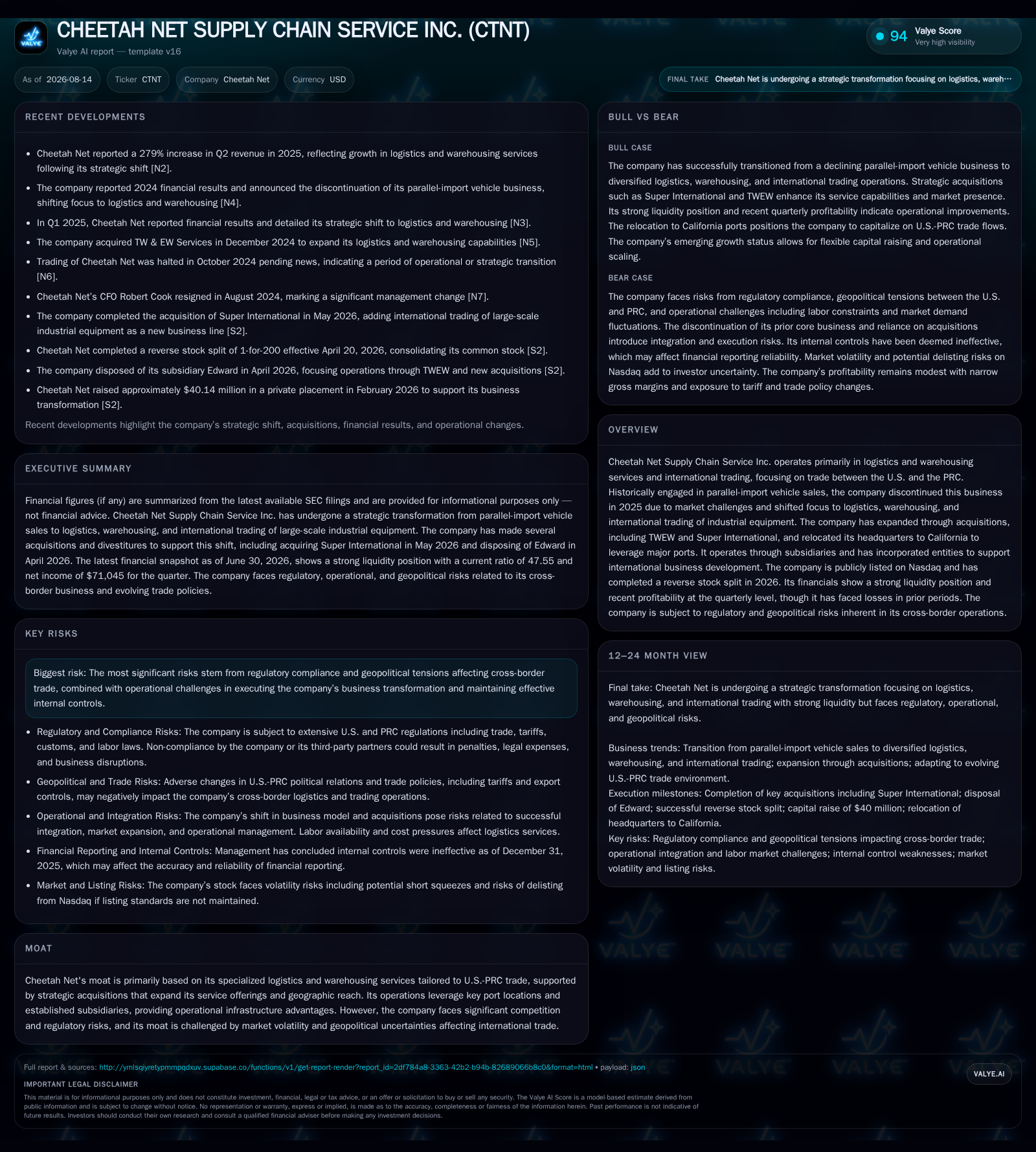
Cheetah Net Supply Chain Service Inc. has transitioned away from its troubled parallel-import vehicle sales business, discontinuing it in early 2025 after sharp volume declines and receivables issues. The company now focuses on expanding logistics, warehousing, and international trading of large-scale industrial equipment, leveraging acquisitions like Super International and relocating its headquarters near key U.S. ports. While recent quarterly results show improved profitability and strong liquidity, the firm remains exposed to geopolitical tensions between the U.S. and China, regulatory compliance risks, and competitive pressures inherent in cross-border logistics operations.
Recent Operating Update
Cheetah Net Supply Chain Service Inc. reported its second-quarter financial results in August 2026 reflecting ongoing strategic transition [S2][S1]. The company has officially discontinued its longstanding parallel-import vehicle sales business as of March 2025 following a collapse in demand driven by weakening macroeconomic conditions in China, intensifying competition from domestic electric vehicles, and pricing pressure from luxury brands. Vehicle volumes plummeted by over 95% in 2024 to just 14 units from over 300 in 2023, provoking a significant $1.6 million credit loss related to difficult receivables collection
Post-discontinuation, Cheetah Net has shifted focus towards expanding its logistics and warehousing services—core competencies supporting cross-border trade—and forged into international trading with the acquisition of Super International in May 2026 [S2][S3][S1]. This acquisition introduced sourcing, purchasing, and selling of large-scale industrial equipment internationally alongside integrated procurement and delivery coordination. The company relocated its headquarters to Irvine, California to optimize access to major Pacific ports critical for U.S.-China supply chain flows enhancing operational efficacy
Business Model Analysis
Cheetah Net operates at the intersection of third-party logistics (3PL) services and international trading intermediary functions primarily servicing U.S.-PRC cross-border commerce. Its revenue streams include fees from freight forwarding, warehousing rental/storage charges, coordination services involving customs brokerage compliance handled primarily through its subsidiary Edward—an authorized ocean transportation intermediary (OTI) licensed as a non-vessel operating common carrier (NVOCC)—and margins earned on equipment sales through trading operations [S1][S2]
The company’s logistics arm provides comprehensive supply chain management including cargo handling coordination between manufacturers/suppliers overseas and end customers within the PRC or U.S., inventory management strategies within warehousing facilities proximate to ports, as well as labor support functions associated with freight consolidation or distribution requirements. These capabilities are complemented by international trade expertise to arrange complex transactions involving industrial equipment with multi-jurisdictional regulatory compliance demands.
Revenue growth depends on increasing shipment volumes measured in TEUs or unit counts for goods handled via freight forwarding agreements while maintaining high warehouse utilization rates and minimizing average transit times—key drivers that enhance client retention by ensuring timely delivery in demand-sensitive markets. Gross margins hinge on efficient orchestration of cargo movements minimizing freight costs per unit while optimizing order accuracy.
Industry Structure and Competitive Environment
The logistics and international trading industry is heavily influenced by geopolitical dynamics—particularly strained U.S.-China relations—which amplify risks around trade tariffs, regulatory compliance burdens, customs processing delays, and fluctuating currency exchange rates that complicate pricing stability for providers like Cheetah Net [S1]. The sector comprises global giants such as DHL Supply Chain offering integrated end-to-end solutions; freight forwarders like Expeditors International known for customs brokerage excellence; regional niche players providing specialized value-added services; shipping lines such as COSCO emphasizing China-related lanes; and specialized warehousers akin to Penske Logistics.
Cheetah Net’s competitive moat derives from its tailored service offerings focusing on large industrial equipment trading combined with targeted logistics service provision aligned with cross-border market needs. However, it remains challenged by intense competition leveraging scale economies, technological advantages in supply chain visibility platforms, broader geographic reach, and deeper capital resources.
Growth Drivers
Key growth catalysts include accelerating volumes of global trade reinstated after COVID-19 disruptions coupled with infrastructure investments at major West Coast ports enhancing throughput capacity. The rising complexity of supply chains—driven by omni-channel retail trends demanding more precise inventory management—and increased demand for value-added logistics services create an opportunity set for companies providing specialized cross-border coordination.
Additionally, expansions into international trading of industrial equipment diversify revenue beyond transactional logistics fees into higher-margin product sales. Cheetah Net’s ability to integrate procurement sourcing with delivery facilitation aims to capture additional value along the supply chain by becoming a trusted end-to-end partner for industrial clients.
Technological adoption improving transit time transparency while reducing freight cost per unit can also unlock margin improvement potential alongside better customer retention through service reliability gains.
Risks and Watchpoints
The predominant risk remains geopolitical uncertainty affecting the bilateral U.S.-China relationship that directly shapes tariffs application, customs clearance processes, export controls, and import licensing regulations—all influencing cross-border shipments volume unpredictability [S1]. This risk profile demands rigorous ongoing regulatory compliance monitoring especially given Cheetah Net’s dependency on third-party ocean carriers and trucking operations which themselves face sanctions or penalties that could cause downstream operational interruptions.
Market volatility also poses challenges from a shifting economic environment that could depress investment in capital equipment affecting demand for industrial machinery trades. Further operational risks stem from legal exposure related to intellectual property claims or failures by third parties leading to cargo damage or loss claims.
Competitively, price pressures arising from commoditized freight forwarding services necessitate differentiation through service quality enhancements or expanded offerings like customs brokerage which have higher barriers to entry but require sustained investment.
What to Watch Next
Investor focus should be on quarterly shipment volumes especially regarding industrial equipment trades post-Super International acquisition as an indicator of successful diversification; warehouse utilization metrics indicating capacity scaling; gross profit margins demonstrating operational leverage; order accuracy rates signaling quality improvements; legal or regulatory updates affecting NVOCC licensing renewal; cash flow stability maintaining low net debt status; progress integrating acquired businesses; and management commentary regarding geopolitical developments impacting cross-border operations [S2][S3]
Sustained execution against these KPIs will validate whether Cheetah Net can convincingly transition from a niche parallel-import vehicle seller into a broader logistics-trading hybrid capable of weathering cyclical macroeconomic headwinds.
Financial Profile Discussion
As of June 30, 2026, Cheetah Net reported cash and equivalents totaling approximately $2.14 million against total debt nearing $0.59 million resulting in a net cash position of around $1.55 million—a healthy liquidity buffer supportive of operational flexibility amidst transformation efforts [F1]. Current assets stand at $75.7 million compared with current liabilities below $1.6 million yielding an exceptionally strong current ratio of nearly 47.55 which signals robust short-term solvency though may partly reflect working capital items linked to recent acquisitions or inventory build-up [F1].
Overall financial positioning provides adequate runway but will require careful working capital management focused on improving cash conversion cycles tied closely to freight billings collection timeliness within complex international payment systems.
This analysis incorporates company-disclosed data up to August 13, 2026 combined with industry context specific to U.S.-China logistics dynamics without making investment research views or forward-looking projections beyond evidence-based interpretation.
Disclaimer: This is research-only, informational analysis and not investment advice. It may include AI-generated interpretation and general industry context. Always verify important details using primary sources.

Comments