
Greenland Energy’s Strategic Partnership and Arctic Exploration Outlook in Q2 2026
In Q2 2026, Greenland Energy maintained robust liquidity while advancing Arctic exploration plans alongside a new Halliburton partnership amid regulatory delays.
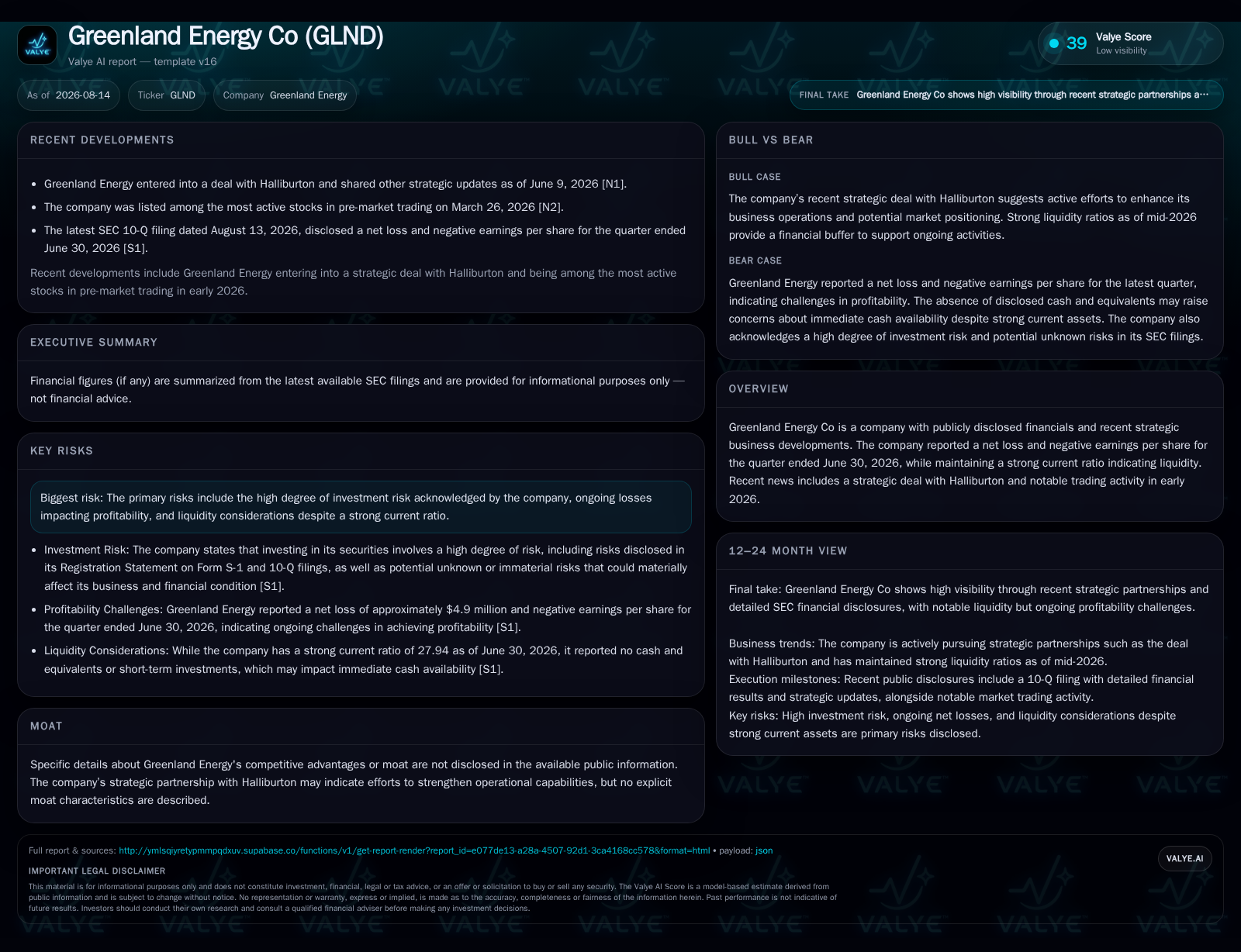
Greenland Energy reported a net loss typical of exploration-stage companies but demonstrated strong liquidity with a current ratio near 28 at quarter-end June 30, 2026 [F1][S2]. The company continues to focus on capital-intensive Arctic exploration in the Jameson Land Basin, with progress largely dependent on permitting processes that have extended into winter 2027 [S3][S8][S15]. A strategic alliance with Halliburton was announced recently, aiming to improve operational execution and manage drilling risks in challenging frontier environments [S2][S3]. Key growth drivers remain seismic surveys and planned wells, though commercial production timelines remain uncertain given regulatory and environmental hurdles [S4][industry_knowledge].
Q2 2026 Operating Update Highlights Continued Investment Amid Losses
In its latest Form 10-Q filed August 13, 2026, Greenland Energy reported a net loss of approximately $4.9 million for the quarter ended June 30, 2026 [F1][S2]. This loss aligns with expectations for an upstream exploration-stage company yet to generate revenues through commercial hydrocarbon production. Crucially, the balance sheet reveals substantial liquidity strength with current assets exceeding $38 million against current liabilities of about $1.36 million, resulting in an exceptionally high current ratio of roughly 27.9 as of quarter-end June 30 [F1]. This ratio indicates the company holds ample short-term financial resources to fund ongoing capital-intensive exploration activities without immediate refinancing pressure.
Operating costs and capital expenditures remain significant given Greenland Energy's stage of development focused fully on pre-production phases—acquiring seismic data, preparing field infrastructure, and progressing drilling plans. Such financial patterns are typical among peers in frontier oil & gas basins where high upfront investment precedes any material revenue inflows.
Exploration-Stage Business Model Demands Capital-Intensive Arctic Operations
Greenland Energy operates in the upstream segment dedicated to exploring prospective hydrocarbon resources primarily in Arctic frontier basins such as the Jameson Land Basin in East Greenland. The company's business model involves identifying prospects via detailed seismic surveys followed by appraisal drilling to confirm commercial viability. Current disclosures stress that no proved reserves or commercial production revenues have been reported thus far [S4][S5], underlining the developmental nature of the firm’s asset base.
Capital expenditures (CapEx) are inherently lumpy and front-loaded in this sector due to the high costs associated with mobilizing rigs, establishing logistics in remote Arctic zones with extreme weather constraints, and engaging specialized third-party contractors for critical services like drilling and completions. Production—and thus monetization—can only commence after successful resource definition and permitting approvals are secured. The company consequently runs substantial operating losses as it invests ahead of any cash inflows from hydrocarbons.
Strategic Working Relationship with Halliburton Enhances Operational Readiness
A material recent development disclosed includes Greenland Energy's strategic partnership with Halliburton announced around the Q2 reporting window [S2][S3]. Halliburton provides oilfield services expertise crucial for the complex technical requirements and risk management inherent in Arctic drilling operations. This partnership likely aims to elevate operational efficiencies by leveraging Halliburton’s technology and experience to mitigate cost overruns and accelerate rig mobilization amid a challenging physical environment.
While this alliance does not yet contribute direct revenue streams for Greenland Energy given its pre-production status, it symbolizes effective value-chain collaboration common among comparable upstream explorers who depend heavily on seasoned service contractors to meet tight windows dictated by seasonal Arctic access and regulatory stipulations.
Frontier Challenges: Regulatory Permitting Complexity Extends Drilling Timelines into Winter 2027
Recent filings provide clear indication that regulatory authorities in Greenland require a comprehensive review process for drilling permits at Jameson Land Basin. The heightened scrutiny has delayed anticipated approval timelines, prompting management to target winter 2027 for permit acquisition—significantly pushing back earlier expectations [S8][S15]
Such protracted permitting cycles are consistent with industry norms in environmentally sensitive Arctic jurisdictions where environmental impact assessments and governmental oversight are rigorous. These delays translate into deferred operational milestones including start of drilling programs and ultimately postponement of any potential production ramp-up timeline.
Capital Structure & Liquidity Provide Near-Term Financial Stability Despite Red Ink
Despite ongoing quarterly losses reported as normal for an early-stage explorer without sales revenue, Greenland Energy’s balance-sheet liquidity mitigates urgent solvency concerns over short horizons [F1]
There are no explicit disclosures regarding long-term debt or leverage constraints at this stage; thus, it appears management focuses on maintaining sufficient cash runway drawn from equity financing events linked to earlier SPAC transactions completed in early 2026 [S20]. Maintaining this liquidity cushion will be essential as upfront investments continue until production is established.
Growth Drivers: Seismic Surveys, Drilling Plans, and Reserve Potential in Jameson Land Basin
Key drivers underpinning Greenland Energy’s value creation prospects hinge on successful execution of planned seismic surveys aimed at refining structural models that will guide well location decisions [S4][S5]. The forthcoming OPW-1 and OPW-6 exploratory wells are critical operational milestones signaling progression from conceptual resource estimates toward possible reserves classification pending positive results.
As with many peers engaged in Arctic frontier plays, converting prospective resources into commercially viable proved reserves depends heavily on exploration success rates which historically exhibit high variability due to geological complexity. Effective deployment of advanced seismic techniques combined with experienced service partners such as Halliburton may improve chances by enhancing subsurface imaging fidelity.
Capital investment levels correlate closely with expansion of resource understanding; therefore, continued funding availability aligned with favorable market conditions—i.e., robust commodity prices—is paramount to sustaining forward momentum.
Key Risks: Geological Uncertainty, Commodity Volatility, and Contractor Dependence
Greenland Energy explicitly highlights multiple material risk factors familiar within the upstream exploration sector: substantial geological uncertainty inherent in unproven basins; lack of currently proved reserves or production evidence posing valuation asymmetries; sensitivity to global oil price fluctuations influencing investment sentiment; stringent regulatory barriers especially severe for Arctic operations; environmental risks linked to fragile ecosystems under climate change scrutiny; reliance on third-party contractors for critical operational activities which introduces execution risk; along with long development timelines generating cash flow delays [S18][S19]
These factors collectively define a high-risk profile characterizing development-stage companies operating in frontier regions worldwide. Continuous monitoring of permit status updates alongside commodity price trends will be crucial signals on Greenland Energy’s trajectory toward commercialization.
What To Watch: Permitting Milestones, Drilling Commencement, and Market Pricing Signals
The near-term outlook centers primarily on attaining final government approvals for drilling activities anticipated around winter 2027 per latest reports—a key gating event enabling field mobilization [S15]. Initiation of the OPW-1 well drill campaign post-permit issuance would represent tangible progress toward resource delineation milestones potentially transforming the asset base from prospective resources closer to reserves category.
Simultaneously monitoring commodity price direction will provide insights into financing environment dynamics impacting ability to raise additional capital if needed. Investor appetite is often correlated with perceived risk-adjusted reward potential contingent on discovery success probabilities.
Lastly, operational performance following commencement—such as well intervention success rates or finding costs—when disclosed will act as quantitative markers shaping market perceptions relative to peer explorers active in similar harsh-environment settings.
This analysis synthesizes Greenland Energy's latest regulatory updates, partnerships, financial health indicators, growth catalysts, and risk factors within the context of Arctic upstream oil & gas exploration. Evidence-based scrutiny underscores a classic early-stage venture profile characterized by strong liquidity supporting intensive CapEx commitments ahead of commercial production amid complex permitting landscapes and technical challenges typical for frontier basin explorers.
Disclaimer: This report is an informational industry analysis based solely on publicly available information up to August 14, 2026. It does not constitute investment advice or research views.
Disclaimer: This is research-only, informational analysis and not investment advice. It may include AI-generated interpretation and general industry context. Always verify important details using primary sources.

Comments