
TMC the Metals Co Advances Governance and Technology Amid Regulatory Headwinds
TMC’s August 2026 quarterly filing reveals escalating regulatory scrutiny alongside advancing technological progress, spotlighting key hurdles for its deep seabed mining ambitions.
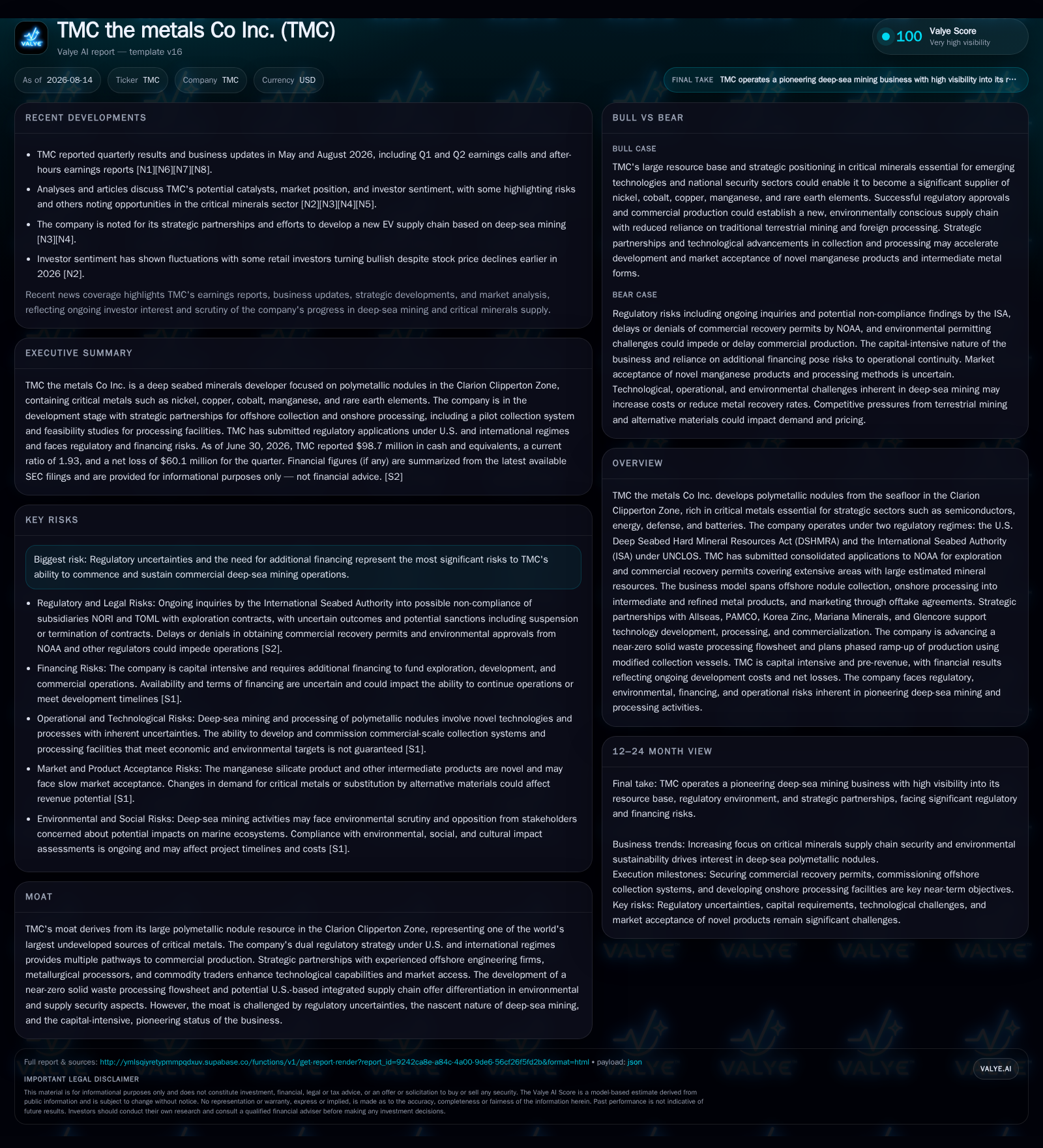
In its latest quarterly 10-Q, TMC the Metals Co Inc. disclosed intensified inquiries by the International Seabed Authority (ISA) into compliance issues concerning its polymetallic nodule exploration contracts. These regulatory developments heighten uncertainty over the company’s ability to secure long-term mining rights in the Clarion Clipperton Zone, a critical step toward commercialization. Despite this, TMC continues to validate its resource base through extensive technical studies and develop processing capabilities via strategic partners like PAMCO and Glencore. The company’s dual-regulatory approach under U.S. and ISA frameworks, combined with ongoing innovation in near-zero waste processing, underpins its differentiated position in the nascent deep seabed mining industry. However, protracted regulatory timelines, financing demands, and execution risks remain pivotal challenges ahead.
Regulatory Uncertainty Shapes Near-Term Project Viability
TMC’s August 13, 2026 quarterly report highlights heightened regulatory scrutiny by the International Seabed Authority (ISA) concerning potential non-compliance by its subsidiaries NORI and TOML with their polymetallic nodule exploration contracts [S2]. The ISA prescribed provisional measures in July 2026 that maintain ongoing inquiries without suspension. The merits phase has been deferred at the ISA’s request to March 30, 2027 or later, extending regulatory uncertainty well into late 2027 [S2].
While NORI secured a five-year exploration contract extension from the ISA Council, this approval remains subject to outcomes from the ongoing inquiry. TOML’s contract extension remains pending with its current term expiring January 11, 2027; although a transitional provision is expected to apply, there is no guarantee absent favorable interpretation by the ISA [S2]. Adverse rulings could lead to sanctions or termination of exploration rights, threatening TMC's ability to maintain sovereign sponsorships from Naoero and Tonga—critical for permit legitimacy—and potentially disrupting commercial partnerships.
Given that long-term exploration and commercial recovery permits underpin control of vast resource areas measured in thousands of square kilometers, these regulatory developments represent a substantial execution risk directly impacting asset tenure security essential for capital-intensive seabed mining ventures.
Integrated Value Chain Anchored in Critical Metal Resources
TMC's business model revolves around securing exclusive rights to polymetallic nodule deposits within the Clarion Clipperton Zone (CCZ), one of the largest repositories globally for critical metals including nickel, cobalt, copper, manganese, and rare earth elements (REE) [S1]. These exploration contracts grant access to resource areas whose tonnage estimates provide the foundation for economic feasibility models that justify significant upfront investments.
The company's strategy encompasses offshore collection using specialized subsea mining equipment—still under development—to harvest nodules from abyssal plains. These raw materials are then shipped onshore for processing into intermediate products such as nickel-, cobalt-, and copper-bearing cathodes along with manganese silicate concentrates suitable for industrial use. This integrated approach was validated through a pre-feasibility study confirming mineral reserves within seafloor nodules—a pioneering milestone demonstrating economic viability for a seabed polymetallic project [S1].
Monetization depends on converting these raw nodules into refined metal products sold through offtake agreements with commodity traders. This dual revenue foundation—resource area control driving volume potential plus metallurgical process yields supporting margins—is fundamental to scaling toward commercial production.
Strategic Partnerships Mitigate Technological Execution Risks
Given the nascent nature of deep seabed mining technology and processing complexity, TMC leverages strategic collaborations to reduce risk and accelerate development. Offshore engineering partner Allseas provides expertise necessary for designing and operating subsea collection vessels capable of operating at abyssal depths—a critical hurdle for scaling collection rates from pilot tests to commercial throughput [S1].
Onshore processing is supported by PAMCO in Japan through toll-processing arrangements at its Hachinohe facility. Having completed prefeasibility studies, PAMCO is conducting ongoing feasibility analyses targeting annual capacities exceeding one million tonnes of wet nodules—this external partnership reduces capital expenditure burdens while utilizing established infrastructure [S1].
Commodity trader Glencore facilitates market access by supporting commercialization pathways for refined metal products. Additional alliances with metallurgical refiners like Korea Zinc enhance process development capabilities.
This network of partnerships collectively addresses technological barriers inherent in offshore collection and metallurgical refinement while allowing TMC to maintain development momentum without bearing full capital intensity alone.
Growth Drivers: Robust Demand Meets Environmental Innovation
Global demand for critical metals essential to batteries, semiconductors, defense systems, and renewable energy technologies underpins TMC's growth potential. With terrestrial supplies constrained and geopolitical focus intensifying on supply chain security—including U.S. government strategic mineral initiatives—polymetallic nodules represent an alternative source poised to capture rising market needs [S1,N9].
Technological advances toward near-zero solid waste metallurgical flowsheets constitute a key competitive advantage amid growing environmental compliance pressures impacting permitting processes and stakeholder acceptance [S1]. Such innovations reduce ecological footprint relative to conventional terrestrial mining methods.
Successful progression through pre-feasibility milestones reinforces economic viability confidence, supporting eventual transition toward commercial recovery permits—the gateway to revenue generation.
Risks: Regulatory Delays, Capital Requirements, Technical Challenges
Despite progress, TMC faces considerable risks that could delay or derail commercialization. Extended ISA inquiry proceedings generate legal costs and prolong uncertainty affecting relationships with sponsoring states and commercial partners [S2]. Pending litigation adds contingent liabilities.
Capital intensity remains high during this pre-revenue stage; operating losses continue as expenditures focus on research and development rather than sales [F1]. Sustained financing will be necessary amid cautious investor appetite for pioneering seabed mining ventures.
Technical uncertainties persist around scaling offshore collection equipment performance and achieving consistent metal recovery rates—variables that directly influence project economics. Environmental opposition poses reputational risks potentially affecting permitting or investor sentiment.
Commodity price volatility further complicates financial forecasts given reliance on metals like nickel whose market cycles can fluctuate sharply.
Monitoring Ahead: Permitting Outcomes and Feasibility Progress
Key near-term indicators include resolution timing of ISA inquiry merits anticipated earliest after March 2027; formal confirmation of NORI/TOML contract extensions remains crucial for uninterrupted operations [S2]
Demonstrations validating sustainable offshore collection throughput will provide tangible evidence bridging technical feasibility with scalable execution—a vital KPI underpinning future capital raises.
Updates from PAMCO’s feasibility studies on toll-processing effectiveness will influence decisions regarding full-scale plant investments or alternative strategies [N9].
Monitoring capital expenditure trends alongside legal costs will shed light on financial sustainability during this extended development horizon.
Financial Profile Discussion: Solid Liquidity Supports Development Phase
At June 30, 2026, TMC held approximately $98.7 million in cash and cash equivalents against minimal debt near $2.5 million resulting in a net cash position close to $96 million; current assets totaled about $101 million versus current liabilities around $52.6 million yielding a healthy current ratio near 1.93 [F1]
This liquidity base supports ongoing research & development activities including engineering design and processing validation rather than capital-intensive commercial production investments which remain years away due to regulatory headwinds.
Reported operating losses reflect typical pre-revenue investment patterns common among early-stage developers in emerging resource sectors focused on pioneering new supply chains [F1]
While financial resources appear adequate for near-term objectives, successful navigation through permit approvals and technological milestones will be essential before larger-scale funding becomes imperative.
This analysis prioritizes recent regulatory developments detailed in TMC’s quarterly filings while integrating broader business model context from annual disclosures. The company operates within complex multilateral governance regimes balancing U.S.-based Deep Seabed Hard Mineral Resources Act provisions alongside International Seabed Authority oversight—a dual framework that shapes risk profiles uniquely compared to terrestrial mining peers. Strategic alliances mitigate some technological execution risks but do not eliminate financing challenges or geopolitical complexities inherent in pioneering deep seabed mining ventures.
Disclaimer: This is research-only, informational analysis and not investment advice. It may include AI-generated interpretation and general industry context. Always verify important details using primary sources.

Comments