
Innovative Solutions & Support Advances Cockpit Modernization with Stable Contracts and Financial Position
ISSC leverages specialized aerospace electronics expertise and long-term OEM contracts to sustain growth and maintain profitability.
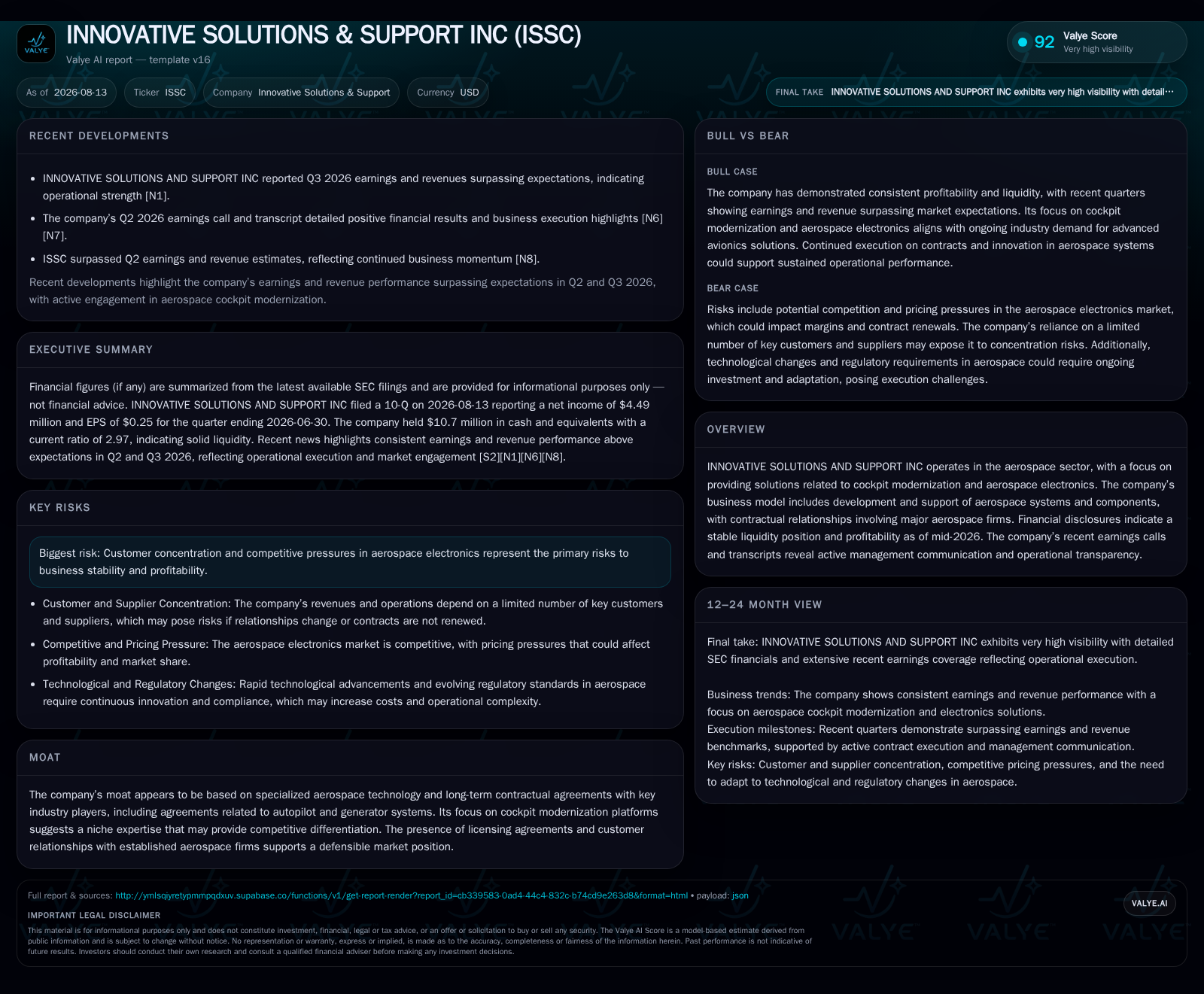
Innovative Solutions & Support Inc's latest quarterly filing shows stable cash reserves and a healthy current ratio, supporting ongoing operations in its niche aerospace avionics market. The company’s focus on cockpit modernization and proprietary aerospace electronics, backed by licensing agreements and contracts with major OEMs, underpins a defensible market position. Risks remain around customer concentration and regulatory complexity, but growth drivers include increasing demand for avionics upgrades and aftermarket support services.
Recent Operating Update
Innovative Solutions & Support, Inc. (ISSC) reported financial results for the third fiscal quarter ending June 30, 2026, highlighting continued operational stability. The company disclosed cash and cash equivalents of approximately $10.7 million alongside current assets totaling over $64 million against current liabilities near $21.7 million, yielding a strong current ratio of about 2.97 [S2][F1]. This liquidity status indicates solid short-term financial flexibility essential for managing working capital in an industry marked by long development cycles.
No impairment indicators were noted against goodwill assets despite volatile macroeconomic conditions in aerospace markets, suggesting management's confidence in sustaining projected cash flows from existing contracts [S2]. The firm also underscored its reliance on contractual relationships with established aerospace OEMs through licensing agreements covering autopilot systems and electrical generators—both critical avionics subsystems driving revenue streams [S5].
Business Model
ISSC operates primarily as a designer, developer, and supplier of specialized aerospace electronic systems concentrating on cockpit modernization, autopilot hardware/software solutions, and power generation components for aircraft. Revenue is predominantly derived from long-term OEM contracts coupled with licensing fees—contracts that often extend multiple years due to the nature of aircraft product lifecycles and certification requirements [S1]
The company's monetization blends direct product sales with system integration services plus aftermarket support including spares provisioning, field service engineering, and software updates. Aftermarket activities enhance margin profiles given their recurring nature compared to capital equipment sales.
Large aerospace manufacturers act as ISSC’s primary customers—these entities are purchasing complex avionics modules requiring ISSC's niche technology expertise. This dynamic underscores customer concentration risks but also highlights switching costs; once integrated into an aircraft platform's avionics suite via certification protocols, replacing ISSC’s components involves significant operational disruption [S1][S5].
Industry Structure & Competitive Position
Within the aerospace electronics value chain, ISSC situates itself between raw component fabrication suppliers and final system assembly by OEMs. The firm's focus on cockpit modernization aligns it closely with peers such as Honeywell Aerospace (noted for avionics suites), Rockwell Collins (now Collins Aerospace), CAE Inc., Ducommun Incorporated, and Kratos Defense & Security Solutions—each occupying complementary niches in avionics manufacturing or systems integration.
ISSC distinguishes itself by emphasizing proprietary technology embedded in autopilot controllers and generator products protected under licensing agreements with large OEMs. This technical specialization confers some competitive moat amidst a backdrop of intense pricing pressures common in the sector.
High regulatory barriers further limit competition; successful entrants must navigate complex certification processes involving FAA/EASA approvals—requirements ISSC has demonstrated proficiency in managing given its established customer base [S1].
Growth Drivers
The principal tailwinds driving ISSC’s growth prospects derive from accelerating market demand for cockpit digital upgrades fueled by rising aircraft production (commercial/military) alongside increased defense budgets emphasizing avionics modernization programs.
Regulatory mandates pushing towards enhanced flight safety standards necessitate upgraded navigation and autopilot systems—areas where ISSC supplies key modules. Additionally, growing emphasis on fuel efficiency incentivizes integration of advanced cockpit solutions that optimize flight operations.
ISSC’s expansion into aftermarket maintenance support provides recurring revenue streams that complement upfront product sales while improving overall gross margins.
Strategic partnerships cemented through multi-year contracts also secure backlog visibility; increases in order intake act as leading indicators for future top-line growth given the lengthy development-to-delivery cycles inherent in aerospace electronics production [S1][S5]
Risks & Watchpoints
Customer concentration remains a cardinal risk given ISSC’s dependence on a limited number of large aerospace firms. Any loss or reduction in contract scope from these customers could materially impact revenue stability [S5]. The company must actively manage these relationships while diversifying its customer base carefully.
Supply chain disruptions pose operational risks—component shortages or delays can cascade downstream affecting production schedules especially amid tight just-in-time inventory practices prevalent in aerospace suppliers.
Long product development cycles accompanied by rigorous technology certification requirements introduce uncertainty regarding timing of new program launches or upgrades. Delays here could postpone revenue recognition or increase engineering expenses.
Competitive pressures from larger incumbents with broader product portfolios may compress pricing or restrict access to emerging platforms unless ISSC continues investing meaningfully in R&D to maintain innovation leadership.
Cross-border geopolitical factors influencing defense spending levels also represent external variables beyond ISSC's direct control but capable of impacting contract renewal climates.
What to Watch Next
Investors should monitor quarterly updates for changes in contract backlog levels since expansion signals upcoming revenue growth potential. Attention to new order announcements or contract renewals would be key milestones confirming strategic progress.
R&D expenditure trends relative to sales will reveal how ISSC balances innovation investments against margin preservation—critical in a sector where technological obsolescence occurs rapidly.
Financial metrics such as operating performance consistency alongside working capital management will indicate operational execution quality given the capital-intensive nature of aerospace system manufacturing.
Regulatory developments or certification achievements associated with new products or platform integrations will also serve as tangible steps toward commercial scaling.
Financial Profile Discussion
As of June 30, 2026, ISSC displayed a strong liquidity position anchored by $10.7 million cash balance supported by total current assets of roughly $64.4 million against current liabilities of about $21.7 million — equating to a robust current ratio near 2.97 that signals ample short-term solvency without depending on external financing sources [F1][S2]
Total debt stood around $54.5 million yielding net debt (debt minus cash) near $43.8 million [F1][S2]. This leverage level underscores the importance of maintaining stable operating cash flows especially given the sizable working capital requirements tied to inventory (which was over $32 million) and receivables management common in this sector
Profitability measures continue illustrating positive operating income trends from previous fiscal periods though the detailed quarterly operating margin was not explicitly stated; however, management commentary suggests ongoing profitability sustained by favorable contract pricing structures combined with efficient cost control strategies [N1][S2]
Ongoing investments into research & development charged through cost of sales reflect commitment toward maintaining technological competitiveness essential for sustaining licensing revenues tied to patented aerospace technologies like autopilot systems [S1][S6]
Overall, ISSC's financial profile balances capital structure prudently against operational needs reflecting an adaptive approach within the cyclical yet technologically demanding aerospace electronics industry environment.
This analysis reflects publicly available information from Innovate Solutions & Support’s recent SEC filings as of August 13, 2026 along with corroborating industry context specific to aerospace electronics manufacturing sectors.
Disclaimer: This is research-only, informational analysis and not investment advice. It may include AI-generated interpretation and general industry context. Always verify important details using primary sources.

Comments