
Telomir Pharmaceuticals Consolidates Telomir-1 Rights but Faces Early-Stage Development and IP Reliance Risks
Telomir Pharmaceuticals reported no revenue growth as it advances preclinical development of Telomir-1 under exclusive North American licensing, highlighting capital needs and intellectual property limitations.
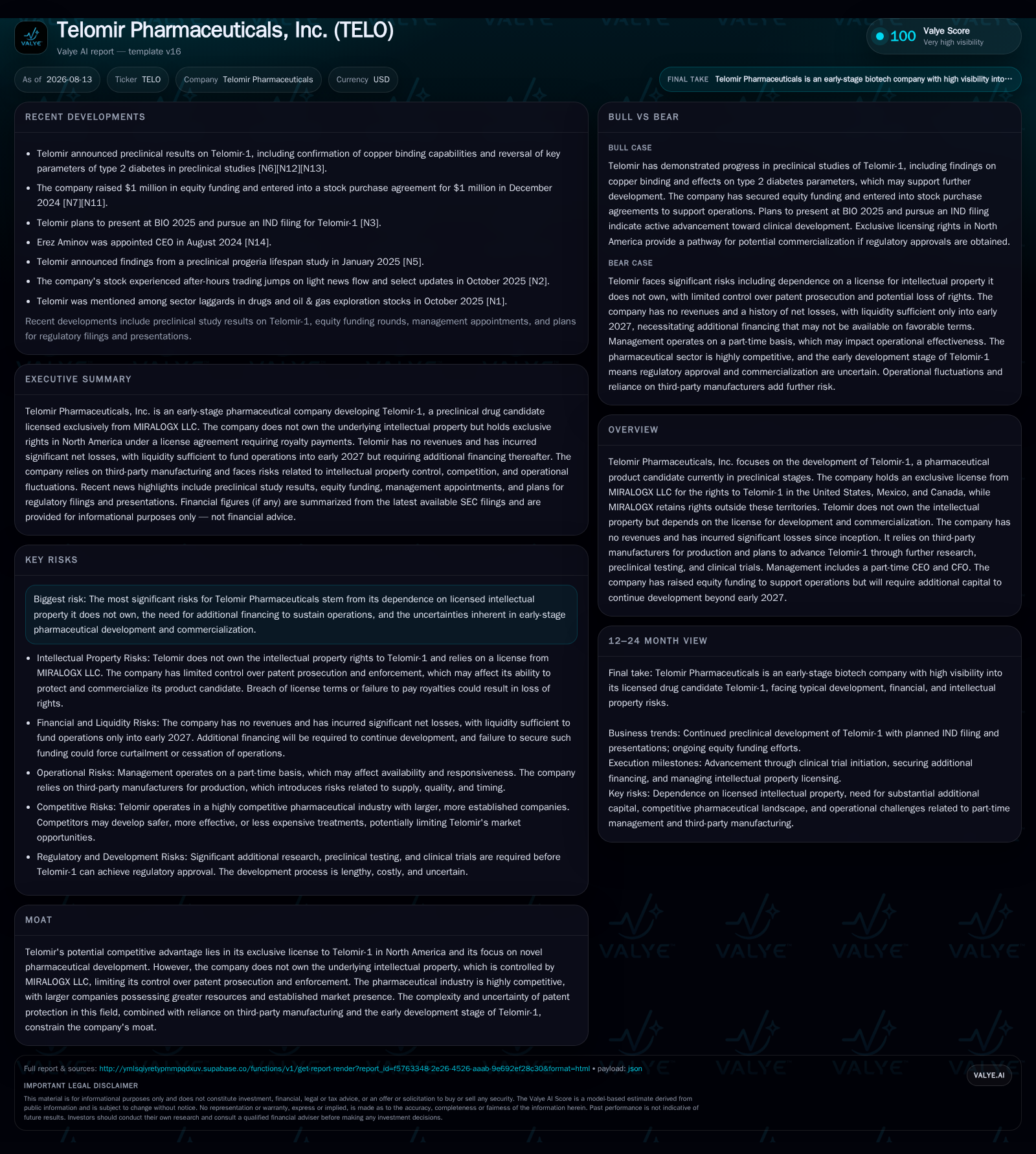
Telomir Pharmaceuticals remains an early-stage biotech focused on developing Telomir-1, a novel drug candidate currently in preclinical testing. The company recently completed a merger that consolidated global rights to Telomir-1 under a single corporate structure, removing prior geographic licensing fragmentation. However, Telomir does not own the underlying intellectual property, relying instead on a license from MIRALOGX LLC, which controls patent prosecution and enforcement. The company has no revenues and substantial losses since inception, depending on equity financing to fund ongoing R&D with a runway extending into early 2027. Operational progress includes peer-reviewed preclinical studies supporting indication targeting for aggressive breast cancers. Key risks remain tied to regulatory uncertainty, financing needs, third-party manufacturing dependencies, and limited control over its licensed IP portfolio.
Recent Operating Update: Consolidation of Rights and Preclinical Milestones
In its latest quarterly filing dated August 13, 2026, Telomir Pharmaceuticals reaffirmed the absence of material changes in its risk profile but underscored key developments shaping its near-term outlook [S2]. A material event earlier in August was the issuance of a peer-reviewed study demonstrating Telomir-1’s mechanism targeting intracellular metal modulation to inhibit epigenetic regulators involved in cancer progression — specifically showing inhibition in certain models of triple-negative breast cancer (TNBC) [S3][S13]. This preclinical data is critical because it informs biological rationale for selecting patient subsets likely to respond in upcoming clinical trials.
Additionally, a merger finalized in April 2026 brought all global rights to Telomir-1 under one entity — consolidating what had previously been fragmented licensing arrangements separating North American rights from international territories held by different parties [S6][S9]. This strategic alignment simplifies development oversight and potential commercialization pathways but does not extend intellectual property ownership; rather, Telomir holds an exclusive license for North America while MIRALOGX retains IP ownership globally.
Business Model Overview: Licensing-Centric Development with Third-Party Dependencies
Telomir operates as an early-stage biotechnology company whose sole value driver is the successful advancement of Telomir-1 from preclinical research through clinical development toward regulatory approval [S1]. The company generates no revenue today; instead its business model centers on maintaining exclusive license rights for Telomir-1 in the U.S., Mexico, and Canada through an agreement with MIRALOGX LLC
Crucially, the intellectual property foundation underlying Telomir-1—including patent applications—is drafted and prosecuted by MIRALOGX without direct control by Telomir. This limits Telomir’s ability to independently influence patent scope or defense strategy against infringement or validity challenges. The license imposes ongoing obligations such as royalty payments and confidentiality commitments critical to retaining commercialization rights [S1][S8]. Failure to comply or adverse outcomes in patent disputes could result in loss of the license and terminate the company’s core asset.
The development work primarily involves engaging contract research organizations (CROs) for preclinical assays and contract manufacturing organizations (CMOs) for GMP production of drug substance—common practice among smaller biotechs lacking internal large-scale production capabilities [S1][S8]. Such reliance introduces operational risk through vendor performance variability.
Revenue generation post-commercialization would depend on successful regulatory approvals followed by either direct product sales or licensing/sub-partnerships with larger pharmaceutical companies. Until then, milestones tied to development progress or strategic collaborations may provide occasional licensing-related income streams; however, none are presently recorded.
Industry Context and Competitive Positioning
Within the biotechnology sector focusing on novel cancer therapeutics, companies like Telomir typically operate within tight timeframes constrained by scientific validation steps including Investigational New Drug (IND) filings and sequential clinical trial phases (Phase 1 through Phase 3). Success hinges upon demonstrating sufficient safety and efficacy across diverse patient populations while navigating regulatory agencies' scrutiny.
Peer firms often contend with challenges such as sustained cash burn without revenues for extended years, navigating complex IP landscapes where patent validity can be challenged frequently, dependency on third-party manufacturers due to high fixed costs of production facilities, and limited internal management resources affecting operational agility. Compared with peers known primarily for active IP ownership or multiple drug candidates in pipeline stages, Telomir’s exclusivity is narrowly concentrated on a single licensed asset still at preclinical stage.
The recent merger positions Telomir favorably relative to fragmented licensing models seen elsewhere by centralizing decision-making over the asset's future; this is an important competitive step conducive to streamlined clinical development planning—an advantage over licensors operating under co-existing regional rights agreements.
Growth Drivers: Preclinical Data Tailoring Clinical Strategy & Unified Global Rights Facilitate Progression
Key drivers supporting potential value creation include publication of peer-reviewed mechanistic data clarifying therapeutic targets within difficult-to-treat tumor subsets like TNBC. By identifying specific tumor types dependent upon intracellular metal regulation pathways that are sensitive to Telomir-1’s mode of action, management can better define clinical trial protocols focusing on high-probability responder populations thus potentially increasing trial efficiency and success probability [S3][S13]
Completion of IND-enabling studies advancing toward regulatory submissions will mark critical inflection points monitored closely by industry investors as indicators that transition from discovery into human testing phases is imminent [S6].
The consolidation of all global rights via merger reduced legal complexity related to cross-border intellectual property enforcement and commercial negotiations—potentially accelerating partnership or out-license opportunities once proof-of-concept data emerges.
Further growth levers hinge on securing sufficient capital resources beyond initial funding rounds since prolonged R&D investment is needed before eventual revenue generation can commence [S1]. Milestone-driven investments from strategic partners or milestone-triggered equity funding commitments such as those evidenced by Bayshore Trust’s conditional $4 million option provide partial cushioning during these capital-intensive periods [S6].
Risks and Watchpoints: Intellectual Property Dependence, Financing Needs, Regulatory Hurdles
The most salient risk is linked intrinsically to Telomir’s lack of ownership over proprietary technology central to its business—the licensed status subjects it to risks including licensor control over patent prosecution quality and execution which could influence the validity or enforceability of key patents protecting Telomir-1 [S1][S8]. Potential disagreements regarding license terms or non-compliance could lead to termination threatening development continuity.
Moreover, early-stage clinical programs carry typical industry risks associated with scientific failure at later trial phases or unforeseen safety issues which would materially impair forward momentum. Regulatory approval pathways are lengthy and uncertain with potential delays impacting financial visibility.
Financing remains a critical watchpoint as the company currently holds cash reserves modest relative to ongoing R&D expenses necessitating further equity financing or partnerships. Although recent transactions have improved liquidity positioning somewhat—a cash balance over $750 thousand reported as of June 30, 2025—the runway extends only into early 2027 assuming current spending trends continue intact [F1][S2]. Dilution risk from future capital raises combined with operating loss trends requires cautious scrutiny.
Lastly, reliance on contract manufacturers and CROs introduces operational vulnerabilities including supply disruptions or cost escalations potentially delaying trial timelines [S1]. Inexperienced part-time executive leadership limits internal management capacity possibly affecting efficient capital deployment and milestone achievement pacing
What To Watch Next
Key upcoming milestones include advances in IND-enabling documentation filings with FDA enabling initiation of Phase 1/2 human trials. Successful enrollment commencement would mark evidential progress warranting reassessment of valuation given reduced scientific risk exposure.
Observations should focus on further peer-reviewed publications strengthening mechanistic rationale or emerging collaborations signaling industry validation. Monitoring cash burn rates alongside capital raise announcements will provide insight into financial sustainability.
Regulatory interactions around approval pathways tailored to selected oncologic indications will shape design refinements influencing time-to-market expectations.
In summary, while well-positioned structurally post-merger and supported by focused preclinical evidence directing future development plans, Telomir faces pronounced uncertainties common to emerging biotech firms—anchored chiefly in licensed IP control fragility and significant capital dependency before potential commercialization.
Financial Profile Discussion
As of June 30, 2025 balance sheet metrics show cash & equivalents at approximately $754 thousand against current liabilities near $332 thousand resulting in a strong current ratio around 16.14 suggesting short-term liquidity adequacy despite modest absolute cash levels [F1]. Total debt reported at about $100 thousand reflects limited leverage exposure with net debt effectively negative owing to cash balance exceeding debt principal levels
Going forward financial health will pivot heavily on successful capital raises timed appropriately relative to milestone achievements while prudently managing expenses linked directly to advancing clinical programs.
This analysis relies exclusively on publicly filed SEC disclosures up through August 2026 combined with biotechnology sector framing. It does not constitute investment advice but aims to provide an informed perspective on Telomir Pharmaceuticals’ operational dynamics within its competitive environment.
Disclaimer: This is research-only, informational analysis and not investment advice. It may include AI-generated interpretation and general industry context. Always verify important details using primary sources.

Comments