
AudioEye Advances Software-Defined LiDAR While Managing SaaS Growth and Liquidity Constraints
Latest quarter highlights dual-market focus on LiDAR innovation and accessibility software amid ongoing profitability challenges.
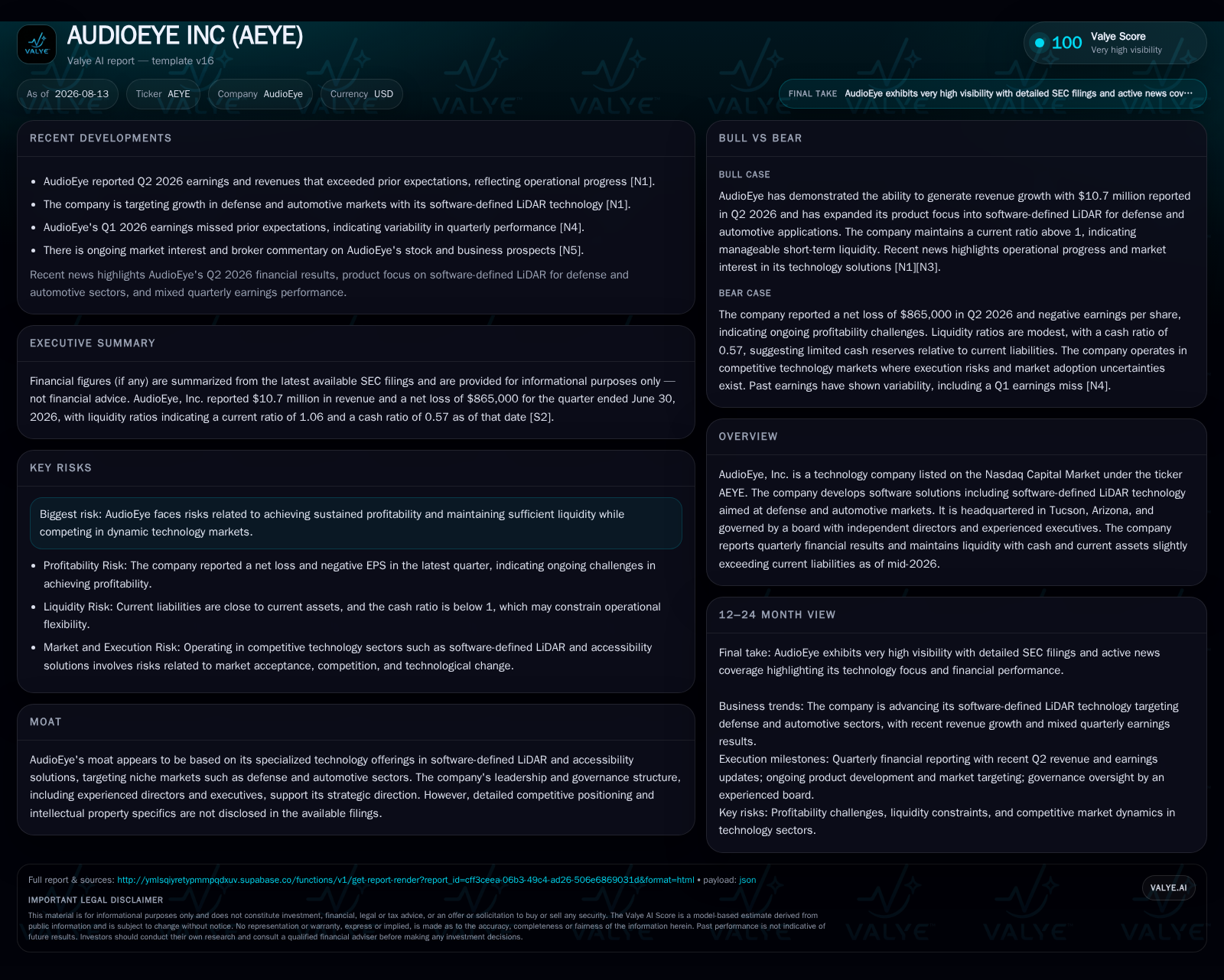
AudioEye, Inc. reported its Q2 2026 results emphasizing progress in its software-defined LiDAR technology targeting defense and automotive sectors alongside its established accessibility solutions business. The company continues to operate within niche segments requiring specialized software offerings and professional services, sustaining investment in R&D while facing typical SaaS profitability and liquidity pressures. Its Q2 performance beat revenue estimates with a current ratio slightly above 1.0, reflecting modest liquidity headroom. Key growth drivers include regulatory mandates for accessibility compliance and emerging demand for advanced sensing technologies, but sustaining cash flow and competitive positioning remain critical challenges.
Recent Operating Update
AudioEye's latest quarterly filing (Q2 ended June 30, 2026) reveals revenue results surpassing market consensus estimates, reflecting growing traction in both its established accessibility solutions platform and nascent software-defined LiDAR technologies targeting defense and automotive markets [S2][N1]. This dual-market approach underlines a strategic pivot to leverage proprietary LiDAR innovations while maintaining steady performance in digital accessibility compliance—two distinct but complementary revenue streams within the software industry verticals it serves.
The August 13, 2026 event filings confirm continued investment in R&D amidst persistent operating losses of approximately $1.8 million operating income shortfall year-to-date, indicative of a growth-phase SaaS company balancing innovation spend against scaling customer adoption [F1][S2]. Liquidity data from the same quarter shows total cash & equivalents at about $8.7 million versus current liabilities near $15.3 million; with a current ratio just over 1.0 (1.06), the company holds minimal buffer above immediate obligations, emphasizing the importance of operational cash flow improvement or financing options to sustain runway [F1].
Business Model
AudioEye operates primarily through subscription-based SaaS offerings supplemented by licensing fees and professional services tailored to the niche requirements of clients in regulated sectors like digital accessibility compliance for web platforms as well as advanced sensing solutions. The latter involves providing software-defined LiDAR technology which requires close collaboration with hardware integrators or OEMs to deliver end-to-end solutions suitable for real-time applications in automotive driver-assistance systems (ADAS) and defense-grade sensing.
Revenue depends on recurring subscription contracts for accessibility software that enforce regulatory standards such as ADA compliance, thus fostering high gross retention potential due to legal obligations compelling customer stickiness. Additionally, the LiDAR side likely generates a mix of upfront licensing fees plus ongoing service contracts supporting integration and maintenance—a common hybrid model in specialized tech software segments.
Customer acquisition processes are elongated given complex sales cycles typical of defense or automotive suppliers requiring certifications and proof-of-concept validations before scaled contract award. Accordingly, CAC is expected to be elevated with a protracted payback period compared to mainstream SaaS providers focused on volume enterprise licenses.
Industry Structure and Competitive Position
AudioEye inhabits an intersection between specialized software firms focusing on either accessibility technologies or advanced sensing through software-defined methods. Competitors range from pure-play LiDAR developers like portions of Velodyne Lidar's business focusing on sensor fusion software to niche SaaS companies catering to digital compliance requirements.
The company's competitive moat is derived from technical differentiation around its adaptable software-defined LiDAR platform—which offers potentially lower cost or higher flexibility than traditional hardware-centric sensor approaches—and the regulatory-driven stickiness of its accessibility suite.
Peers emphasize ARR growth rates and retention metrics as proxies for business health; however, specific AudioEye ARR figures remain undisclosed publicly, limiting direct peer comparative analysis. Nonetheless, sustaining competitive advantage demands accelerating product breadth expansion while reducing churn among regulated-sector customers who prioritize reliability and legal conformity.
Growth Drivers
Several macrotrends bode well for AudioEye's expansion prospects:
- Regulatory mandates globally intensifying enforcement around digital content accessibility fuel rising adoption of AudioEye’s core compliance solutions across diverse industries.
- Advances in automotive automation escalate demand for sophisticated sensing modalities; software-defined LiDAR innovation enables more agile deployment compared to rigid hardware incumbents.
- Defense sector initiatives promoting modernization create windows for tailored secure sensing applications leveraging AudioEye’s technology stack.
- Cloud computing proliferation facilitates scalable delivery of subscription models underlying recurring revenue growth.
- Strategic partnerships with OEMs and system integrators can catalyze market penetration beyond small-scale pilot projects toward broader commercial contracts.
Risks and Watchpoints
Key execution risks include managing steep R&D outlays while moving toward sustained profitability—a frequent challenge for growing technology firms where upfront innovation costs precede large-scale commercial returns [F1][S22].
Competitive pressure may intensify from larger technology firms entering LiDAR or accessibility markets with deeper resources or broader ecosystems; maintaining technological relevance requires continuous innovation cycles amidst fast-evolving standards.
Customer concentration risk exists due to targeted verticals; losing key contracts could materially impact revenues given limited diversification.
Regulatory uncertainties—for both defense-related export controls on sensing solutions or shifts in digital accessibility laws—carry potential compliance complexity impacting go-to-market speed.
Integration dependencies on hardware partners impose coordination risks potentially slowing time-to-market or creating margin pressure if unfavorable commercial terms arise.
What to Watch Next
Investors should monitor quarterly disclosures for:
- Progression in ARR growth rates reflecting subscription base expansion amid competitive SaaS benchmarks.
- Commentary on sales cycle dynamics signaling improvement in lead conversion velocity within defense/automotive channels.
- Margin trajectory improvements demonstrating better absorption of fixed R&D/sales expenses as scale increases.
- Updates on strategic partnerships or contract awards validating technology adoption outside early pilots.
- Cash flow trends together with any financing activity that may influence liquidity runway beyond mid-term horizons.
- Management discussion around executing product roadmap milestones related to LiDAR module deployment or feature maturation supporting broader market applicability.
Financial Profile Discussion
As of Q2 ended June 30, 2026, AudioEye held $8.7 million in cash against $16.8 million total debt levels evidencing moderate leverage given current assets near $16.3 million versus liabilities at about $15.3 million [F1]. The company’s current ratio of approximately 1.06 reflects a minimal short-term liquidity cushion, underscoring the importance of operational cash flow improvement or financing options to sustain runway [F1].
While the absence of disclosed ARR or detailed segment financials limits deeper margin analysis, careful management of operating expense ratios relative to top-line growth will be essential for progressing towards positive EBITDA ranges typical among healthy SaaS peers.
Liquidity management will also be critical given the negative free cash flow profile evident from interim data; evidence of improving cash conversion rates accompanied by possible refinancing options could extend operational runway into pivotal commercialization phases.
Conclusion
AudioEye finds itself evolving within specialized technology niches combining regulatory-driven SaaS offerings with innovative software-defined LiDAR development aimed at fast-growing defense and automotive markets. Recent quarterly beats underscore early success embracing these distinct revenue engines but highlight classic challenges—primarily persistent losses fueled by growth investments alongside tight liquidity metrics signaling operational sensitivity.
Success depends on execution across extending subscription footprint with adherence to strict digital compliance standards while simultaneously proving scalable commercial viability for its cutting-edge sensing products requiring hardware ecosystem integration—a dual-front demanding both technological excellence and measured capital stewardship.
Industry context points toward favorable long-term secular demand supported by regulatory imperatives and automotive automation trends but underscores competitive intensity wherein product innovation pace, go-to-market efficacy, and sound financial discipline define sustainability thresholds going forward.
Disclaimer: This analysis is based solely on publicly available SEC filings as of August 2026 combined with industry context; it does not constitute investment advice or research views.
Disclaimer: This is research-only, informational analysis and not investment advice. It may include AI-generated interpretation and general industry context. Always verify important details using primary sources.

Comments