
Intuitive Machines Advances Lunar Infrastructure with Integrated Build-Connect-Operate Model Amid UK Expansion
Strong backlog growth and strategic acquisitions position Intuitive Machines to capitalize on emerging lunar and cislunar space infrastructure demand, despite ongoing integration and financial challenges.
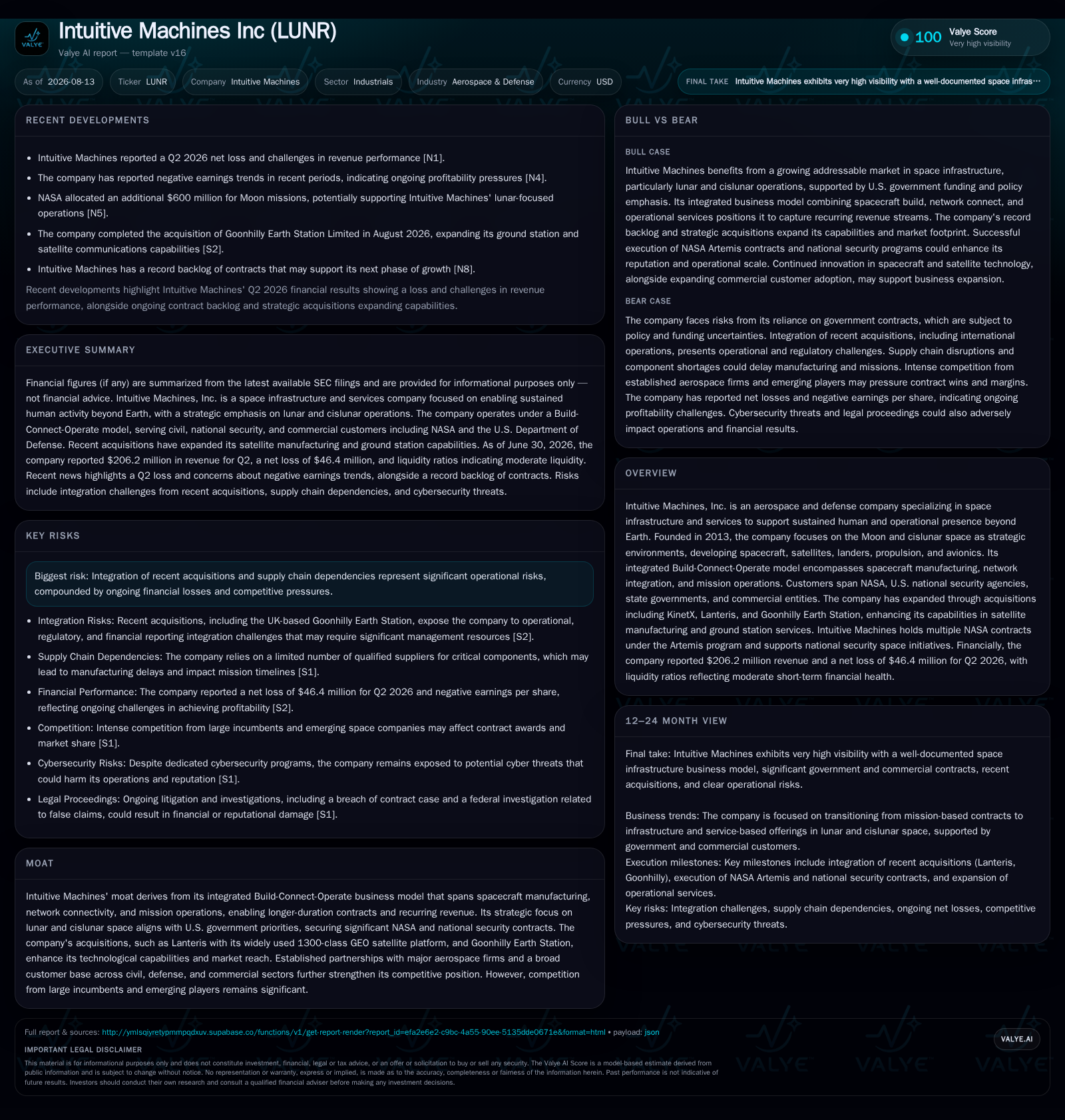
Intuitive Machines (LUNR) reported an expanding contract backlog of $1.8 billion at Q2 2026, supported by multiple NASA Artemis program awards and national security contracts. The company's Build-Connect-Operate business model integrates spacecraft manufacturing, network services, and long-term mission operations to transition the space economy toward persistent infrastructure. Recent acquisitions, including UK-based Goonhilly Earth Station, broaden capabilities but present integration risks. While revenue momentum continues, the company posted losses reflecting heavy R&D and acquisition costs. Monitoring contract execution milestones and operational scaling will be key to validating growth durability.
Recent Operating Update
Intuitive Machines reported a significant expansion in its contract backlog to $1.8 billion as of June 30, 2026 — a notable increase reflecting sustained momentum in lunar and cislunar demand from government and commercial sources [S16]. This follows a series of award wins under NASA’s Artemis program, including cargo delivery missions as part of NASA’s Commercial Lunar Payload Services (CLPS) initiative where Intuitive Machines maintains four lunar surface delivery contracts [S23]. The company also secured growth from national security clients such as the Space Development Agency (SDA), supplying satellite buses for missile tracking constellations in low Earth orbit [S23].
Operationally, the period was marked by completing the acquisition of UK-based Goonhilly Earth Station Limited in August 2026, adding critical ground station infrastructure assets that extend Intuitive Machines’ network integration capabilities beyond spacecraft manufacturing into terrestrial connectivity solutions—a vital layer in end-to-end space communications [S2]. This step broadens the addressable market but introduces additional complexity related to international regulatory compliance and cross-border operational integration risks [S24].
Despite the growing backlog and expanding portfolio, the company reported losses for calendar year-end 2025 with net income at -$83 million on revenues around $210 million as of December 31, 2025. The financial results reflect heavy investment in R&D developments for advanced landers and propulsion technologies, combined with costs associated with recent acquisitions [F1], underscoring that Intuitive Machines remains in an investment-heavy scale-up phase.
Business Model Analysis
Intuitive Machines operates an integrated Build-Connect-Operate model tailored for sustained presence beyond Earth—especially focused on lunar and cislunar environments where U.S. policy prioritizes exploration and national security initiatives [S1]. The "Build" component encompasses engineering and manufacturing spacecraft including landers tailored for lunar cargo delivery, satellites (both GEO communication platforms via its Lanteris unit and smaller tactical satellites), propulsion systems optimized for efficiency gains such as advanced pump-fed engines, avionics suites for precise navigation, and surface mobility systems [S19].
The "Connect" segment integrates deployed assets into comprehensive communications and navigation networks utilizing satellite constellations coupled with terrestrial ground stations like those acquired from Goonhilly [S21]. This ensures persistent connectivity—linking lunar surface operations with Earth-based command centers—and provides layers of data relay which are foundational for continuous mission support rather than episodic spot missions
Finally, "Operate" involves mission operations services including hosted payload management, real-time navigation and timing services critical to both civil exploration (Artemis Gateway support) and defense applications (persistent ISR networks). This infrastructure-as-a-service approach aims to transition Intuitive Machines’ revenue streams from one-off milestone recognitions tied to delivery toward longer-duration contracts with recurring servicing fees—potentially improving revenue visibility and margins over time [S1]
Revenue generation thus combines hardware sales (spacecraft manufacturing contracts) typically awarded by government agencies like NASA or DoD entities with recurring service revenues linked to operating satellites or ground stations over multi-year periods [S21]. Contract structures vary between fixed-price milestone commissions commonly seen in civil contracts to indefinite delivery/indefinite quantity (IDIQ) arrangements prevalent in defense sectors that allow flexible task orders based on evolving needs
Industry Structure and Competitive Position
The aerospace & defense space infrastructure sector is evolving from episodic mission-driven contracts toward persistent operational infrastructure models—a shift driven by increasing government emphasis on sustained lunar presence coupled with emerging commercial business models around space-based data services. Competitors span established aerospace giants such as Lockheed Martin, Northrop Grumman—each offering extensive space system integration capabilities—and next-generation entrants like Astrobotic focusing on moon landers or Rocket Lab concentrating on launch plus satellite constellation services [S20]
Intuitive Machines distinguishes itself through its full-stack approach: it not only builds spacecraft but also operates associated network infrastructure (communications relays) while managing mission operations. This breadth helps secure longer-term contracts integrating multiple value-chain segments rather than bidding solely on discrete deliverables. Their acquisitions—Lanteris consolidating satellite bus expertise with a dominant GEO platform footprint (>95 satellites operational worldwide), KinetX providing space navigation support legacy, and now Goonhilly enhancing ground segment reach—collectively augment its competitive moats around technological breadth and diversified customer base spanning civil NASA missions, U.S. national security programs (e.g., SDA), international customers, state governments investing in local space economies, and commercial payload providers seeking lunar delivery or hosting payload services [S1; S26; S28].
However, challenges persist: supply chain constraints for precision components continue industry-wide delays; certification requirements driven by cybersecurity standards enforced by government clients impose operational overhead; multi-year contract cycles can delay revenue recognition; plus ongoing legal proceedings related to prior subcontractor claims add some uncertainty [S4; S8].
Growth Drivers
The primary growth driver is surging U.S. government investment in lunar surface infrastructure and cislunar communications aligned with Artemis priorities. Upcoming Artemis missions necessitate reliable cargo delivery landers capable of “survive the night” power solutions—a focus area receiving intensified R&D funding by Intuitive Machines targeted at larger lander designs enabling broader customer adoption [S1; S19].
In parallel, national security programs accelerating deployments of proliferated optical tracking smallsats fuel demand for satellite bus production capacity. Intuitive Machines’ continuing wins within SDA’s Tranche 2 Tracking Layer program demonstrate growing defense relevance attached to real-time missile threat detection capabilities leveraged through infrared sensing constellations built on Lanteris platforms acquired before 2026 [S23; S26].
On the commercial front, increasing appetites for satellite broadband data throughput via high-throughput satellites using the classic Lanteris 1300 bus sustain manufactured spacecraft volumes while hosted payload operations atop operated constellations provide recurring revenue uplift opportunities within emerging infrastructure-as-a-service frameworks [S26; S28].
Expanding geographic reach through Goonhilly opens potential international ground network service offerings that have traditionally been fragmented among regional players—this extension into terrestrial connectivity completes synergy between deployed space assets & ground control networks needed for fully integrated mission ecosystems [S2; S9].
Furthermore, state governments sponsoring local economic initiatives adopt commercial space technologies as catalysts—facilitating partnerships enhancing Intuitive Machines’ R&D scope across Texas, California, Arizona etc.—helping embed company offerings across multiple ecosystem layers outside purely federal domains [S26].
Risks & Watchpoints
Integration remains a paramount risk driver: assimilating Goonhilly’s operations alongside established subsidiaries KinetX & Lanteris requires harmonizing internal controls / reporting processes which could strain management bandwidth impacting timely financial disclosures or operational execution if not expertly managed [S2; S24]. Regulatory burdens related to UK market laws including export controls introduce compliance complexity potentially affecting cash repatriation or licensing arrangements.
Operationally supply chain vulnerabilities persist as specialized propulsion system components face availability risks possibly leading to timeline slippages or cost escalations given highly engineered tolerances demanded by lander engines or avionics boards under development phases currently prioritized according to latest filings [S1; S19].
Financially, the company operates at persistent net losses during this capital-light growth period. As of June 30, 2026, Intuitive Machines held approximately $367 million in cash and equivalents with no reported outstanding debt obligations recorded through December 31, 2024, supporting ongoing capital expenditures associated with R&D initiatives and acquisition integrations [F1]
What To Watch Next
Critical near-term milestones include successful completion of upcoming CLPS lunar missions that validate platform reliability crucial for securing follow-on Artemis cargo delivery extensions—the first several missions are proof points that confirm design maturity affecting order inflow speed.
Progress integrating Goonhilly within corporate IT systems while maintaining service uptime will indicate management’s ability to realize acquisition synergies without operational disruption 1 significant given ground station network reliability is fundamental for uninterrupted cislunar communication services.
Monitoring incremental increases in recurring mission operations revenue portion—particularly from hosted payloads or navigation/time services contract renewals—will reveal traction toward transforming milestone-driven hardware sales into durable annuity streams.
Acquisition-related legal proceedings closure timelines especially around Lanteris-related False Claims Act investigations underway with DOJ also present material event risk horizons influencing investor sentiment.
Continued incremental contract awards from emerging national security efforts buttressing IDIQ pipelines should track expanding footprint especially if further Tranche orders confirm scaling capability.
Financial Profile Discussion
As of June 30, 2026, Intuitive Machines held approximately $367 million in cash and equivalents backed by current assets totaling nearly $663 million against current liabilities close to $400 million yielding a comfortable current ratio of 1.66 indicative of sound near-term liquidity positioning without any reported outstanding debt obligations recorded through December 31, 2024 per available data sets emphasizing a clean balance sheet foundation supporting ongoing capital expenditures associated with R&D initiatives along with acquisition integrations [F1]
Revenues stood at approximately $210 million as of December 31, 2025 but operating loss totaled around $87 million representing significant spend ahead of future scalable returns typical during commercialization ramp phases across aerospace startups transitioning into recurring service revenue models [F1]. Cash burn intensity reflects foundational investments needed to advance core spacecraft platform technologies like the ‘survive the night’ power systems plus augmented lander designs that enable access expansion across diverse customer segments including new commercial payload-hosting markets.
Effective working capital management paired with favorable contract renewals will be pivotal walking this scaling path seamlessly bridging development-heavy loss periods towards positive adjusted EBITDA metrics increasingly demonstrated already in early quarters according to earlier public disclosures.
This analysis uses only publicly available SEC filings combined with general aerospace industry context without forward-looking projections or investment research views.
Disclaimer: This is research-only, informational analysis and not investment advice. It may include AI-generated interpretation and general industry context. Always verify important details using primary sources.

Comments