
Sparta Commercial Services Battles Capital and Structural Challenges Amid Niche FinTech and Financial Services Expansion
Sparta operates diversified subsidiaries in FinTech, municipal financing, niche e-commerce, and health supplements, yet financial strains cloud near-term execution.
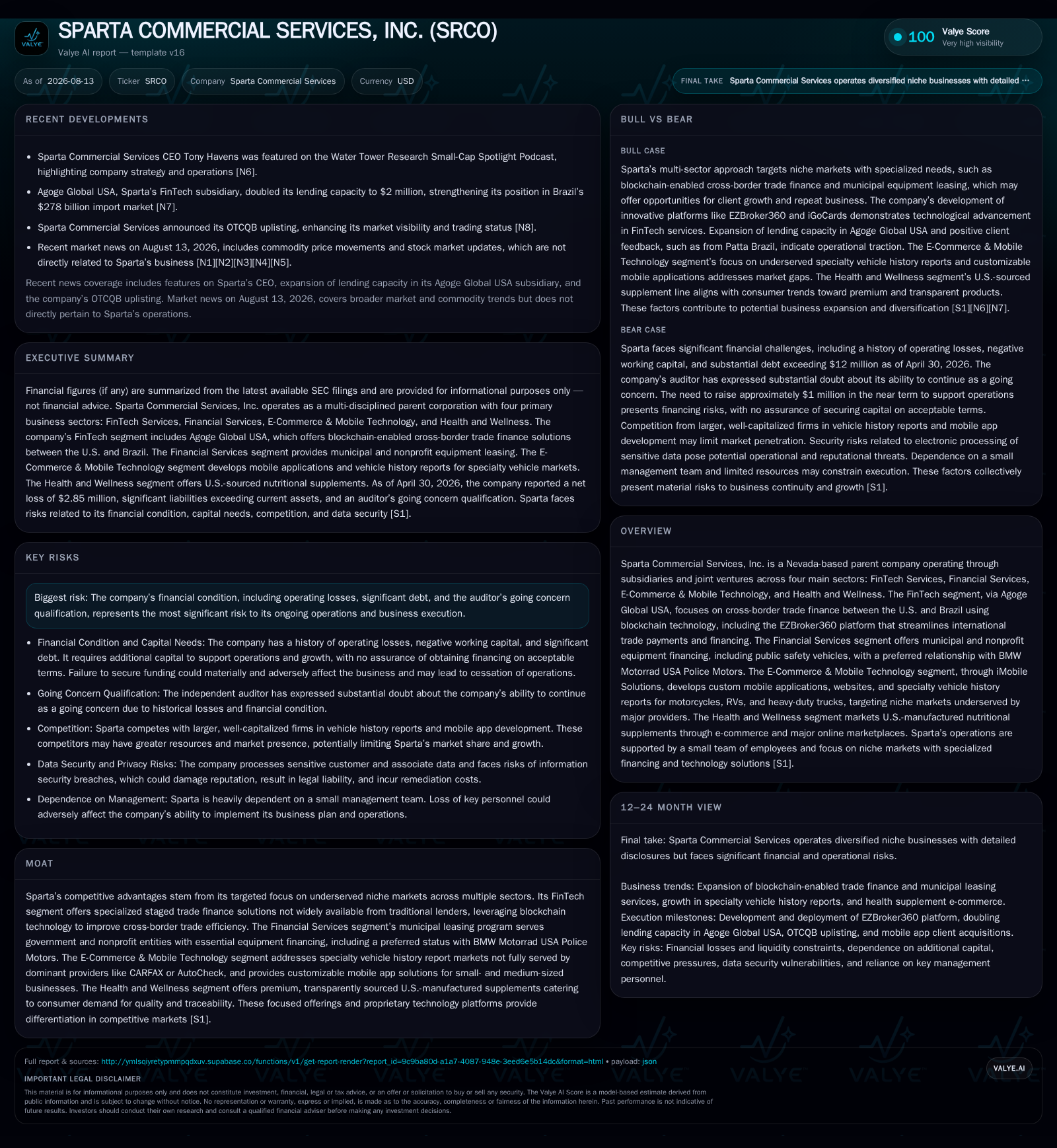
Sparta Commercial Services, Inc. continues to develop specialized offerings across four distinct sectors—FinTech cross-border trade finance, municipal equipment leasing, customizable mobile technology, and direct-to-consumer health supplements. Recent disclosures highlight ongoing operational expansion through innovative blockchain-enabled platforms and niche vehicle data products. However, Sparta faces critical financial headwinds including substantial operating losses, significant debt burden with a current ratio near 0.01, and an auditor's going concern warning. The company’s growth depends heavily on successful capital raises and execution in underserved markets where it leverages proprietary technology and preferred vendor status. Monitoring liquidity improvements, debt restructuring efforts, loan deployment scaling, and customer adoption rates will be key to assessing sustainability.
Recent Operating Update
Agoge has deployed $2 million in staged loans primarily addressing freightage costs, customs duties, taxes, import/export documentation facilitation, and market entry support for clients such as Patta Brazil. The latter has credited Sparta’s financing solutions for enabling scalable operations including a projected 50% increase in revenue alongside new hiring efforts [S1]. Additionally, Agoge is advancing its iGoCards virtual expense management platform to integrate payables-receivables capabilities with multi-user controls aimed at globally oriented businesses.
Meanwhile, Sparta’s municipal financing program remains operational with a target on municipalities and nonprofit organizations requiring essential public safety vehicles including police motorcycles—a segment bolstered by its preferred status with BMW Motorrad USA Police Motors [S17]. The company markets these financing products through direct outreach channels including trade shows and industry publications.
In parallel, Sparta’s E-Commerce & Mobile Technology segment under iMobile Solutions delivers subscription-based mobile applications customized for SMBs across diverse verticals such as vehicle dealerships and entertainment venues. It also offers distinct specialty vehicle history reports branded Cyclechex (motorcycles), RVchex (recreational vehicles), and Truckchex (heavy-duty trucks), targeting niches not fully addressed by large incumbents like CARFAX or AutoCheck [S19][S21].
Lastly, the Health & Wellness subsidiary New World Health Brands launched premium U.S.-sourced supplements during the COVID-19 pandemic that are sold on e-commerce marketplaces such as Amazon and Walmart. The product line includes vitamins with transparent sourcing catering to consumer demand for quality wellness products [S6].
Business Model Nuances
Sparta operates as a diversified holding company that monetizes through several revenue streams tailored to underserved niches rather than mass markets. Its FinTech segment generates income from staged loan origination fees and interest linked to cross-border trade transactions that conventional lenders often avoid due to complexity or risk profiles. The blockchain platform reduces traditional frictions in global payments while enabling compliance support specifically for U.S.-Brazil commercial corridors. Crucial KPIs here include loan deployment volume—$2 million so far—and repeat client engagement signaled by Patta Brazil’s referrals.
In municipal equipment financing—a high-touch domain typified by lower volume but higher service customization—the company benefits from longstanding relationships with government agencies requiring reliable funding for public safety assets. Revenue arises mainly through pass-through interest spreads funded by partner banks alongside administrative fees.
The E-Commerce and Mobile Technology division operates primarily on subscription fees for app development/maintenance services combined with one-time purchases of specialty vehicle history reports which rely heavily on access to authoritative data sources like NMVTIS (National Motor Vehicle Title Information System). Client retention hinges on delivering highly customizable digital products tailored to specific industry verticals deprived of dominant competitor focus.
The Health & Wellness unit employs direct-to-consumer e-commerce sales channels utilizing marketplaces plus proprietary distribution networks emphasizing product quality transparency—a critical differentiation factor in premium supplement branding amid consumer skepticism.
This multi-channel revenue approach requires coordinated operational oversight due to disparate industry-specific regulatory hurdles: fintech operations contend with fast-evolving crypto regulations; municipal financing demands strict underwriting compliance; vehicle data services must maintain data integrity; supplement sales abide by FDA standards.
Industry Structure and Competitive Positioning
Sparta sits at an intersection of fragmented industries where dominant players cater mostly to large-scale clients or generalized services. In FinTech trade finance, many competitors like Greensill or Taulia specialize in supply chain finance but do not focus narrowly on complex cross-border corridors involving emerging markets coupled with blockchain innovation. Sparta’s relative advantage stems from combining technology-driven payment acceleration with tailored lending solutions to bridge overlooked transactional gaps.
Within municipal equipment financing its peer set features companies like Marlin Business Services; however Sparta's emphasis on niche public safety vehicles backed by exclusive vendor ties offers some moat against commoditized lending products.
Similarly, the triple-branded specialty vehicle report services operate in a semi-niche space compared against behemoths CARFAX or AutoCheck which largely dominate passenger car histories but lack tailored data for motorcycles or RVs at scale.
Mobile app development targets SMEs underserved by broad software firms by providing turnkey customizable tech solutions incorporating advanced features like geo-fencing or CRM integration under subscription pricing models enhancing customer stickiness.
In health supplements, while Nature’s Bounty or Ritual hold scale advantages, Sparta prioritizes premium sourcing transparency responding to evolving consumer preferences beyond price competition alone.
Growth Drivers
Key expansion catalysts include growing demand for efficient cross-border payment methods amid increasing international trade volumes especially involving emerging markets where traditional banks remain hesitant due to currency volatility or regulatory burdens. Blockchain-enabled platforms like EZBroker360 address this pain point by cutting costs and transaction times which can trigger accelerated client acquisition if execution sustains.
Municipal sector growth benefits from steady public safety investment cycles combined with budgetary pressures prompting leasing over outright purchases—favoring specialists able to customize financing terms per jurisdiction policies.
Expansion opportunities also lie within accelerating adoption curves for mobile technologies among SMEs looking for affordable yet robust digital marketing tools suited for variable local market demands.
On consumer health supplements the surge in direct e-commerce sales coupled with increased premiumization trends provide tailwinds assuming efficient inventory turnover management underpinned by transparent branding strategies.
Repeat client referrals within finance segments serve as organic growth levers signaling service satisfaction essential for scaling loan portfolios profitably without disproportionate customer acquisition expense increases.
Risks / Watchpoints / Constraints
Dominating concerns revolve around Sparta’s fragile financial footing evident from persistent operating losses culminating in a cumulative deficit north of $71 million plus negative working capital approximately -$11.5 million reflecting severe liquidity distress [F1][S3]. Such leverage amplifies dependency on timely capital raises which may dilute existing shareholders given current multiple convertible securities outstanding potentially adding up to 42 million shares subject to price fluctuations [S3][S8].
Auditors explicitly question going concern viability spotlighting funding uncertainty alongside negligible operating cash flows underscoring execution risk even if markets favor the company’s niche offerings [S3]. Failure to restructure debt or secure new credit lines would translate into operational curtailments jeopardizing all business segments.
Furthermore regulatory landscape complexity spanning fintech crypto-asset compliance regimes through municipal finance statutes to FDA supplement regulations mandates costly adherence investments exposing Sparta to enforcement risks including fines reputational damages or license revocations should controls falter [S5][S13][S26].
Competitive pressures manifest through larger well-funded incumbents capable of undercutting prices aggressively while benefiting from economies of scale particularly evident in vehicle report aggregators or commercial fintech lenders constraining Sparta's market penetration pace [S7].
Capital-raising announcements coupled with updates on any debt restructuring arrangements will provide early signals whether liquidity constraints ease sufficiently to allow uninterrupted business scaling absent drastic cost-cutting measures [S3]
Growth metrics across mobile app subscriber counts along with sales volume trends from the Specialty Vehicle History Reports channel will quantify penetration success within fragmented small/medium business verticals opening further cross-sell pathways.
Within Health & Wellness division tracking inventory turnover rates allied to marketplace sales velocity will elucidate whether premium sourcing fetches adequate margins against competitive pricing norms amidst fluctuating raw material costs.
Finally any regulatory audit outcomes or new compliance requirements imposed across fintech or supplement operations could materially reshape operating cost structures entailing keen attention given the increased scrutiny addressed in risk disclosures [S5][S24].
Financial Profile Discussion
Sparta Commercial Services’ financial position underscores substantial near-term operational risks rooted in cash flow insufficiency amid high leverage [F1]. As of April 30, 2026, the company reported cash & equivalents totaling approximately $118K against total current liabilities exceeding $11.7 million, yielding a current ratio near 0.01—an indicator of extreme liquidity constraints where short-term obligations significantly exceed readily available assets [F1].
Total liabilities near $12.46 million reflect ongoing debts despite minimal revenue generation ($601K top line), corroborating continued net losses (-$2.85 million net loss most recently) compounding an accumulated deficit exceeding $71 million since inception, highlighting chronic unprofitability [F1]
Debt levels remain elevated at approximately $8.39 million total debt as of July 31, 2025, translating into constrained financial flexibility absent successful refinancing or equity capital inflows, which may be dilutive given convertible instruments previously issued impacting shareholder value [F1][S3][S8]
The auditor’s explicit doubt about going concern amplifies emphasis on the strategic necessity for aggressive capital raising campaigns alongside potential asset disposals or partnership concessions if internal cash generation does not materialize soon enough, posing existential threats otherwise [S3]
Interim improvements would be measurable through increased cash balances relative to maturing liabilities plus upward trajectory visible in segment-level revenue lifts particularly in FinTech loan deployments—signaling firmer footing before sustainable profitability becomes achievable.
This analysis is based exclusively on publicly available filings dated up to August 13, 2026. It reflects observed facts without offering investment advice or price guidance.
Disclaimer: This is research-only, informational analysis and not investment advice. It may include AI-generated interpretation and general industry context. Always verify important details using primary sources.

Comments