
American Shared Hospital Services Faces Contract and Liquidity Challenges While Managing Capital-Intensive Radiation Equipment Leasing
AMS reports mixed procedure volumes amid contract expirations and ongoing liquidity stress linked to its debt obligations.
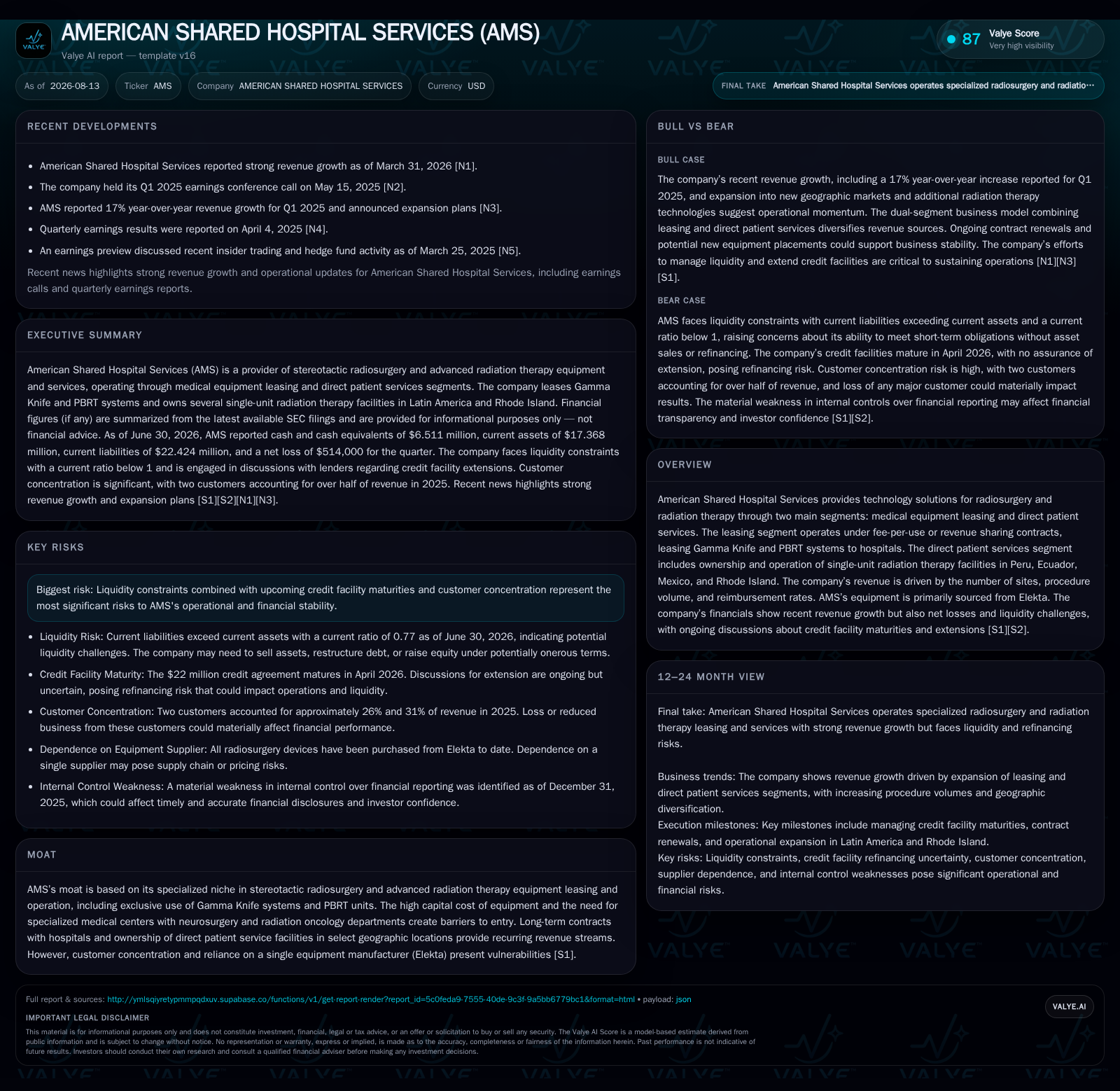
American Shared Hospital Services (AMS) operates a niche dual-segment business model leasing advanced radiosurgery equipment and running direct patient treatment facilities. The company’s recent quarterly update highlights a decline in Gamma Knife and Proton Beam Radiation Therapy procedure volumes primarily due to equipment lease contract expirations and cyclical fluctuations, partially offset by growth in LINAC procedures from acquisitions. Financially, AMS contends with significant liquidity constraints due to multiple covenant breaches under its credit agreements, raising substantial going concern doubts. The capital intensity of its business, customer concentration, and reliance on key suppliers present ongoing risks as AMS negotiates potential debt refinancing and contract renewals.
Recent Operating Update
American Shared Hospital Services (AMS) reported in its Q2 2026 filing that the Proton Beam Radiation Therapy (PBRT) operations represented the majority of revenue and net income within the leasing segment during the quarter ending June 30, 2026 [S2]. However, this was tempered by continued procedural volume challenges stemming from lease contract activity. AMS’s medical equipment leasing footprint contracted from 10 Gamma Knife units at the end of 2024 to seven units as of December 31, 2025, reflecting multiple contract expirations—including three notable terminations around late 2024 through mid-2025—and at least one additional lease expected to expire mid-2026 [S1]. The erosion of leased Gamma Knife units pressures revenue visibility critically tied to fee-per-use and revenue sharing agreements.
Conversely, direct patient services reported favorable trends boosted by acquisitions completed in May 2024 adding LINAC-based radiation therapy facilities in Rhode Island [S1][S2]. This segment includes two Gamma Knife centers in Peru and Ecuador and several LINAC facilities across Mexico and Rhode Island. Notably, LINAC procedure volume nearly doubled year-over-year to over 28,000 treatments in 2025 as the acquired sites ramped patient throughput, underpinning revenue growth within direct patient services despite continuing competitive pressures
Business Model Analysis
AMS generates revenue via two intertwined segments: medical equipment leasing focused primarily on specialized radiosurgery systems (notably Gamma Knife units) and direct patient radiation therapy services operating treatment centers internationally. The leasing model usually relies on fee-per-use or revenue sharing contracts with hospitals possessing neurosurgery or oncology departments equipped to leverage such capital-intensive stereotactic radiosurgery gear [S1]. These arrangements generate recurring but volume-sensitive cash flow indexed closely to procedure counts reimbursed either by insurance or government payors.
The direct patient services segment involves AMS owning and operating standalone radiation therapy facilities that bill patients or their insurers directly for treatments administered using LINAC or Gamma Knife technologies. This model offers higher operational complexity but captures value along more of the care delivery continuum.
AMS sources all major equipment—Gamma Knife and PBRT—from Elekta exclusively, consolidating supplier dependency risks but benefiting from Elekta’s leading-edge devices like the Esprit upgrade which expands treatable diagnoses thereby enabling procedure volume growth at existing sites after upgrades [S1]. Given the sizable upfront capital outlay for these systems—running into multi-million-dollar investments—the company finances purchases through structured credit agreements secured by its assets.
Revenue-driving KPIs prominently include number of leased units under active contract, total procedure volume per site (sometimes fluctuating based on local demand or reimbursement changes), revenue per procedure influenced by payor mix shifts, plus contract renewal success critical for equipment utilization continuity.
Industry Structure and Competitive Position
The healthcare equipment leasing sector for advanced radiosurgery represents a highly specialized niche characterized by elevated barriers to entry—not only from equipment costs but also from regulatory approvals required for delivery centers capable of complex cancer treatments. Competitors generally fall into categories like hospital-owned treatment providers who purchase rather than lease equipment or diversified healthcare financing companies offering similar rental models.
Within this context, AMS’s moat derives from exclusive rights to operate certain Gamma Knife units in select geographies combined with their ownership stakes in foreign treatment centers that act as growth levers via direct billing models [S1]. Such geographic diversification into Latin America adds exposure differential versus purely U.S.-based peers but introduces currency risk and operational challenges.
However, competitive risks include potential technology substitution (alternative radiation modalities), supplier dependency on Elekta limiting bargaining power on pricing or upgrades, customer concentration with a handful of hospital partners responsible for most leasing revenues—which complicates long-term pipeline predictability—and pronounced leveraged balance sheet constraints restricting strategic flexibility.
Growth Drivers
Structural drivers supporting AMS’s long-term growth prospects align with broader oncology trends: increasing incidence of cancers amenable to stereotactic radiosurgery; aging demographics fueling greater demand for non-invasive targeted therapies; technology advances expanding treatable disease indications especially through upgrades like Elekta’s Esprit system; geographic market penetration notably through acquisitions adding LINAC capabilities; and gradual improvements in reimbursement policies enhancing per-procedure revenue.
These dynamics were evidenced during 2025 when same-center Gamma Knife procedures grew by around 11%, underscoring successful upstream product enhancements enabling new diagnostic applications despite net unit reductions due to lease terminations [S1]. Similarly large lifts in LINAC procedure volumes post-Rhode Island acquisition highlight scalable patient treatment growth potentials in direct service operations. Continued investments in capital expenditures aimed at upgrading domestic Gamma Knife assets further aim at capturing rising demand once contractual renewal hurdles are overcome [S16].
Risks and Constraints
Liquidity concerns dominate AMS’s near-term risk profile with repeated covenant breaches under its $22 million credit facility culminating in an event of default notice received December 10, 2025 that persists through mid-2026 filings [S2][S6]. Key breached covenants include minimum cash balances set at $5 million—a threshold unmet as company cash hovered near $6.5 million against over $16 million debt as of June 30—maximum funded debt-to-EBITDA ratio ceilings repeatedly violated amid shrinking earnings capacity, plus fixed-charge coverage ratio shortfalls signaling deteriorated operating cash flow cushions [F1][S2][S6][S16]. The combined effect has been suspension of revolving loan availability by Fifth Third Bank alongside incremental default interest rates accruing on borrowings exacerbating financial strain.
Moreover, contract expirations affect recurrent leasing income visibility given the loss recently suffered across multiple Gamma Knife leases that are unlikely to be immediately replenished absent renewals or new deals with alternate customers [S1]. Customer concentration remains intense—with two large customers representing over half total revenues in some years—meaning loss or renegotiation risks loom large regarding top accounts’ continued engagement [S10]. Supplier dependence on Elekta further constrains negotiating leverage for upgrades or pricing.
Lastly international operations expose AMS to operational complexities including geopolitical risk factors implicit in Latin American markets alongside currency volatility impacting translated earnings from treatment centers abroad.
What To Watch Next
Key milestones include:
- Outcome of ongoing discussions with Fifth Third Bank regarding extension or amendment of Credit Agreement maturity terms beyond April 9, 2026; failure here could trigger acceleration events threatening liquidity severely [S6][S16].
- Contract renewal developments related to expiring Gamma Knife leases slated throughout 2026 impacting medium-term revenue stability.
- Procedure volume trajectories at upgraded centers leveraging Elekta’s Esprit platform indicating realized monetization from technology investments.
- Progress integrating acquired LINAC facilities commercially realized through sustained growth in direct services revenues as shown by recent gains [S2][S15].
- Negotiations addressing breach waivers or amendments under DFC Loan which carries cross-default implications given overlapping covenants with principal credit facility.
- Capital expenditure decisions balancing equipment upgrades against tightening liquidity constraints influencing asset downtime risk profiles.
Regular monitoring of these operating metrics combined with liquidity ratio movement will inform AMS’s ability to sustain its unique dual-segment model reliant on recurrent capital investment backed by stable hospital partnerships.
Financial Profile Discussion
As of June 30, 2026, AMS held approximately $6.51 million in cash equivalents against total debt nearing $16.29 million producing a net debt position around $9.78 million indicative of notable leverage pressures [F1]. Current assets totaled about $17.37 million while current liabilities stood at $22.42 million resulting in a sub-unity current ratio of approximately 0.77 underscoring short-term solvency challenges facing working capital management requirements [F1].
Historical financial covenant breaches under Fifth Third’s Credit Agreement reflect ongoing struggles meeting minimum fixed charge coverage ratio (required ≥1.25), maximum funded debt-to-EBITDA ratio cap (≤3x), plus mandatory minimum unrestricted domestic cash balances ($5 million floor) which manifest in events of default occurrences starting September 30, 2025 continuing through mid-2026 filings without cure evidenced yet [S2][S6][S16]. The Credit Agreement originally secured these borrowings via liens over substantially all Company assets including those owned by domestic subsidiaries; failure to achieve amendments risks forced acceleration potentially jeopardizing going concern assumptions acknowledged explicitly by management given uncertainties around refinancing success amid tight capital markets for highly leveraged healthcare companies like AMS [S14][S20]. Debt amortization schedules feature second supplemental term loans maturing towards late decade horizon (December 18, 2029) but interim principal obligations pressure near-term liquidity given suspended revolver access since late calendar year owing to defaults escalating interest cost burdens further eroding free cash flow cushions [S16][F1].
Disclaimer: This is research-only, informational analysis and not investment advice. It may include AI-generated interpretation and general industry context. Always verify important details using primary sources.

Comments