
Lifeward Ltd. Advances Rehabilitation Device Adoption Amid Financial Challenges
Strong Q2 2026 revenue growth highlights Lifeward’s commercial traction despite ongoing profitability and liquidity pressures.
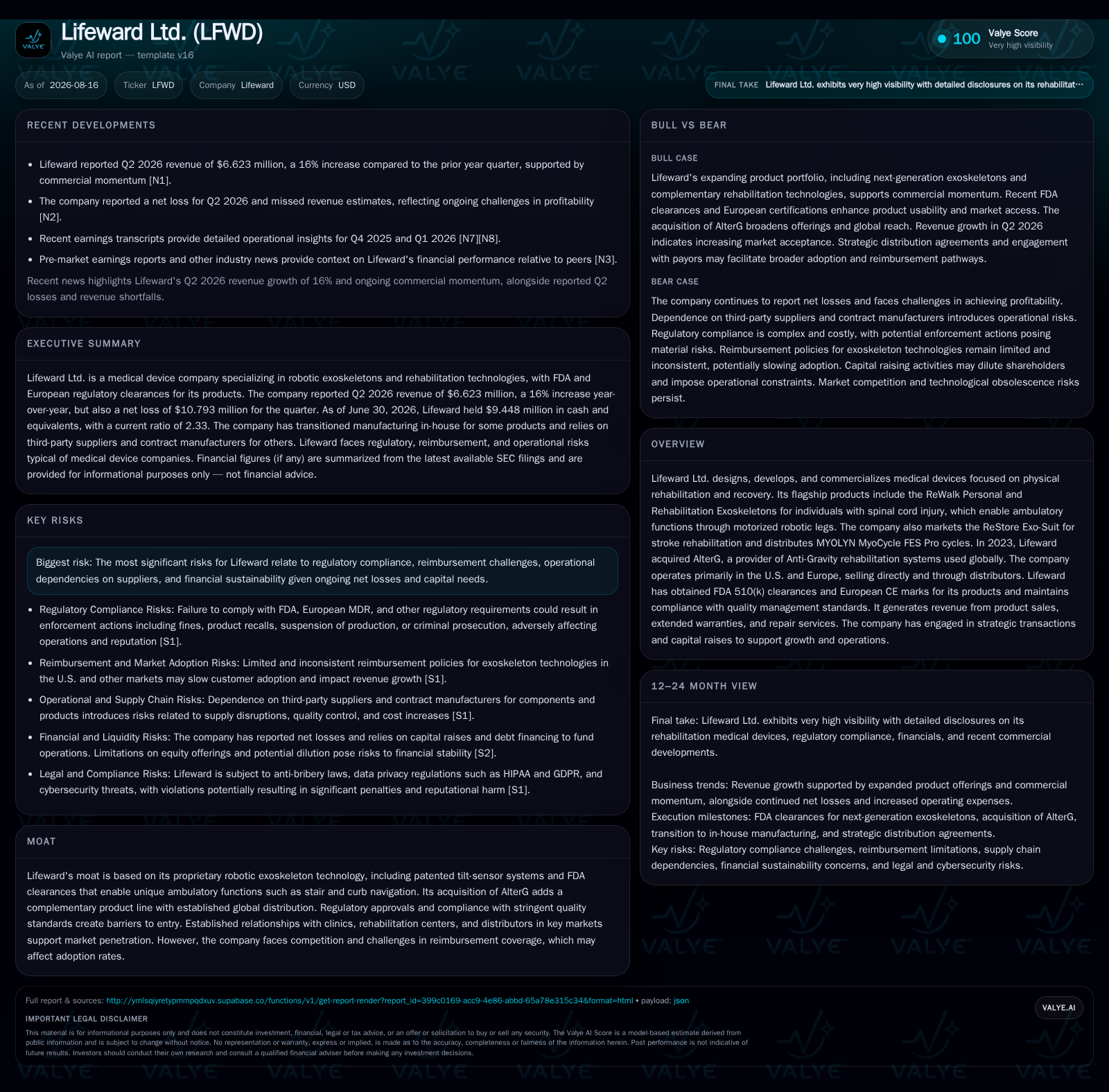
Lifeward Ltd. reported a 16% revenue increase in Q2 2026, driven by expanded sales of its ReWalk Personal exoskeleton and Anti-Gravity rehabilitation systems acquired through AlterG. The company benefits from substantive regulatory clearances including FDA 510(k) and CE marks supporting market access in the U.S. and Europe. Lifeward's moat is anchored in proprietary robotic exoskeleton technology and established distribution partnerships targeting rehabilitation clinics and home users. However, the firm continues to operate at a net loss with substantial accumulated deficits, facing ongoing capital needs amid reimbursement uncertainties that pose adoption risks. A recently closed financing bolstered cash reserves to approximately $11 million, extending runway to scale commercialization efforts while integrating recent acquisitions and advancing a broadening product pipeline.
Recent Operating Update
xpanding penetration across key rehabilitation clinics globally [S1, S2].
Concurrently, Lifeward bolstered its balance sheet through a strategic financing completed in July 2026 that secured approximately $5.6 million initially, with additional conditional capital available upon achieving sales or share price targets — elevating cash reserves to nearly $11 million on a pro forma basis as of June 30, 2026 [S2]. This liquidity increase supports ongoing commercialization investments and integration efforts related to recent acquisitions.
Business Model Nuances
Lifeward generates revenue primarily through the sale of specialized robotic medical devices engineered for physical rehabilitation among patients with neurological impairments such as spinal cord injuries (SCI) and post-stroke disabilities. Its flagship SCI offerings — the ReWalk Personal and Rehabilitation exoskeletons — are sophisticated powered exoskeletons employing proprietary tilt-sensor systems coupled with onboard computing and sensor arrays enabling motorized leg movement to facilitate ambulatory functions including standing, walking, stair climbing, and curb navigation [S1]. These devices are marketed predominantly to rehabilitation clinics and individuals under supervision of healthcare providers or trained companions.
The company supplements device sales with extended warranties, repair services, and distribution agreements exemplified by its partnership distributing MYOLYN MyoCycle FES cycles to U.S. clinics and veterans’ hospitals [S1]. The addition of AlterG's anti-gravity treadmill systems broadened its portfolio into biomechanical support for gait retraining, leveraging NASA-derived differential air pressure technology to enable finely calibrated weight support during therapy sessions — an increasingly sought-after modality in clinical rehab settings worldwide [S1].
Regulatory approvals underpin Lifeward’s ability to commercialize effectively across geographies. For example, the U.S. FDA has granted multiple pivotal clearances including de novo classification for ReWalk as a Class II powered exoskeleton device with special controls requiring rigorous clinical and non-clinical testing for safety and efficacy [S1]. The March 2023 FDA 510(k) clearance extended indications enabling use on stairs and curbs in daily activities — previously approved in Europe via CE mark since initial launch — significantly enhancing real-world utility for end users based on extensive longitudinal data from European cohorts [S1]. Ongoing compliance with quality management systems ensures maintenance of these regulatory pathways while fostering trust among clinicians and patients alike.
Industry Structure & Competitive Positioning
The medical devices industry specializing in powered exoskeletons and assistive rehabilitation technologies is characterized by high barriers to entry due to complex FDA/EU medical device regulations, intense R&D requirements, and reimbursement hurdles. Lifeward competes alongside peers such as ReWalk Robotics and Ekso Bionics who focus exclusively on powered exoskeletons as well as manufacturers of soft exo-suits or anti-gravity systems like AlterG itself prior to acquisition. The value chain involves design innovation, clinical trial validation, regulatory submission expertise, manufacturing scalability often constrained by component supply chains (motors, sensors), direct sales forces plus strategic distribution partnerships serving rehabilitation clinics as primary customers.
Lifeward’s competitive strengths lie chiefly in its patented sensor technologies enabling unique ambulatory functionalities (e.g., stair climbing), supported by FDA clearances that credential safety/effectiveness claims necessary for insurance reimbursement approval processes—a critical step given high device costs limiting out-of-pocket purchasing. The acquisition of AlterG was strategically relevant not only to diversify product offerings but also integrate an established global distribution network facilitating cross-selling opportunities within rehabilitation ecosystems focused on neurological recovery.
Nonetheless, the sector remains challenged by reimbursement variability across states/countries which directly affects customer purchasing decisions; gaining consistent coverage from Medicare Advantage plans or commercial insurers materially impacts adoption rates by clinics thereby driving volume growth or contraction [S2]. Moreover, compliance burdens with quality standards plus cybersecurity considerations around embedded software continuously demand attention amid tightening regulatory environments.
Growth Drivers
Several structural factors underpin demand for Lifeward’s core offerings: rising incidence rates of spinal cord injuries globally combined with aging populations sustaining stroke prevalence generate enlarging addressable markets requiring innovative physical therapy solutions. Advances in robotic control algorithms and sensor miniaturization have yielded improvements in device usability fostering increased acceptance.
The company’s newly expanded product mix incorporating anti-gravity treadmill technology complements existing platforms by offering diversified therapy modalities attractive to clinicians seeking comprehensive rehab toolkits [S1][S2]. Further growth momentum is expected from enhanced reimbursement penetration facilitated through targeted payer engagement strategies noted in recent filings partially accounting for doubled unit shipments quarter-on-quarter [S2]. Additionally, international market expansions backed by CE marking allow leveraging standardized regulatory credentials essential for sustained European presence.
Lastly, development progress on an emerging biomedical pipeline derived from Oratech assets—focused on oral protein delivery candidates—signals potential medium-term diversification beyond hardware-centric revenues toward integrated restorative healthcare solutions [S6]
Risks & Watchpoints
A principal risk remains Lifeward’s precarious financial position with an accumulated deficit exceeding $284 million raising substantial doubt about going concern viability absent additional capital infusions or material operating improvements [S1]. Despite improved revenues recently reported, operating losses persist reflecting intensive R&D outlays exceeding marketing efficiencies [S20]. The limited scale exposes the company to liquidity volatility especially amid constrained public float impacting equity raise flexibility given Form S-3 limitations [S1].
Regulatory compliance constitutes an ongoing challenge given stringent FDA/CE requirements demanding continual investment in surveillance post-market monitoring plus training program adherence; any failure could provoke enforcement actions impeding commercialization [S1][S10][S24]. Similarly, delays or failures achieving expected reimbursement coverage could dampen customer adoption velocity directly impacting topline growth sustainability.
Integration risks associated with acquisitions—such as potential loss of key personnel or operational disruption—could undermine synergy realization between legacy Lifeward products and newly acquired platforms like AlterG or Skelable upper-body exoskeleton technologies recently noted [S1][S20]. Supply chain constraints remain material given component sourcing dependencies essential to manufacturing timelines impacting capacity scaling.
Cybersecurity risks linked to device software integrity expose operational vulnerabilities with possible reputational damage beyond direct financial losses [S1][S22]. Legal exposure including intellectual property disputes or compliance allegations pose additional uncertainties inherent within this technologically advanced sector.
What To Watch Next
Key upcoming milestones include execution progress on clinical trials associated with the Oratech-acquired oral protein delivery product ORMD-0801 targeting Phase 2 trial initiation—a potential inflection point for broader therapeutic diversification [S6][S15]. Commercially focus remains on scaling ReWalk Personal sales through expanded geographic coverage including pilot deployment via Ottobock Care’s extensive clinic network announced recently providing national U.S. patient reach enhancements [S2]. Monitoring rates of reimbursement adoption across Medicare Advantage plans will be critical demand drivers providing early indications of longer-term sustainable volume growth potential.
Further insights into integration effectiveness following additions of AlterG anti-gravity systems production ramp-up alongside Skelable upper-limb exoskeleton technology could clarify future product pipeline breadth supporting incremental margin expansion via cross-selling synergies [S20]. Continuing reduction in cash burn through operational efficiencies coupled with potential capital raises contingent upon achieving specified sales/share price hurdles will remain focal points assessing financial resilience prospects.
Financial Profile Discussion
Reflecting Q2 ending June 30, 2026 metrics supported by the latest SEC disclosures: Lifeward held cash & equivalents totaling approximately $9.45 million with current assets at about $25.95 million against current liabilities near $11.16 million yielding a comfortable current ratio of approximately 2.33 at quarter-end—indicating adequate short-term liquidity coverage [F1][S2]. Total debt remains low at roughly $394 thousand as per last best-effort data, though recent convertible notes issuance has added complexity to the capital structure [F1][S2].
Despite these liquidity improvements, the company continues operating below breakeven levels evidenced by ongoing operating losses and a heavy cumulative deficit weighing on shareholder equity balances [S1]. Elevated R&D spend reflecting acquisition-related intellectual property charges plus clinical trial commitments underscore ongoing investment intensity necessary for future growth avenues but also sustaining negative operating margins temporarily [S11][S20].
Sales & marketing expenses have shown modest contraction year-over-year signaling improved cost discipline albeit balanced against necessary investment prioritization in reimbursement strategy execution vital for volume ramps [S20]. Capital expenditures remain focused largely on supporting manufacturing scalability requirements tied closely to evolving demand forecasts across device lines.
In summary, Lifeward’s financial profile illustrates typical early-stage medical device commercialization dynamics: meaningful top-line acceleration tempered by cash flow deficits necessitating staged capital raisings coupled with disciplined spending adjustments while integrating acquired assets into a cohesive innovation platform positioned for longer-term stakeholder value creation.
This analysis relies solely upon publicly available filings (10-Q dated August 14 2026; 10-K dated March 18 2026) and does not constitute investment advice.
Disclaimer: This is research-only, informational analysis and not investment advice. It may include AI-generated interpretation and general industry context. Always verify important details using primary sources.

Comments