
Kartoon Studios Shifts Focus to IP Monetization Following Channel Business Divestiture
The animation content company refines its strategy on original IP and licensing amid operational losses and trade policy risks.
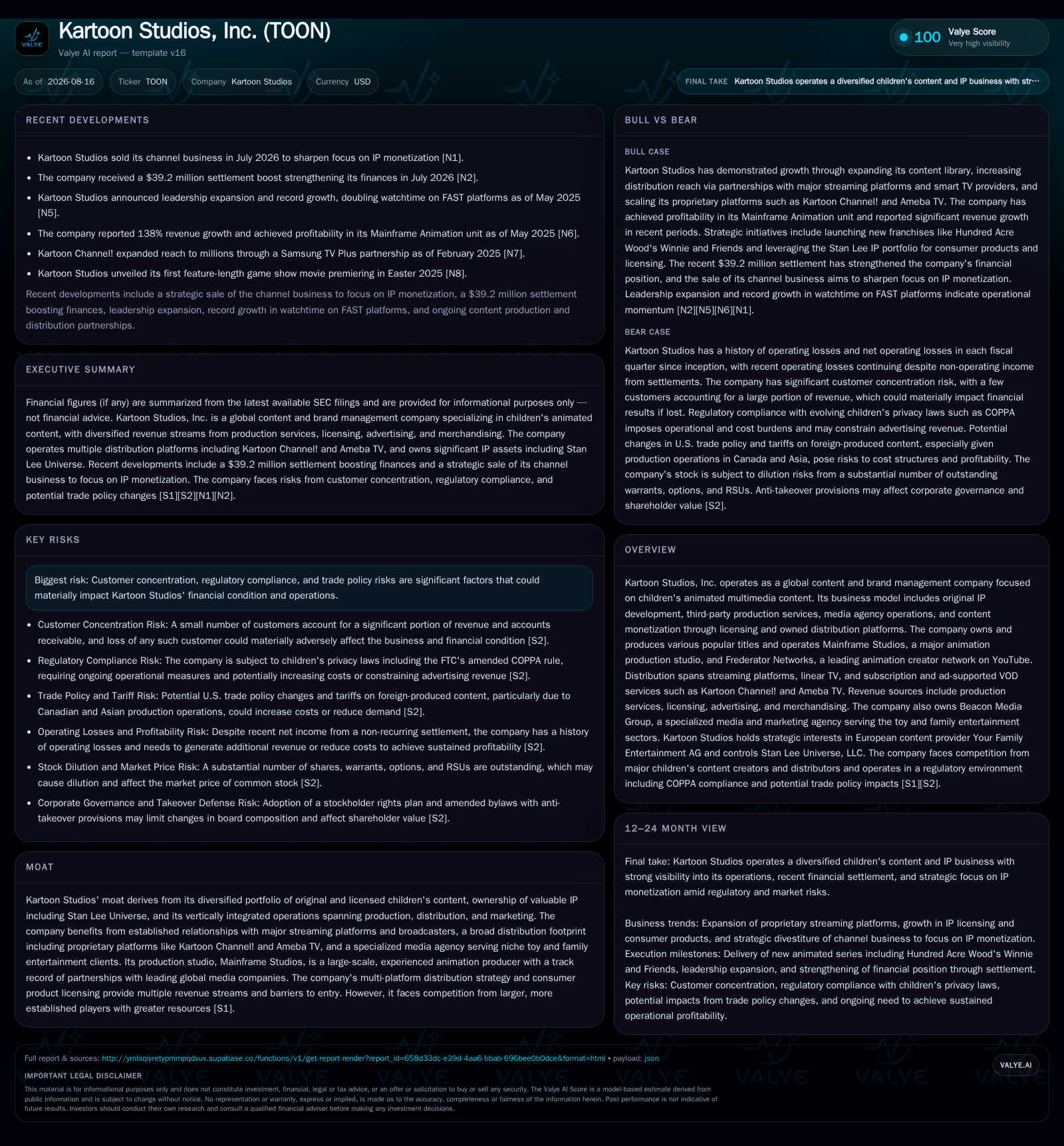
Kartoon Studios reported Q2 2026 revenues of $5.8 million with a net operating loss of $3.4 million, reflecting continued operating challenges despite a recent non-recurring $39.2 million settlement. The company has divested its Federator Networks channel business to concentrate resources on intellectual property (IP) monetization and licensing, leveraging owned platforms like Kartoon Channel! and Ameba TV. It operates a vertically integrated model spanning original IP development, third-party production services through Mainframe Studios, content distribution across multiple platforms, and a specialized media agency. The business faces typical industry risks including high content costs, trade policy uncertainties due to foreign production reliance, customer concentration, and competitive pressures from larger content owners.
Recent Operating Update
Kartoon Studios disclosed total revenues of $5.8 million for Q2 ended June 30, 2026, down substantially from $10.3 million in the same period last year [S2]. This revenue contraction likely reflects the impacts of strategic portfolio adjustments including the July sale of Federator Networks’ channel business [S7][N2], signaling a pivot away from direct channel operations toward focusing on intellectual property monetization and licensing activities focused on owned brands.
The company incurred a net loss from operations of $3.4 million for Q2, slightly higher than the prior-year quarter's $3.2 million loss despite lower revenues [S2]. While the operating performance remains negative consistent with historical trends—Kartoon has recorded operating losses every quarter since inception—the reported net income for both three- and six-month periods ending June 30 was positively affected by a one-time cash settlement of $39.2 million related to a court-approved legal resolution [S2][N1]. Crucially, this sizeable non-recurring cash influx does not derive from core operations but temporarily strengthens liquidity.
Kartoon’s focus sharpened further with the July divestiture of Frederator Networks' channel business for $500,000 cash consideration while retaining key associated intellectual properties such as Bee & PuppyCat and Castlevania for future licensing opportunities [S7][N2]. This deal aligns with management’s strategic emphasis on leveraging owned IP to drive upstream revenue growth via licensing rather than downstream distribution ownership.
Business Model
Kartoon Studios operates as a vertically integrated children's media company combining original IP development, third-party animation production services via Mainframe Studios, branded content distribution through owned platforms like Kartoon Channel [S1][S21]! (an ad-supported video-on-demand service) and Ameba TV (subscription-based), alongside broader content licensing agreements with leading streaming platforms such as Amazon Prime Video, Netflix, Paramount+, HBO Max, and Nickelodeon
Revenue is generated across four main streams:
- Content Licensing: Licensing owned IP to broadcasters and streaming platforms globally.
- Production Services: Third-party contract work performed primarily by Mainframe Studios—one of the largest global animation producers delivering episodes, movies, and features.
- Advertising: Monetization from traffic on owned digital distribution channels through ad sales.
- Merchandising & Licensing: Consumer product licensing deals supported by Beacon Media Group's specialized media agency focused on toy and family entertainment sectors.
This multi-pronged approach partially mitigates dependence on any single income stream or distribution partner by blending recurring licensing revenues with variable production contracts and advertising-based cash flows [S1]. However, sustained profitability demands scale across these activities and effective cost control given high content development costs typical in animation.
Industry Structure and Competitive Position
Kartoon operates within the children's animated content sector characterized by intense competition from larger media conglomerates with deep pockets for content creation and extensive global distribution networks—companies like WildBrain, Nelvana (Corus Entertainment), Hasbro, ViacomCBS (Nickelodeon), Disney+, and Netflix Kids are notable incumbents. Unlike these giants that combine vast IP portfolios with proprietary streaming infrastructure or cable networks, Kartoon's competitive advantage is anchored in leveraging its owned IP portfolio including Stan Lee Universe characters and niche premium production capabilities through Mainframe Studios.
Its acquisition-led vertical integration encompassing creation (IP), production (Mainframe), distribution (Kartoon Channel!, Ameba TV), alongside complementary media agency offerings (Beacon Media Group) forms an ecosystem that can cultivate cross-channel monetization synergies absent in pure-play studios or standalone licensors [S1]
Nonetheless, limitations arise from ongoing operating losses reflecting the challenge of scaling high-cost animation production profitable enough to amortize over steady licensing revenues [S1][S28]. Additionally, customer concentration risk exists given a limited number of major streaming/broadcast partners critical for global distribution
Growth Drivers
Key growth avenues include:
- Expansion of Proprietary Digital Platforms: Increasing subscribers/viewership on Kartoon Channel! (AVOD) and Ameba TV (SVOD) can stimulate advertising revenue growth directly attributable to owned audiences without reliance on third parties.
- Original IP Development & Acquisition: Developing or acquiring compelling new IP enables fresh licensing deals across content rights as well as consumer products, reinforcing long-term brand value.
- Licensing & Merchandising Partnerships: Scaling consumer product licensees amplifies revenue streams beyond content consumption alone; Beacon Media Group plays an instrumental role expanding client base within toy/family markets through retainer plus commission-based engagements [S1].
- International Content Distribution: Broader geographic reach through deals spanning multiple streaming services enhances audience exposure and revenue diversity.
- Strategic Streaming Partnerships: Collaborations like the recently announced Amazon Prime Video deal for its “Hundred Acre Wood” series launch in early 2027 with embedded "Shop the Show" merchandising reflect initiatives that integrate content promotion with direct-to-consumer purchase opportunities [S21].
Growth success hinges on enhancing brand visibility among young audiences amidst fragmented digital ecosystems dominated by large-scale players while managing hefty production investments effectively.
Risks and Watchpoints
Kartoon faces several risk factors typical in children’s media alongside company-specific concerns:
- Operating Losses & Cash Needs: Persistent quarterly losses necessitate ongoing capital raises or alternative financing solutions; without sufficient funding sustainability is at risk [S28][S1].
- Trade Policy & Tariffs: Heavy reliance on Canadian-based Mainframe Studios production exposes the company to potential U.S.-imposed tariffs or retaliatory trade measures affecting cross-border animation production costs following shifting U.S. trade policies introduced since 2025; regulations remain uncertain but could materially increase expenses or disrupt supply chains [S2].
- Customer Concentration: Revenue dependency on major streaming/broadcast partners concentrates risk case if contract negotiations deteriorate or renewal terms worsen.
- Competitive Pressure: Fierce competition from larger media conglomerates investing heavily in premium children’s programming heightens pressure on pricing power and audience capture.
- Technology & Market Fragmentation: Rapid evolution in digital consumption models may fragment audiences further challenging monetization; demand elasticity among consumers for diverse animated content requires constant innovation.
- Legal & Intellectual Property Risks: Ongoing litigation noted in filings could result in financial burdens; also risks inherent to protecting IP both domestically and internationally exist given complex rights management dynamics.
What to Watch Next
Investors should monitor:
- Quarterly revenue segmentation shifts among licensing, advertising, production services indicating traction toward profitability drivers.
- Subscriber growth or engagement metrics for Kartoon Channel! and Ameba TV as concrete evidence of owned platform scaling.
- New original IP launches or strategic acquisitions expanding franchise portfolio.
- Impact outcomes related to trade policy developments especially post-U.S. Supreme Court rulings addressing tariff authority which may influence international production economics [S2].
- Further asset sales or strategic partnerships sharpening focus on core monetization areas evident since recent divestitures ([N2]).
- Updates on legal settlements beyond isolated cases affecting non-operational income streams which distort profit/loss analysis timing [N1],[S16].
Financial Profile Discussion
As of June 30, 2026, Kartoon reported current assets totaling approximately $63 million against current liabilities near $31.6 million yielding a stable current ratio around 2x suggesting reasonable short-term liquidity coverage as of the latest quarter-end [F1]. However, reported cash balance from last known mid-2023 data is modest near $4.8 million indicating working capital skewed towards receivables or other non-cash assets which may challenge daily operational flexibility without timely collection or capital infusion [F1].
Total debt appears negligible based on available figures implying low leverage but substantial accumulated deficit around $763 million denotes chronic unprofitability demanding ongoing external capital support highlighted repeatedly in risks disclosures including substantial doubt about going concern status without new financing secured shortly [S1][S28]
Operating expenses largely driven by high fixed costs of content development and animation production constrain margin expansion prospects while content amortization adds overhead burdens typical for media firms balancing long-term asset values against periodic cash flows.
Overall financial sustainability depends critically on executing its refined strategic focus post-divestiture towards higher-margin IP monetization balanced against operational efficiencies within its vertically integrated model spanning creation to marketing services.
This analysis synthesizes Kartoon Studios’ most recent quarterly data together with strategic events framing their evolving business model within children’s animated content industry dynamics but excludes investment research views per policy guidelines.
Disclaimer: This is research-only, informational analysis and not investment advice. It may include AI-generated interpretation and general industry context. Always verify important details using primary sources.

Comments