
Volato Group’s Fleet Expansion and Leasing Program Signal Shift Toward Revenue Diversification
Volato Group’s recent Q2 disclosures reveal a strategic pivot with fleet enlargement through partnership and the launch of an aircraft leasing program, aiming to broaden revenue streams despite ongoing liquidity headwinds.
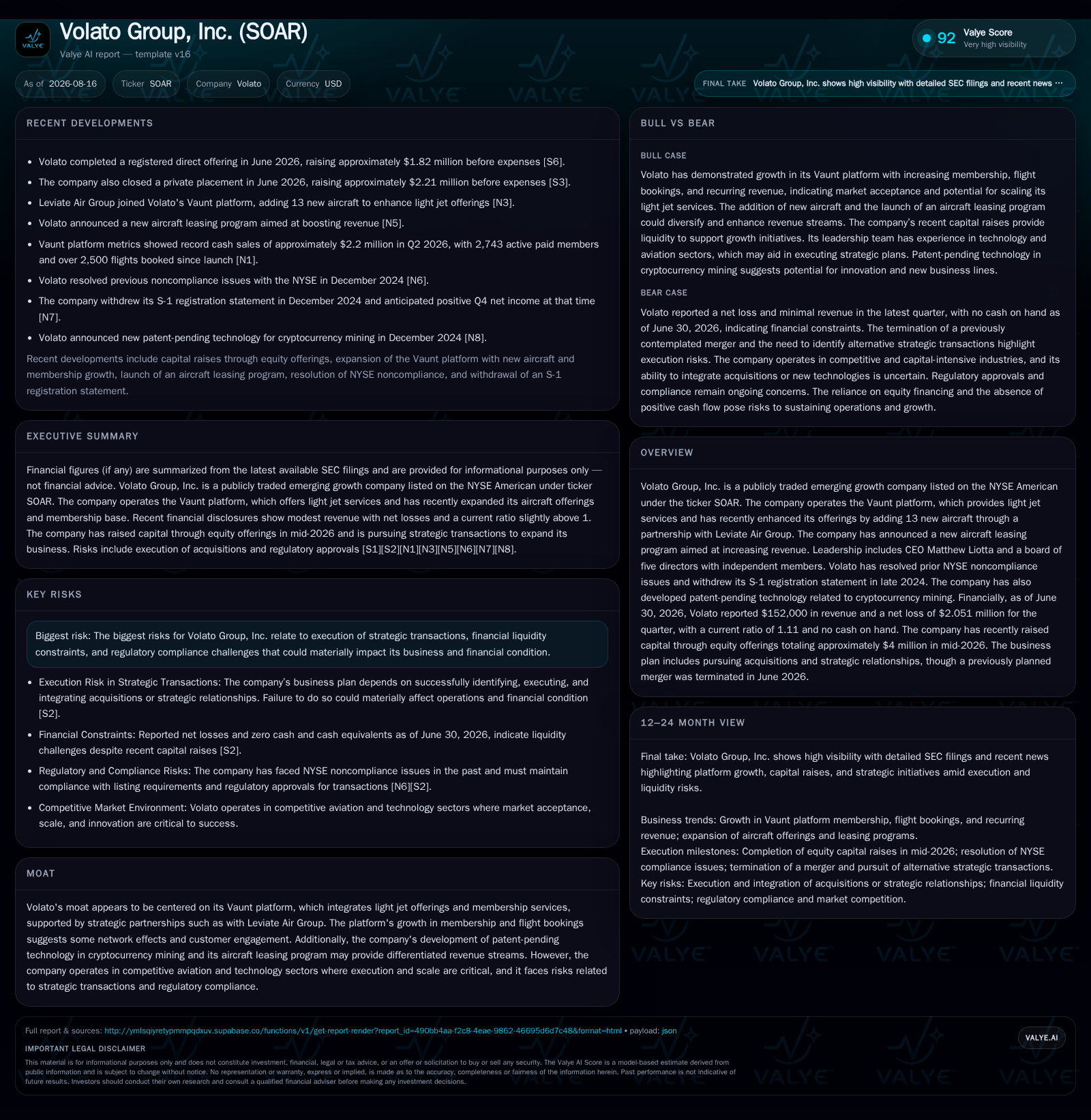
In its latest quarterly filing, Volato Group, Inc. (SOAR) reported operational progress marked by the addition of 13 new light jets via a strategic partnership with Leviate Air Group and introduced an aircraft leasing program. These developments indicate a deliberate move to diversify revenue beyond its Vaunt membership platform and charter services. However, financial results show continued net losses and constrained liquidity, underscoring the capital intensity of scaling in the aviation services and technology platform sector. Volato’s integration of patent-pending cryptocurrency mining technology adds an ancillary revenue angle but remains nascent. Key risks include execution challenges around strategic transactions, regulatory compliance, and managing capital requirements.
Q2 Operational Update: Fleet Expansion and Leasing Launch Reframe Growth Strategy
Volato Group’s latest Q2 filing dated August 14, 2026 reveals pivotal operational developments that recalibrate its growth trajectory. The company added 13 new light jets through a strategic partnership with Leviate Air Group, thereby significantly expanding the fleet available on its Vaunt platform [S2][S3]. Concurrently, Volato launched an aircraft leasing program designed to generate revenues separate from its traditional membership and charter flight businesses. This transition toward owning or controlling more fleet assets suggests an effort to improve utilization rates directly and leverage fixed costs more efficiently within a capital-intensive business model.
Despite these positive strides in capacity expansion, financial results for the quarter show modest revenue generation at $152,000 alongside a net loss of $2.051 million [S2][F1]. The operating losses highlight the urgency for Volato to achieve scale benefits from its expanded fleet and diversified revenue sources. The leasing program, while nascent, represents a critical test case for broadening income streams beyond flight bookings driven by the Vaunt membership platform.
Hybrid Business Model: Integrating Light Jet Services with Emerging Technology Revenue Streams
Volato operates primarily through its Vaunt platform that facilitates light jet services via membership subscriptions and per-flight revenues [S1]. Membership growth trends—reportedly up 71% year-over-year to about 2,743 paid members—drive recurring revenue potential [S19]. However, the business remains capital intensive: aircraft procurement or control introduces heavy upfront costs that pressure cash flow before steady utilization is achieved.
Beyond traditional aviation services, Volato has developed patent-pending technology related to cryptocurrency mining [S1], signaling an attempt to create ancillary technology-driven income streams that could mitigate volatility tied to core flight operations. While still early-stage without disclosed monetization metrics or integration timelines, this hybrid model aims to tap into emerging trends at the intersection of aviation platform services and blockchain-related technologies.
Competitive Position in Membership Aviation Platforms and Aircraft Leasing Markets
Within membership-based private aviation platforms, Volato’s Vaunt compares conceptually to established peers like Wheels Up and NetJets, which benefit from larger scale, brand recognition, extensive fleets, and network effects fostering customer retention. Those incumbents have also navigated challenges around asset utilization and operational scalability.
Volato's introduction of an aircraft leasing program aligns conceptually with Flexjet’s fractional ownership model but appears at an earlier stage without fractional ownership elements disclosed. Competing successfully requires not only growing fleet size but also optimizing lease occupancy rates—a key profitability driver. Volato's relatively small scale versus industry leaders may constrain bargaining power in cost management or pricing flexibility until operational scale is reached.
Strategic Partnerships Fueling Fleet Growth but Increasing Capital Intensity Risks
The Leviate Air Group partnership enables rapid fleet scaling without direct purchase obligations but still increases operating commitments inherent in fleet management such as maintenance, insurance, regulatory compliance, crew staffing, and scheduling logistics [S1][S2]. These factors elevate capital requirements indirectly even absent outright acquisition.
Managing this expanded fleet effectively will be critical to avoid excessive fixed costs dragging on margins before utilization improves. Aviation sector regulatory scrutiny adds another layer of risk especially when integrating new aircraft types or altering leasing structures. Supply chain considerations for parts or pilot availability can further complicate rapid fleet deployment strategies.
Patent-Pending Cryptocurrency Mining: Potential Differentiator or Distraction?
Volato’s pursuit of patent-pending cryptocurrency mining technology represents an unconventional adjunct within its primarily aviation-centered portfolio [S1]. If commercially viable and scalable, this could provide diversified revenues less correlated with airline travel economic cycles. However, risks include substantial R&D investments without guaranteed returns, distraction from core aviation scaling efforts, potential regulatory complexities linked to crypto activities, and investor skepticism over unrelated tech ventures diluting focus.
This novel integration reflects broader industry experiments by some aviation firms pursuing blockchain or alternative tech innovations for competitive differentiation but remains early in proving commercial viability.
Scaling Challenges: Liquidity Constraints Amid Execution Risks Post-Merger Termination
As of June 30, 2026, the company had no cash on hand despite current assets totaling $11.158 million against $10.011 million in liabilities—yielding a current ratio of 1.11 [F1]. This thin margin for working capital places high reliance on frequent equity or debt raises to sustain operations through continued net losses intrinsic to ramp-up phases.
Moreover, the termination of the previously planned merger with M2i in June 2026 removed a key anticipated source of strategic scale expansion capital [S2][S12]. The company is actively evaluating alternative strategic transactions but faces uncertainty regarding timing or regulatory hurdles [S12]. Such execution risks create short-term volatility in operational focus and financial planning.
'What to Watch': Key Milestones for Membership Growth, Leasing Program Uptake, and Tech Adoption
Critical near-term performance indicators include tracking Vaunt membership growth trajectory beyond existing gains; improved lease occupancy rates reflecting traction in new aircraft leasing initiatives; utilization rates across the expanded fleet; booking frequency per member signaling customer engagement depth; and any burgeoning revenue recognition from the cryptocurrency mining technology segment.
Progress against these KPIs would validate that Volato is moving beyond an asset-heavy startup phase toward scalable aviation service operator status with diversified income streams reducing dependency on single revenue vectors. Delays or stagnation might underscore execution challenges tied to capital scarcity or market competition.
Financial Profile Discussion: Fine Balancing Act Between Capital Needs and Operational Ambitions
Volato's financial snapshot as of Q2-end underlines acute capital intensity intrinsic to aviation service scaling coupled with operational liquidity risk: zero cash reserves contrasted against nearly equal current assets versus liabilities [F1]. The reported net loss $2.051 million amplifies pressure on free cash flow requiring additional cash infusion mechanisms—equity offerings as recently executed raise approximately $4 million combined over Q2 sequence—but sustainable funding remains uncertain [S16][S23].
The structure demands disciplined capital allocation prioritizing fleet utilization enhancement while cautiously managing overheads including regulatory compliance costs incurred by dual aviation-tech operations. Continued reliance on periodic capital raises exposes volatility potential unfavorable for long-term valuation confidence absent demonstrable operating leverage gains.
Disclaimer: This analysis is based solely on publicly available regulatory filings as cited. It does not constitute investment advice or research views. Investors should conduct their own thorough due diligence including evaluation of risks detailed in official SEC reports.
Disclaimer: This is research-only, informational analysis and not investment advice. It may include AI-generated interpretation and general industry context. Always verify important details using primary sources.

Comments