
ClearSign Technologies Advances Combustion Innovation with OEM Partnerships and Regulatory Traction
The August 2026 quarterly filing highlights incremental operational gains supported by broadened OEM collaboration and established regulatory validations for its proprietary combustion technology.
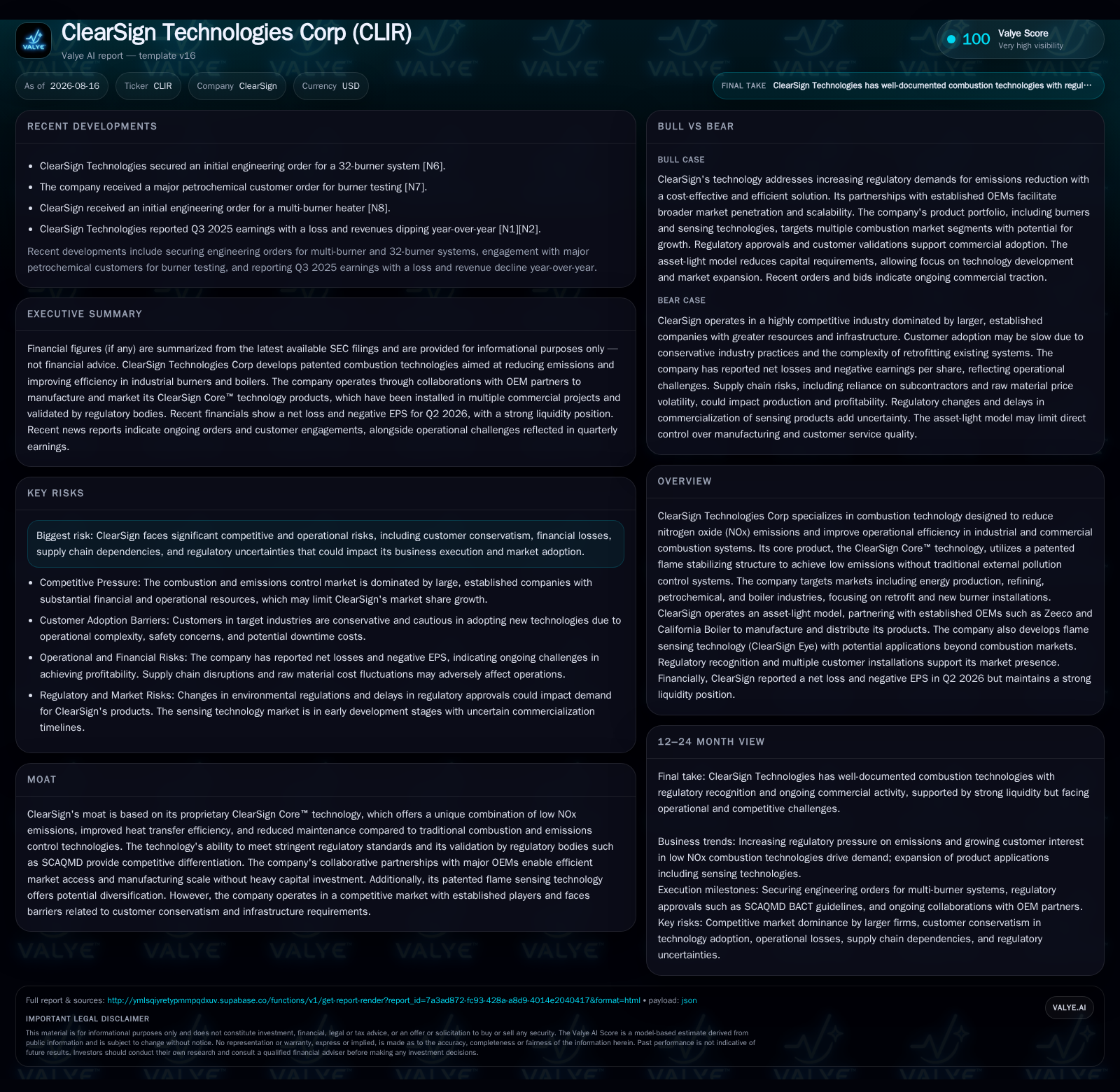
ClearSign Technologies’ latest quarterly update reveals ongoing progress in commercial adoption anchored by strategic OEM partnerships and regulatory recognition. The company’s ClearSign Core™ combustion technology delivers a differentiated value proposition through low NOx emissions and enhanced heat transfer efficiency, targeting retrofit opportunities in industrial boilers and heaters. While customer conservatism and capital constraints temper rapid scaling, sustained R&D efforts supported by a solid liquidity position keep the company positioned for eventual growth. Key upcoming milestones include expanding order backlogs and accelerating installations that will validate market traction amidst competitive traditional emissions control alternatives.
August 2026 Quarterly Update Illuminates Operational Progress
In its latest 10-Q filing dated August 14, 2026, ClearSign Technologies reported continued operational progress characterized primarily by incremental growth in system deployments and deepening partnerships with original equipment manufacturers (OEMs) such as Zeeco and California Boiler [S2][S3]. While revenue remains minimal given the company’s early-stage commercialization focus, the report highlighted stable order backlogs consistent with prior periods and no material shifts in risk factors. The absence of new litigation or adverse regulatory developments underlines a steady if cautious operational footprint as ClearSign works to convert engineering partnerships into commercial-scale projects.
The August 11 event filing further documented board-level continuity and reinforced leadership cohesion amid evolving deployment schedules [S3]. Although not disclosing specific new contract awards, these disclosures collectively indicate the company remains on track to build install base momentum within targeted industrial markets that increasingly prioritize emission reductions.
ClearSign’s Technology Model: Low-Emission Combustion Offered via Strategic OEM Partnerships
At the core of ClearSign’s offering is its patented ClearSign Core™ technology—an innovative flame stabilizer engineered to dramatically reduce nitrogen oxide (NOx) emissions by shortening flame length without the need for traditional external controls such as selective catalytic reduction (SCR) units or flue gas recirculation systems [S1]. This proprietary approach provides dual benefits: compliance with stringent emissions standards and improved heat transfer efficiency, which field data suggest can translate into low to mid-single digit percentage fuel cost savings during operation.
ClearSign monetizes this innovation primarily through licensing arrangements combined with product sales channeled via established OEM partners like Zeeco and California Boiler who manufacture combustion equipment incorporating the ClearSign Core™ design. This asset-light operating model minimizes the capital intensity typical of industrial hardware firms while leveraging partners’ scale and distribution networks to penetrate both retrofit projects and new burner markets across refining, petrochemical, power generation, and commercial boiler segments.
This partnership strategy reduces execution risk relative to sole-source manufacturing while positioning ClearSign favorably to tackle retrofit opportunities driven by tightening emission regulations targeting flare units, once-through steam generators (OTSGs), boilers, and enclosed flares. By providing a technology that avoids costly external pollution control devices yet meets or exceeds NOx limits imposed by agencies like SCAQMD, ClearSign aims to shorten payback periods for end users while supporting operational efficiency improvement—a compelling value proposition in capital-constrained industrial sectors.
Industrial Combustion Competition: Balancing Proprietary Tech Versus Traditional Emission Controls
Competition in this segment centers primarily on incumbent emissions control solutions such as SCR systems deployed by environmental technology firms along with alternative burner designs featuring external flue gas recirculation. These legacy approaches typically involve higher upfront costs due to additional hardware complexity but benefit from longstanding market acceptance.
ClearSign’s moat resides in its validated proprietary flame stabilizing technology which not only meets mandated NOx thresholds but also achieves increased heat transfer efficiency—a combination less common among traditional competitors [S1]. Regulatory recognition from agencies including SCAQMD bolsters ClearSign’s credibility versus unproven alternative burners or retrofit options. Despite these differentiators, customer conservatism remains significant given sunk costs in existing equipment and slow adoption cycles characteristic of large industrial operators.
Moreover, flame sensing technology development (marketed as ClearSign Eye) introduces a potential diversification pathway focused on combustion monitoring and optimization. While promising, this venture competes against specialized firms already entrenched in combustion diagnostics markets. As yet, it contributes limited revenue but may augment overall customer value over time.
Growth Catalysts: Regulatory Pressures, Heat Transfer Gains, and Retrofit Market Penetration
Growth prospects hinge importantly on accelerating demand driven by an increasingly stringent emissions regulatory landscape targeting NOx from flare stacks, boilers, OTSGs used in Enhanced Oil Recovery (EOR), and petrochemical heaters [S1]. The company reports successful deployment of Duplex technology in three OTSG projects within California’s EOR sector—a niche marked by regulatory pressure combined with a need for operational efficiency gains.
Installation activity coupled with field data confirming measurable heat transfer improvements support cost saving claims that enhance retrofit appeal. Key operating KPIs include rising numbers of installed combustion systems employing ClearSign Core™, retrofit project win rates growing steadily within target verticals, and expanding relationships across several OEM partners facilitating increased market access.
OEM partnerships remain vital conduits for delivering ClearSign’s technology at scale without overextending corporate capital resources. The combination of retrofitting aging combustion infrastructure to meet newer emission standards alongside new-build burner installations presents a sizable addressable market growing under local environmental policy pressures.
Challenges Ahead: Customer Conservatism, Capital Needs, and Supply Chain Dependencies
Despite technological promise, multiple headwinds temper more rapid commercialization. Customer conservatism—inherent in capital-intensive industrial sectors—introduces slow adoption cycles requiring extended pilot programs before full-scale retrofits or new installs proceed [S1][S2]. This dynamic is compounded by supply chain dependencies tied to OEM manufacturing partners whose capacity constraints could delay deliveries.
Financially, sustained research & development expenditure reflects commitments to iterative innovation but generates recurring operating losses limiting near-term profitability. Legal proceedings referenced around director disputes appear immaterial operationally but underscore governance complexity during early-stage growth phases [S1].
An asset-light model mitigates capex outlays but requires maintaining strong liquidity which depends on equity financing or grants until revenues scale meaningfully from product sales or licensing fees.
Looking Forward: Order Backlogs, Installation Pace, and Regulatory Milestones to Monitor
Key indicators of approaching inflection points will include measurable acceleration in project win rates noted through order backlogs reported in future quarterly filings alongside reduced installation cycle times evidencing operational scalability [S2][S3]. Growth will also hinge on continued expansion of regulatory approvals or recognition that tilt incentives away from costly traditional SCR/fuel recirculation toward inherently low-emission burner technologies like ClearSign Core™.
Monitoring end-user adoption trends alongside OEM partner uptake will clarify penetration velocity. Additionally, evolving emissions limits at state or federal levels could rapidly change demand dynamics for retrofit burner kits as well as new equipment sales.
Financial Profile Discussion: Liquidity Position Supports R&D Despite Current Losses
As of June 30, 2026, ClearSign holds approximately $9.9 million in cash and equivalents against current liabilities near $2.3 million yielding a strong current ratio around 4.78 — indicative of solid short-term financial health supportive of ongoing R&D investment despite operational losses accrued over prior years [F1]. Total debt remains negligible at approximately $98 thousand per the last available point data from September 2021 [F1], reflecting an essentially debt-free capital structure well suited for an early-stage tech licensor reliant on equity funding rather than leverage.
Operating expenses remain weighted toward development activities crucial for refining core combustion systems while pursuing commercial scale partnerships. Capital expenditures are modest under the asset-light manufacturing approach reliant on third-party OEM production capabilities.
Going forward, the balance between managing cash burn versus demonstrating accelerating market traction constitutes a pivotal financial balancing act influencing investor confidence and ability to fund growth initiatives.
This analysis synthesizes the latest publicly available financial statements alongside regulatory disclosures to provide an informed perspective on ClearSign Technologies' evolving operational trajectory within the industrial combustion equipment sector. It highlights operational progress anchored by meaningful technological differentiation while acknowledging ongoing challenges related to market adoption cycles characteristic of industrial emission control innovations.
Disclaimer: This is research-only, informational analysis and not investment advice. It may include AI-generated interpretation and general industry context. Always verify important details using primary sources.

Comments