
URSB Bancorp’s Credit and Operational Profile Reflects New Jersey Real Estate Focus
URSB Bancorp’s second-quarter 2026 filings underscore the challenges and strengths of a community bank centered on New Jersey real estate lending amid evolving economic conditions.
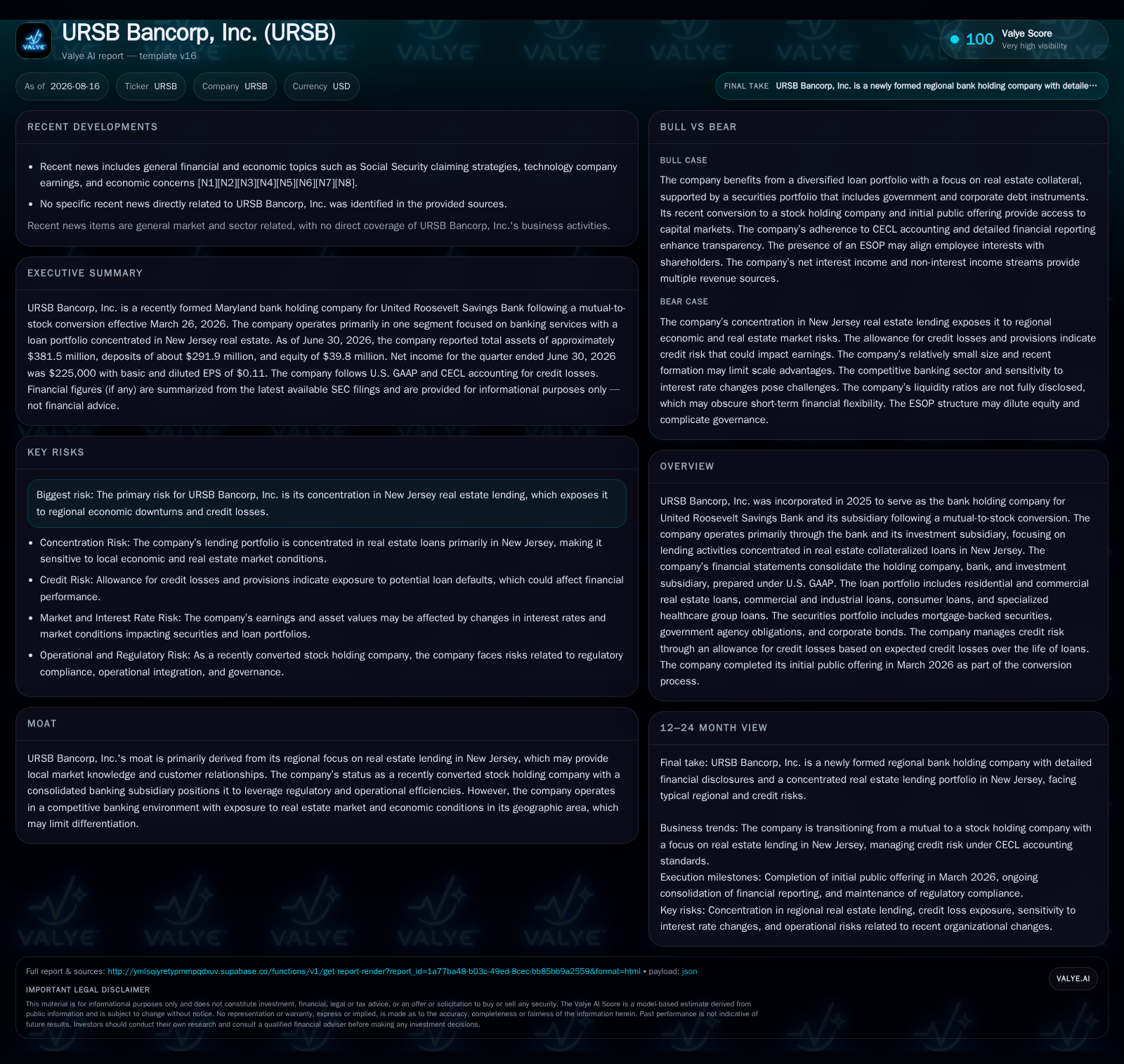
URSB Bancorp, Inc. operates primarily as a regional banking holding company with loan concentrations in residential and commercial real estate in New Jersey. The company’s Q2 2026 disclosures highlight disciplined underwriting standards with conservative loan-to-value limits and a credit loss allowance methodology sensitive to localized economic trends. A recent director departure marks a governance change, while the bank maintains a cautious posture on investment securities despite minor unrealized losses. As a relatively new public entity with a concentrated geographic footprint, URSB faces typical regional banking risks balanced against potential growth from local market dynamics.
Recent Operating Developments
URSB Bancorp’s latest quarterly filing dated August 14, 2026, provides the primary insight into current business conditions [S2]. Management continues to emphasize disciplined underwriting standards for its residential real estate loan portfolio, generally refraining from originating loans exceeding an 80% loan-to-value ratio nor subprime classifications at origination. This policy signals conservative risk appetite aimed at mitigating credit losses in what remains a cyclical and competitive segment
The quarterly report also sheds light on the company's allowance for credit losses methodology, which integrates qualitative factors tailored to each loan segment's risk characteristics. For instance, risk sensitivity varies between residential mortgages—which typically exhibit collateral value stability—and commercial loans that depend more on borrower cash flows and broader economic conditions [S2]. This nuanced approach recognizes that credit loss provisions must respond dynamically to local economic forecasts and borrower profiles, essential for a regionally concentrated lender like URSB
In terms of investment securities, URSB holds government-sponsored mortgage-backed securities (MBS) and U.S. government agency obligations as core components of its portfolio. While aggregate unrealized depreciation stood at approximately 3.8% at mid-2026 compared to amortized cost basis, management does not regard these positions as credit-impaired under current regulatory guidelines [S2]. This stance aligns with expectations that MBS backed by government or agency guarantees will not settle below par absent legislative shifts affecting enterprise support
A non-operating but notable update disclosed in July 2026 was the resignation of Michael L [S3]. Hammer from his directorship roles at both URSB Bancorp and United Roosevelt Savings Bank due to conflict with policies of his broker-dealer affiliation related to the bank’s public company status. This departure may have implications for board composition and governance dynamics going forward amidst the company’s ongoing transition from mutual to stock ownership structure
Business Model Overview
URSB Bancorp operates predominantly as a financial intermediary within the New Jersey regional banking landscape through its subsidiary United Roosevelt Savings Bank. The company's revenue model is chiefly interest income derived from its lending activities—primarily residential and commercial real estate loans—supplemented by interest from investment securities and fee-based banking services.
Loans represent the largest asset segment on the balance sheet; these include first and second lien positions on residential properties secured by collateral historically evaluated against stringent loan-to-value benchmarks around or below 80%. Commercial loans are extended mainly to small businesses within the region with repayments based on operating cash flows rather than solely collateral liquidation value [S1][S2]. Additionally, URSB offers consumer loans and specialized niche exposures such as those linked to healthcare professionals through its Bankers Healthcare Group loans segment
Interest income production depends critically on maintaining a net interest margin (NIM) that reflects funding strategies anchored largely in retail deposits combined with borrowings when necessary. Fee income streams add diversity but remain secondary contributors compared to lending yields.
Risk management features prominently given loan concentration risks intrinsic to regional banks. Credit risk controls via an allowance for credit losses reflect expected lifetime losses adjusted for economic forecasts specific to New Jersey's property markets.
Overall operational efficiency depends on controlling noninterest expenses relative to total revenue—monitored using efficiency ratios common among comparable regional lenders—to sustain profitability despite competitive pressures from larger institutions like Valley National Bancorp or Lakeland Bancorp.
Industry Structure & Competitive Positioning
URSB fits squarely within the regional banking archetype focused on geographically concentrated real estate lending markets. Unlike diversified national banks or fintech lenders targeting broad digital customer bases or niche financial products, URSB leverages local knowledge of New Jersey borrowers and property valuations as part of its differentiation strategy.
However, this geographic focus creates inherent vulnerability: adverse shifts in New Jersey’s housing or commercial property markets could disproportionately impact asset quality compared to peers with more dispersed portfolios. Industry peers such as Valley National Bancorp offer scale advantages enabling broader product suites and more extensive deposit networks.
Competition also arises from non-bank mortgage originators whose streamlined credit approval processes can pressure traditional banks’ lending volumes or pricing power.
Operationally, URSB’s status as a recently converted stock holding company (post-mutual conversion) affords certain efficiencies but entails ongoing costs related to compliance, investor relations, and public disclosure obligations that distinguish it from smaller community thrifts still privately held.
Growth Drivers
Primary growth catalysts for URSB derive from positive developments within its core New Jersey markets. Local economic expansion or rising property values tend to spur demand for both residential mortgages and commercial lending opportunities.
Expanding its deposit base through retail consumer relationships supports funding capacity critical for loan book growth; steady deposit inflows underpin liquidity while helping maintain attractive cost of funds.
Targeted initiatives around banking service cross-sells—such as investment advisory offerings through its subsidiaries—may incrementally increase noninterest income streams beyond traditional net interest income.
Interest rate environment dynamics will influence net interest margin trajectories wherein increasing short-term rates relative to longer-duration assets might compress margins unless mitigated through asset repricing or liability management strategies.
Further technological investments could improve customer acquisition efficiency and operational scalability—a notable trend among peers aiming to modernize front- and back-office capabilities.
Finally, selective acquisitions or partnerships within the region remain potential avenues for expanding market share if aligned with regulatory frameworks governing capital adequacy.
Risks & Watchpoints
A key vulnerability remains URSB’s loan concentration risk: predominantly New Jersey real estate-dependent portfolios expose the bank to localized economic downturn effects including elevated credit losses if property values decline or commercial tenants face cash flow difficulties [S1]
Credit quality deterioration would likely pressure allowance for credit losses requiring incremental provision expense impacting earnings stability [S2]. Monitoring nonperforming loan ratios specific to residential versus commercial segments will be important short- to mid-term KPIs.
Interest rate volatility presents another challenge; steepening yield curves can hurt net interest margins if liabilities reprice faster than assets.
Liquidity risks hinge upon maintaining robust deposit growth amid competition; disruptions here could limit lending capacity or force costly wholesale funding alternatives.
Further governance considerations arise from recent board changes impacting strategic oversight capabilities during this critical growth phase [S3].
Operational risks tied to cybersecurity threats or regulatory compliance remain ongoing concerns typical across regional lenders.
What To Watch Next
Key indicators for upcoming quarters include:
- Trends in allowance for loan losses reflecting updates in local economic outlooks tied closely to New Jersey housing market performance [S2].
- Evolution of nonperforming loans by portfolio segment signaling emerging credit stress domains.
- Deposit growth rates providing insight into funding availability for expanded lending operations.
- Net interest margin movements amid any shifts in interest rate environment impacting asset-liability management.
- Any further governance disclosures following director departures that might affect risk oversight structures [S3].
- Progression on technology investments aiming at operational efficiency metrics relative to peer benchmarks.
- Updates related to securities portfolio valuation policies should regulations around government-sponsored enterprise guarantees evolve [S2].
Monitoring these factors will clarify whether URSB balances its conservative risk stance with sustainable growth execution within its market niche.
This analysis synthesizes facts from URSB Bancorp's latest SEC filings alongside contextual understanding of regional banking industry dynamics without providing investment research views.
Disclaimer: This is research-only, informational analysis and not investment advice. It may include AI-generated interpretation and general industry context. Always verify important details using primary sources.

Comments