
AmperCap Acquisition Co Navigates Post-IPO Phase with Focus on Business Combination Execution
As a newly public SPAC, AmperCap holds significant capital in trust and is focused on identifying an acquisition target within regulatory timelines.
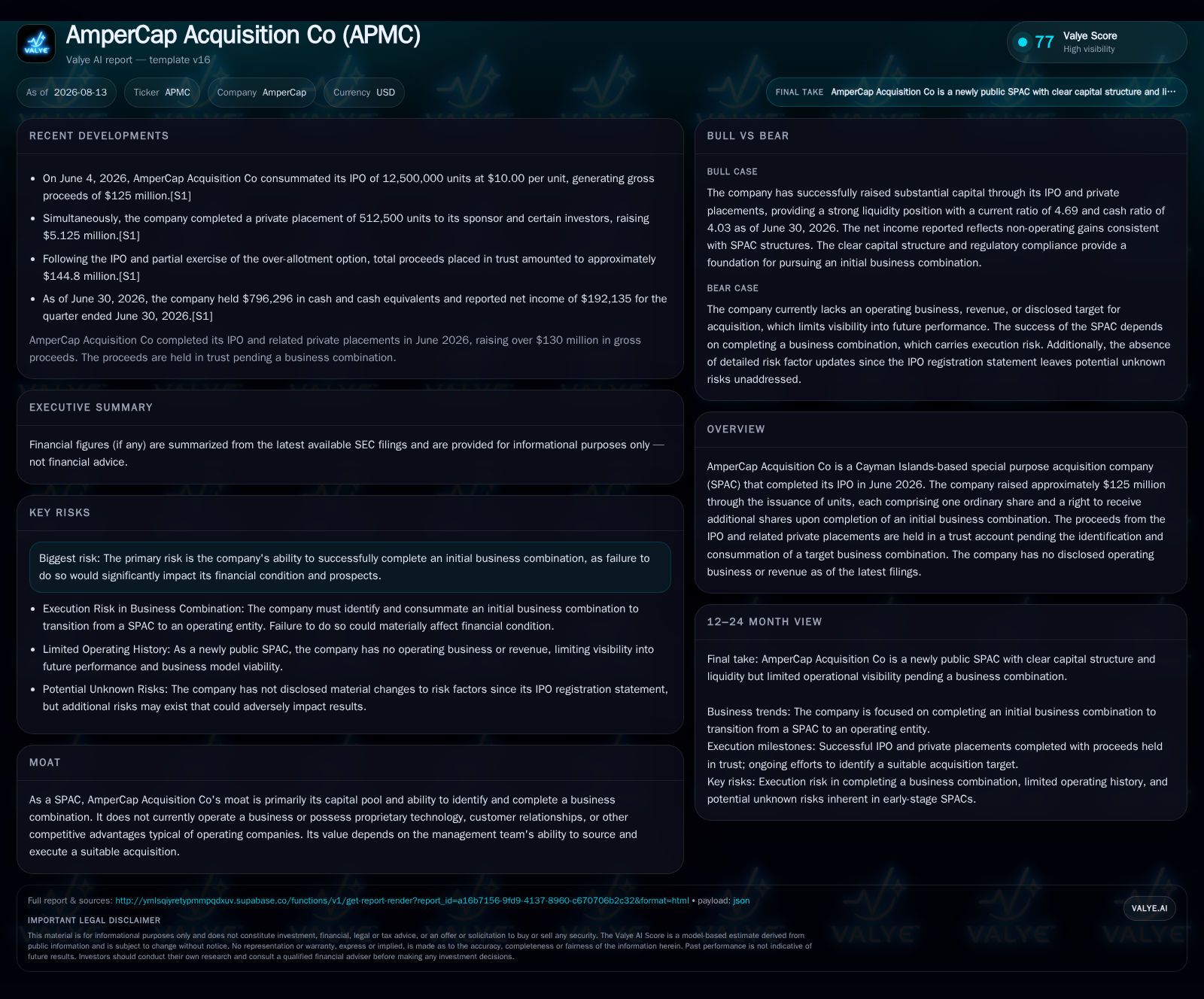
AmperCap Acquisition Co completed its IPO in June 2026, raising approximately $125 million through unit sales combining ordinary shares and rights exercisable upon a business combination. The capital raised, supplemented by private placements and overallotment proceeds, is held in trust pending the identification and completion of an initial business combination. Recent amendments shifted administrative service fee payments to quarterly advance schedules, reflecting operational standardization. As a typical SPAC with no current operations, AmperCap’s value depends on timely deal execution, sponsor capabilities, and navigating industry-standard risks including shareholder redemptions and market conditions.
Recent Operating Update
AmperCap Acquisition Co reported its quarterly results for the period ending June 30, 2026, following its June 4 IPO that raised approximately $125 million through the issuance of units consisting of ordinary shares paired with rights convertible upon completion of a qualifying business combination [S2][S11]. Additional private placement units sold to the Sponsor and underwriters further bolstered the capital base [S11]. As of quarter-end, cash and equivalents stood at roughly $796 thousand with total current assets at $926 thousand against current liabilities below $200 thousand, resulting in a strong current ratio near 4.7 [F1].
The company remains without operating revenues or commercial activities, consistent with the SPAC structure where proceeds are secured in a trust account pending a de-SPAC transaction. A recent amendment effective July 1, 2026 revised the payment terms for administrative services fees from monthly arrears to quarterly advance payments [S3], reflecting operational streamlining but not materially affecting underlying economics.
No material changes to previously disclosed risk factors were reported as of August 2026 filings, emphasizing that key uncertainties remain tied to completing an initial business combination within regulatory deadlines [S2]
Business Model Overview
AmperCap operates as a special purpose acquisition company (SPAC) focused on raising capital via an IPO by issuing units comprising shares and derivative rights exercisable post-business combination [S11]. The primary asset is the trust account holding gross proceeds—approximately $145 million when including overallotment options and private placements—dedicated exclusively to consummating an acquisition or merger within a limited timeframe typically spanning up to two years post-IPO.
Before any business combination, revenue sources are limited primarily to interest income generated on trust assets, which may fund minimal administrative expenses but do not represent operational profitability [S12]. Value creation depends on management’s ability to identify attractive private companies seeking alternative public market access through a de-SPAC transaction. Upon successful merger completion, the combined entity assumes operational activities while AmperCap transitions into an operating public company.
This archetype leverages sponsor expertise alongside capital from retail and institutional investors who gain exposure to private companies without traditional IPO complexities. Sponsors generally receive founder shares or promote interests providing significant equity upside post-merger contingent on deal closure.
Industry Structure and Competitive Position
The SPAC industry is characterized by intense competition among vehicles differentiated principally by sponsor reputation, deal sourcing capability, due diligence rigor, and alignment with shareholder interests post-merger. AmperCap’s competitive positioning will depend heavily on its sponsors’ ability to source suitable targets quickly while managing increasing regulatory scrutiny common in SPAC transactions.
Maintaining capital integrity amid potential investor redemptions—which can significantly reduce acquisition funds—is critical. Although AmperCap has yet to disclose redemption rates or data typically revealed during shareholder votes, its initial capital raise compares favorably with peers of similar scale.
Notable peers such as Pershing Square Tontine Holdings highlight both the benefits of strong sponsor credentials and challenges related to protracted timelines or failed deals. AmperCap’s disciplined governance framework—including formalized quarterly fee payments per recent amendment—may support competitive execution in this environment [S3].
Growth Drivers
Growth before deal completion is constrained given the absence of operating subsidiaries; however, success metrics revolve around timely completion of an initial business combination within regulatory deadlines (often within 18-24 months). Key growth drivers include:
- Robust Capital Markets Appetite: Sustained investor interest in alternative public listing vehicles enhances prospects for sizable acquisitions.
- Sponsor Network Strength: Access to diverse target pipelines improves deal flow quality and selection.
- Regulatory Clarity: Evolving disclosure requirements increase transparency and investor confidence.
- Innovative Deal Structuring: Use of mechanisms like PIPE financing adds validation layers supporting transaction feasibility.
Monitoring milestones such as merger announcements or PIPE commitments will provide early indicators of progress toward operational revenue generation post-merger.
Risks and Watchpoints
Despite strong cash reserves secured in trust accounts early after IPO, several execution risks persist:
- Completion Risk: Failure to close a qualifying acquisition before expiration mandates liquidation with potential dilution after expenses [S2].
- Redemption Risk: Shareholder redemptions can erode available funds impacting transaction viability.
- Sponsor Conflicts: Fee structures or promote interests may create misaligned incentives between sponsors and public shareholders.
- Market Volatility: Fluctuations can hinder favorable deal negotiations or PIPE participation.
- Limited Operating History: Absence of prior operations complicates due diligence increasing risk premiums.
These risks are endemic across SPACs irrespective of size or sponsorship pedigree. Transparency around target sectors or announced deals remains essential but currently unavailable for AmperCap.
What To Watch Next
Key upcoming developments will focus on:
- Disclosure of acquisition targets or proposals outlining sector focus, valuation metrics, and ownership distribution pre/post-merger.
- Progress adherence relative to regulatory timelines governing de-SPAC transactions.
- Management updates on target screening progress or anticipated shareholder votes signaling deal advancement.
- Redemption activity once transaction details are public influencing final funding availability.
- Any further amendments affecting sponsor fees altering expense profiles prior to deal closure beyond recent quarterly payment adjustments [S3].
These markers will clarify operational momentum while shaping valuation negotiations versus shareholder acceptance prospects central to sustaining SPAC value.
Financial Profile Discussion
Reflecting its status as a non-operating acquisition vehicle, AmperCap’s financial profile centers on cash management rather than earnings generation. As of June 30, 2026, cash & equivalents totaled approximately $796 thousand supporting working capital related primarily to administrative functions and service agreements with the Sponsor [F1]. Current liabilities were modest at roughly $198 thousand yielding a robust current ratio near 4.7 [F1]. Reported net income was positive but mainly attributable to accounting entries rather than substantive operational performance [F1].
The recent amendment effective July adjusted administrative services fee payments from monthly arrears to quarterly advances beginning Q3 but does not materially affect liquidity or leverage due to low expense levels involved [S3]. The bulk of capital remains segregated in trust accounts dedicated exclusively for future acquisitions until deployment or mandatory refunding as stipulated by regulations [S12].
Going forward, financial scrutiny will intensify around potential redemption cash outflows once definitive merger terms emerge—a frequent pressure point influencing transaction structures amid competing shareholder interests prior to de-SPAC completions.
AmperCap Acquisition Co exemplifies typical new SPAC entrants leveraging substantial raised capital pools aimed at transformative acquisitions enabling private firms’ public access without traditional IPO hurdles. Its nascent phase underscores reliance on experienced management teams aligned with prevailing market conditions favoring alternative listing vehicles. Without proprietary technologies or operating revenues currently, ultimate success depends heavily on disciplined execution surrounding business combination milestones balanced against inherent structural risks. Close attention to forthcoming disclosures about deal prospects will be pivotal for evolving investment narratives beyond this foundational capital raising stage.
This analysis is based entirely on publicly available SEC filings and does not constitute investment advice.
Disclaimer: This is research-only, informational analysis and not investment advice. It may include AI-generated interpretation and general industry context. Always verify important details using primary sources.

Comments