
Thayer Ventures Acquisition Corp II Approaches Business Combination Deadline Amid Liquidity Constraints
Thayer Ventures Acquisition Corp II, a Cayman Islands-registered SPAC, holds over $201 million in trust from its May 2025 IPO to finance an initial business combination. However, limited liquidity outside the trust account and ongoing public company expenses present execution challenges as the company approaches its February 2027 deadline.
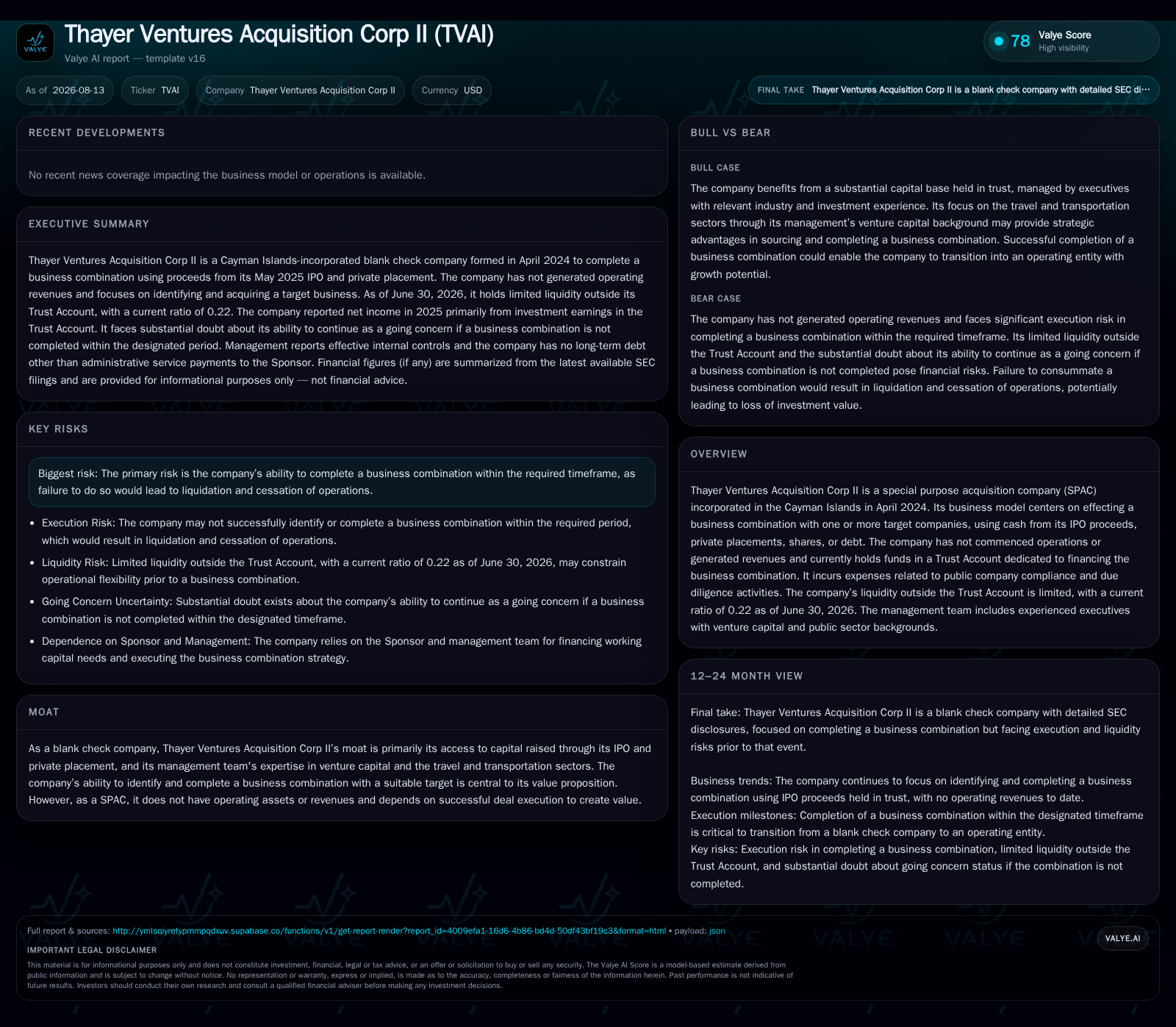
Thayer Ventures Acquisition Corp II is a blank check company formed to complete one or more business combinations using IPO proceeds held in a trust account. Since its May 2025 IPO and private placement, it has generated no operating revenues and relies solely on earnings from investments in the trust account to offset administrative costs. As of June 30, 2026, the company reported negligible cash outside the trust, current assets of $165 thousand against current liabilities of $732 thousand, resulting in a low current ratio of 0.22. The sponsor’s venture capital experience in travel and transportation sectors supports deal sourcing efforts. Key risks include the looming business combination deadline, working capital constraints for due diligence and compliance activities, redemption rights impacting deal financing, and competitive pressures within the SPAC market. Monitoring target announcements, shareholder votes and redemption rates will be critical for assessing execution prospects.
Recent Operating Update
Thayer Ventures Acquisition Corp II’s latest quarterly filing dated August 13, 2026 ([S2]) reconfirms its status as a blank check company awaiting completion of an initial business combination. The SPAC holds over $201 million raised through its May 16, 2025 IPO and concurrent private placement units invested in money market funds within a segregated trust account ([S1], [S12]). This trust account is legally protected and earmarked exclusively for financing one or more acquisitions.
Outside this trust account—the only source available for operational expenses—the company reported virtually no cash as of June 30, 2026 ([F1]). Current assets stood at approximately $165 thousand while current liabilities approached $732 thousand at quarter-end ([F1]), resulting in a constrained current ratio of just 0.22. This highlights tight working capital availability for ongoing public company administration including legal compliance and due diligence efforts despite having no operating revenues pre-business combination.
Business Model Analysis
As a typical Special Purpose Acquisition Company (SPAC), Thayer Ventures raises capital upfront through an initial public offering combined with private placement units sold to insiders (the Sponsor). The bulk of these proceeds—over $201 million—are held in a trust account invested conservatively pending deployment for a future merger or acquisition ([S1]).
Monetization occurs only upon successfully completing a de-SPAC transaction within a fixed timeframe—here by February 16, 2027—or else face mandatory liquidation returning funds pro rata to shareholders ([S1], [S14]). The Sponsor holds founder shares providing potential upside after deal completion but also bears upfront underwriting fees funded via deferred discounts payable upon closing ([S15]).
Pre-combination income consists solely of earnings from investments held in the Trust Account ($5.1 million for year ended December 31, 2025) offset by general administrative costs ($1 million) plus share-based compensation ($180 thousand), reflecting ongoing expenses necessary to maintain public status and pursue acquisitions ([S1], [F1]).
Investor dynamics are critical: Public Shareholders have redemption rights allowing them to redeem shares for their portion of trust assets upon deal approval. Managing these redemption levels is vital since excessive redemptions reduce net proceeds available for acquisition financing potentially necessitating alternative funding or increasing execution risk.
Industry Structure and Competitive Position
SPACs function upstream in capital markets as vehicles providing private companies an alternative route to public markets without traditional IPO complexities or timelines. They surged during periods when volatility or regulatory environments delayed conventional listings but now face heightened scrutiny due to some high-profile post-merger underperformance.
Notable peers like Pershing Square Tontine Holdings (PSTH) and Churchill Capital Corp (CCIV) exemplify large-scale blank check companies targeting marquee acquisitions across sectors. Thayer Ventures’ Sponsor’s venture capital background focused on travel and transportation may afford sector-specific sourcing advantages if synergies materialize post-merger.
However, competition among SPACs intensifies as many seek attractive targets simultaneously. This compresses deal pipelines and pricing flexibility while heightening risk around timing windows for mandated transaction completion.
Growth Drivers
Primary growth hinges on identifying compelling acquisition candidates aligned with Sponsor expertise whose owners favor de-SPAC routes amid generally supportive capital markets conditions ([S1]). Increasing investor appetite for flexible liquidity solutions versus traditional IPOs supports demand.
Regulatory clarity improving disclosure standards enhances market confidence conditional on efficient compliance management—directly affecting shareholder support during approval votes.
Innovations such as sponsor promote structures tied to performance milestones or escrow arrangements mitigating misalignment risks could enhance post-merger value creation potential. Upward secular trends in travel technology sectors further catalyze candidate attractiveness within Sponsor networks.
Risks and Constraints
The paramount risk remains failure to consummate at least one qualifying business combination by February 16, 2027—a hard deadline triggering liquidation ([S14]).
Dilution risk arises from sponsor founder shares (~6.7 million shares) plus private placement units convertible at favorable terms potentially diluting public shareholders particularly if redemptions spike ([S4]). Market volatility affecting share price ahead of announcement could elevate redemption votes jeopardizing deal closure.
Reputational risk exists if target valuations prove excessive or integration challenges surface post-deal undermining investor confidence relative to competitors. Regulatory scrutiny tightening financial reporting or disclosure requirements specific to SPAC accounting may increase compliance costs.
Concentration risk reflects dependence on key Sponsor executives’ ability to source viable deals; failure here would materially impact outcomes.
What To Watch Next
Key near-term indicators include announcements identifying target companies entering definitive agreements; scheduling shareholder meetings for approval votes; monitoring redemption election rates impacting financing availability; management updates on pipeline quality amid competitive bidding; adherence to regulatory timelines toward executed merger documentation; any extensions granted on mandated deadlines; utilization details around sponsor working capital loans affecting pre-combination cash runway; and trading patterns post-announcement reflecting market reception.
Transparency on these metrics coupled with disciplined expense control will signal whether timely transaction completion remains feasible.
Financial Profile Discussion
Latest disclosures as of June 30, 2026 ([F1]) show Thayer Ventures holds no cash equivalents outside its Trust Account with zero debt outstanding.
Since inception through December 31, 2025 ([S1]), net income largely derived from investment earnings within Trust Account totaling roughly $5.1 million offset by general administrative expenses exceeding $1 million along with share-based compensation near $180 thousand reflecting inherent costs maintaining public vehicle status while pursuing Business Combination.
Deferred underwriting fees totaling about $7.57 million remain contingent liabilities payable upon successful Business Combination closure per underwriting agreements ([S15]). These reduce net proceeds ultimately available post-merger.
Sponsor working capital loans up to $1.5 million exist but utilization appears limited given negligible operating cash balances reported ([S7]). Absence of material debt pre-merger aligns with typical early-stage SPAC profiles minimizing leverage risk.
Maintaining sufficient non-trust working capital alongside judicious cost management remains crucial until transaction consummation enables operational scale expansion and revenue generation.
This analysis synthesizes evidential insights exclusively drawn from Thayer Ventures Acquisition Corp II's SEC filings including its most recent quarterly report dated August 13, 2026 paired with foundational annual filing context from March 30, 2026 without extrapolating unverified forward-looking projections or undisclosed target specifics characteristic of pre-business-combination SPAC entities.
Disclaimer: This is research-only, informational analysis and not investment advice. It may include AI-generated interpretation and general industry context. Always verify important details using primary sources.

Comments