
Aethlon Medical Advances Hemopurifier Clinical Trials Amid Regulatory and Financial Challenges
Aethlon Medical progresses its immunotherapeutic device targeting cancer and viral diseases, supported by FDA Breakthrough Device designations and ongoing funding.
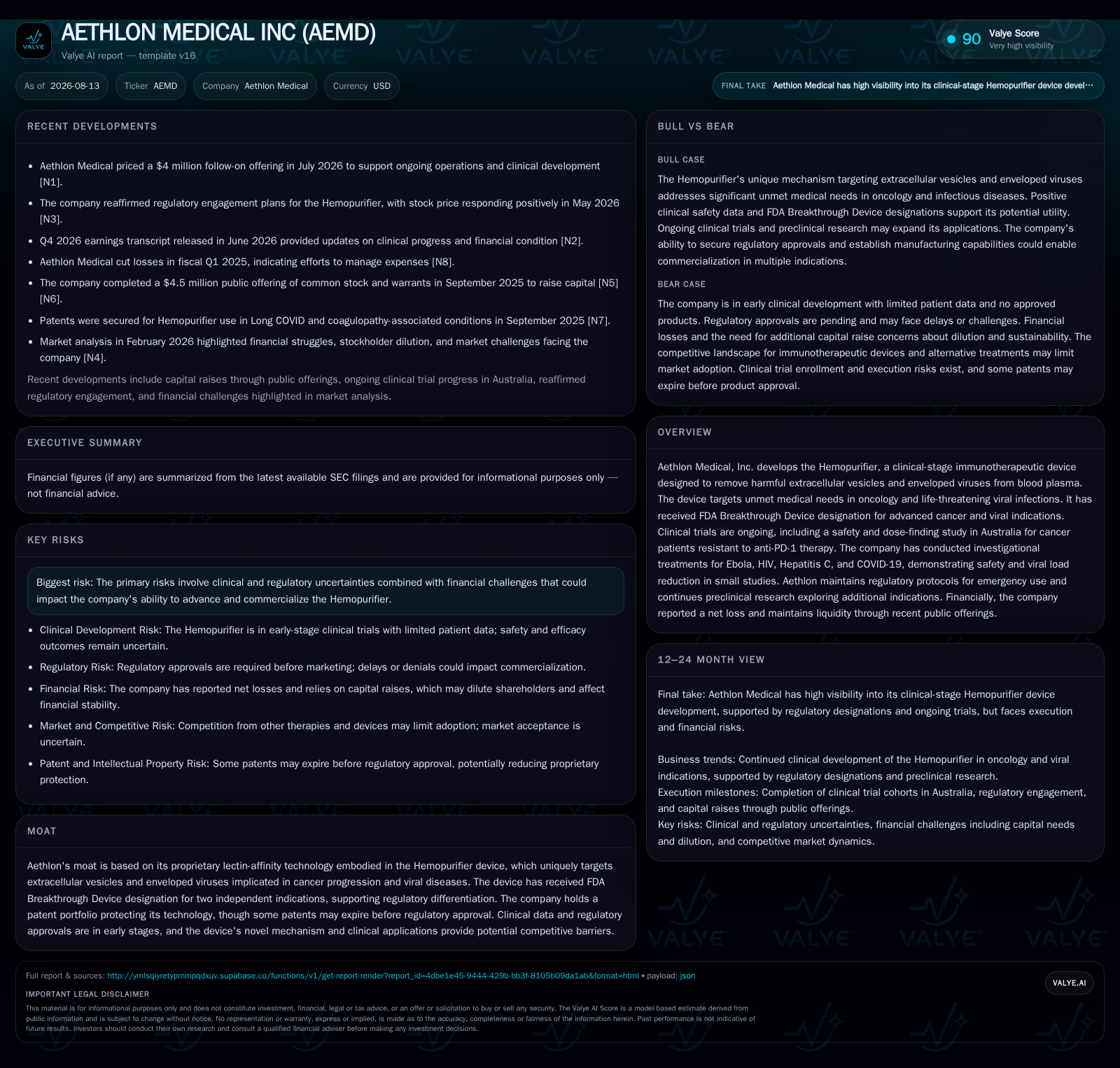
Aethlon Medical continues clinical development of its Hemopurifier device aimed at removing disease-associated extracellular vesicles and enveloped viruses. The latest quarterly update confirms progress in its oncology-focused safety and dose-finding trial in Australia, building on prior studies in infectious diseases. The company maintains a strong patent portfolio and regulatory designations but faces typical early-stage risks including funding needs and regulatory approval uncertainty. Its financial position reflects a cautious runway sustained by recent equity offerings without debt, underscoring reliance on further capital to support R&D and commercialization efforts.
Recent Operating Update
In its August 13, 2026 quarterly filing, Aethlon Medical confirmed continued enrollment in its Australian safety, feasibility, and dose-finding clinical trial evaluating the Hemopurifier in patients with solid tumors exhibiting stable or progressive disease despite anti-PD-1 therapy [S2]. This trial is pivotal to establishing human safety data and dose parameters necessary for regulatory submissions. The company retains FDA Breakthrough Device designation for the Hemopurifier's use in advanced/metastatic cancer unresponsive to standard therapies as well as for life-threatening viral infections without approved treatments [S1].
Beyond oncology, ongoing preclinical research explores applications such as Long COVID by analyzing extracellular vesicle profiles—demonstrating the platform's potential versatility [S5]. No new material risk factors were reported this quarter; however, inherent uncertainties remain typical for clinical-stage medical device companies progressing through complex regulatory pathways [S16].
Business Model Analysis
Aethlon Medical's Hemopurifier employs proprietary lectin-affinity technology within an extracorporeal device designed to selectively capture and remove pathogenic extracellular vesicles (EVs) and enveloped viruses from blood plasma. These particles are implicated in immune suppression, cancer metastasis, therapy resistance, and severity of viral infections [S1]. Revenue generation depends on successful clinical validation leading to FDA clearance followed by commercialization through direct sales or partnerships/licensing arrangements.
Currently pre-revenue due to investigational status, Aethlon finances R&D—including clinical trials and manufacturing scale-up conducted under FDA current Good Manufacturing Practice (cGMP) standards—primarily through equity offerings [S1],[S6]. Manufacturing involves assembling critical components sourced from limited suppliers requiring FDA qualification; delays here represent operational risks [S21]. Post-approval success also hinges on securing reimbursement coverage from third-party payors such as Medicare/Medicaid that require demonstration of "reasonable and necessary" use [S18].
Industry Structure & Competitive Position
Operating within the biotechnology medical devices sector targeting oncology and infectious diseases, Aethlon faces lengthy development cycles under stringent regulatory scrutiny across multiple jurisdictions. The Hemopurifier's niche as an extracorporeal blood filtration immunotherapeutic distinguishes it from conventional pharmacologic therapies but places it among competitors developing affinity-based or immunomodulatory devices targeting EVs or pathogens.
The FDA Breakthrough Device designations confer accelerated regulatory pathways that can reduce time-to-market relative to standard reviews—a significant competitive advantage given few similar devices have achieved parallel milestones [S1]. Nonetheless, companies like ExThera Medical Corporation exemplify evolving competition requiring differentiation through clinical efficacy, safety profile, ease of integration into hospital workflows, cost-effectiveness, and manufacturing readiness [S25]. Success depends on KPIs including trial enrollment pace, safety/adverse event monitoring, biomarker efficacy (e.g., viral load or EV clearance), manufacturing scale-up progress, partnership formation, and regulatory progress.
Growth Drivers
Growth catalysts include positive safety and efficacy data emerging from the Australian oncology trial alongside prior evidence from viral infection studies involving Ebola, HIV, HCV, and COVID-19 which demonstrated notable viral load reductions without serious adverse events [S1],[S26]. Expansion into indications like Long COVID highlights strategic adaptability powered by advances in EV biology.
Further drivers encompass strengthening the global patent portfolio protecting the Hemopurifier's proprietary binding technologies and therapeutic methods—supporting competitive defensibility [S25]. Regulatory advantages through Breakthrough Device designations facilitate expedited review processes [S28]. Transitioning manufacturing in-house under cGMP enables tighter quality control poised to support future commercial-scale production despite currently limited output aligned exclusively with clinical trials [S18]. Recent at-the-market equity raises totaling nearly $2 million post-quarter bolster working capital essential for advancing R&D prior to revenue generation [N1],[S6].
Risks & Watchpoints
Key risks revolve around clinical trial outcomes where efficacy signals must meet stringent safety thresholds without dose-limiting toxicities; adverse results could delay or prevent regulatory approvals [S26]. Manufacturing is vulnerable due to supplier dependency on critical components like GNA lectin sourced from vendors requiring FDA qualification—a process subject to delays impacting supply continuity [S21]. Regulatory changes or increased post-market surveillance demands may raise compliance costs or operational complexity [S4],[S10]. Reimbursement uncertainty persists given variability among payors absent long-term cost-effectiveness data [S18],[S22].
High net operating losses exceeding $7 million reflect ongoing heavy investment in R&D without imminent revenue; dilution risk remains from future capital raises needed to sustain operations [N1]. Cybersecurity risks concerning clinical data integrity also warrant vigilance given reputational stakes even at this developmental stage [S1]. Competition from pharmaceutical firms expanding into device platforms could elevate market entry barriers upon approval.
What To Watch Next
Upcoming milestones include enrollment completion in subsequent cohorts of the Australian oncology trial with interim data assessing reductions in circulating EVs correlated with clinical benefit—critical validation of mechanism-of-action hypotheses. Regulatory submissions related to Investigational Device Exemption amendments for manufacturing changes will indicate operational readiness. Further interactions with FDA regarding Breakthrough Device status or expedited pathways remain relevant.
From a financial perspective, successful ATM equity offerings extending runway beyond mid-2027 would demonstrate management’s capacity to fund R&D while pursuing partnerships or alliances that could mitigate commercialization risks. Announcements of collaborations or licensing deals would offer insights into market positioning. Monitoring developments in reimbursement policy engagement with CMS or private insurers will be key ahead of potential market launch.
Financial Profile Discussion
As of June 30, 2026, Aethlon held approximately $4.9 million in cash and equivalents against current liabilities of about $1 million, resulting in a strong current ratio of approximately 5.42—indicative of manageable near-term liquidity absent large unexpected expenses [F1]. The company reports no outstanding debt, consistent with early-stage biotech norms reliant on equity financing [F1]. Recent at-the-market equity raises generating nearly $2 million post-quarter provide essential capital enabling continued development without immediate dilution from debt instruments [N1],[S6].
Ongoing cash burn will hinge on patient recruitment success across trials plus costs associated with scaling manufacturing under FDA oversight—a determinant shaping longevity of current runway before future financing or partnership proceeds are required.
This analysis is based solely on publicly available filings as of August 13th, 2026. It does not constitute investment advice nor an offer or solicitation to buy or sell securities. Given inherent uncertainties in early-stage medical device development, investors should exercise caution as future developments may significantly alter operating trajectories described herein.
Disclaimer: This is research-only, informational analysis and not investment advice. It may include AI-generated interpretation and general industry context. Always verify important details using primary sources.

Comments