
VIAVI Solutions Advances 3D Sensing and Network Infrastructure Amid Margin and Supply Chain Pressures
Strong Q4 data center demand offsets ongoing geopolitical and supply chain challenges for VIAVI Solutions.
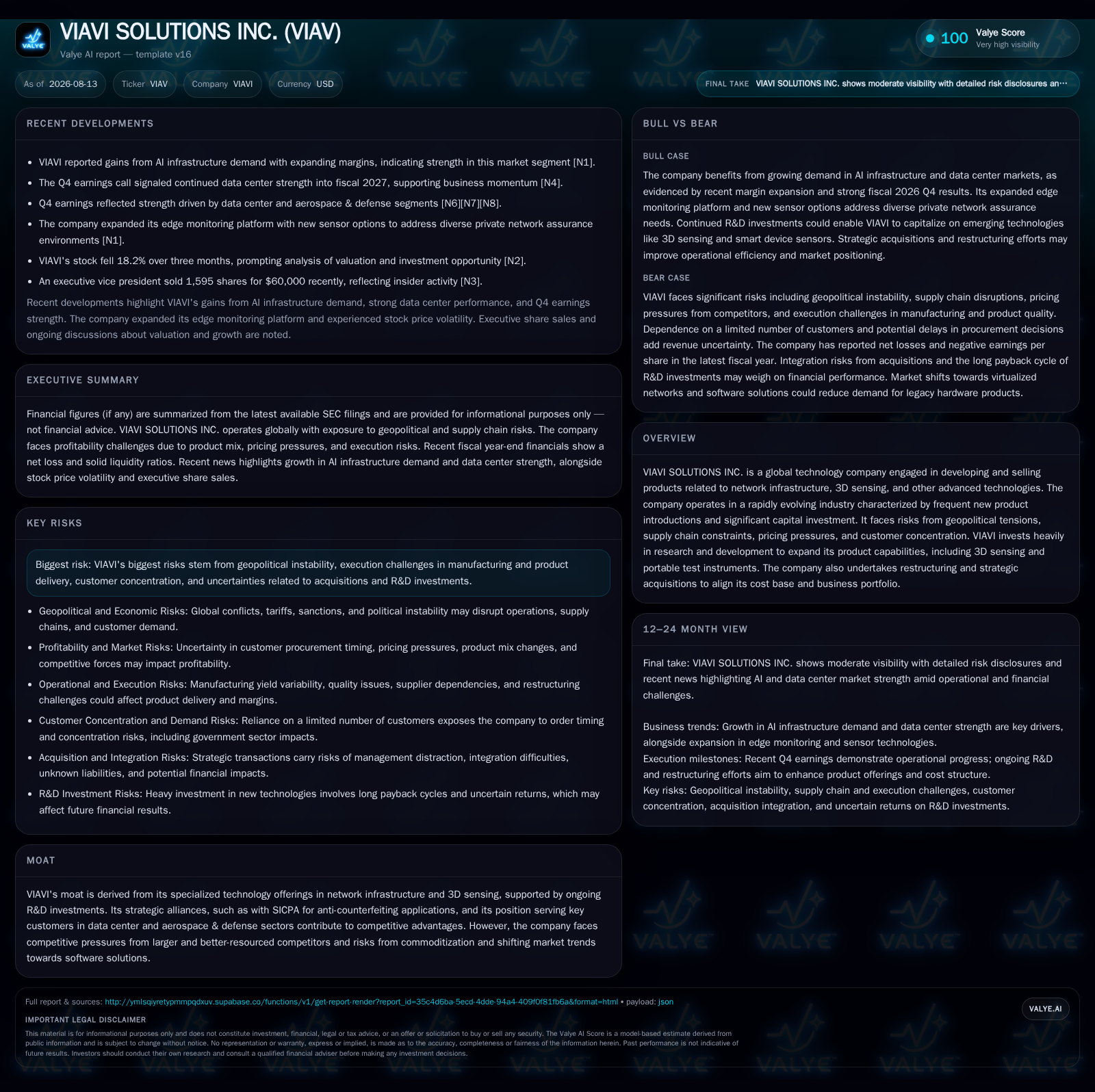
VIAVI Solutions reported solid fiscal Q4 results driven by strength in data center and aerospace & defense segments despite persistent supply chain constraints and pricing pressure affecting network products. The company’s business model, centered on specialized network infrastructure hardware and advanced 3D sensing technologies, faces cyclical demand alongside structural shifts toward software-enabled solutions. Ongoing investments in R&D and strategic restructuring aim to expand product capabilities and improve cost structures. Key risks remain in geopolitical tensions, customer concentration, and competitive pressures from commoditization and Asia-based rivals.
Recent Operating Update
VIAVI Solutions’ latest quarterly filing for the period ended April 30, 2026 highlights mixed but generally positive operational trends during persistent external headwinds. Notably, the company's fiscal fourth quarter—reported August 5, 2026—revealed strength in data center-related demand as well as aerospace & defense sectors that helped offset continued challenges in its network systems equipment (NSE) segment [S2][S3][N1][N2]. This momentum reflects ongoing secular tailwinds around cloud infrastructure buildout and military technology modernization.
However, supply chain constraints remain a salient issue. Extended lead times for critical components such as memory chips have exerted upward pressure on manufacturing costs while limiting throughput capacity [S2]. Such bottlenecks complicate timely fulfillment especially for NSE products that rely on intricate semiconductor assemblies. Additionally, persistent pricing pressure particularly from Asia-based competitors has weighed on average selling prices (ASPs), further impacting gross margins [S2][S1].
Despite these headwinds, VIAVI managed an improvement in operating margin overall—aided by cost optimization initiatives including corporate restructuring—as the optical solutions platform (OSP) segment experienced margin compression due to its growing proportion of lower-margin 3D sensing products alongside rising operating expenses [S1][S2]. This dynamic underscores a transitional phase where advanced sensing innovation coexists with legacy network hardware that faces commoditization challenges.
Business Model
VIAVI operates primarily in the midstream to downstream parts of the network infrastructure value chain, designing, manufacturing, and selling specialized hardware tailored for telecommunications test equipment, optical transport gear, and frontier imaging/sensing applications such as 3D sensing hardware used in consumer electronics and industrial security solutions [S1]. Revenue generation centers mainly on product sales complemented by service contracts that support after-sales calibration or maintenance.
The company segments revenue broadly into Network Systems Equipment (NSE), Optical Solutions Platform (OSP), and emerging technology verticals emphasizing 3D sensing. Customer concentration is high among select telecom carriers and cable operators who control significant capital expenditure decisions impacting VIAVI's NSE sales pipeline [S1]. This concentration amplifies cyclicality linked to carrier capex cycles as well as vulnerability to shifts in procurement timing.
Pricing power varies markedly: legacy NSE products face commoditization pressures from low-cost Asian manufacturers eroding ASPs, while newer OSP offerings leveraging proprietary sensing technology sustain higher margins despite ramp-up costs [S1]. Research & development investment remains substantial as VIAVI commits resources toward expanding its patent portfolio, enhancing instrumentation precision, and addressing new use cases like anti-counterfeiting tied to strategic alliances
Industry Structure and Competitive Position
VIAVI operates within a complex ecosystem alongside peers such as Keysight Technologies and Anritsu in the telecommunications test equipment domain. The sector demands continuous innovation fueled by rapid technology evolution—for example moving from 4G to expansive 5G/6G rollouts—and significant capital outlays for R&D coupled with agile supply chain management.
While VIAVI holds niche technological advantages particularly in precision optical test instruments and advanced 3D sensing platforms supported by alliances like with SICPA for anti-counterfeiting applications, it faces competitive pressures from larger diversified firms with deeper financial resources as well as aggressive pricing undercutting from Asian manufacturers targeting commoditized network equipment segments [S1]
The company's mid-size scale enables flexibility in pursuing targeted acquisitions to supplement organic innovation but limits its leverage against global macroeconomic risks such as tariffs or export restrictions influenced by geopolitical tensions—factors that may constrain market access or increase cost bases unpredictably [S1][S2].
Growth Drivers
Several secular trends underpin VIAVI’s growth outlook:
- Expansion of high-speed network infrastructure globally, driven by telecom carriers upgrading platforms to support increasing bandwidth demands associated with AI workloads, streaming media, and IoT proliferation.
- Data center buildouts accelerating cloud capacity worldwide translate into heightened needs for optical transport testing instruments where VIAVI holds core competency.
- Advancements in aerospace & defense spending on secure communications create expanded addressable markets for VIAVI’s precision measurement devices adapted for rugged environments.
- Emerging adoption of anti-counterfeiting features powered by sophisticated 3D sensing enhances demand within regulatory-driven sectors.
- Next-generation telecom technologies including 6G initiatives poised to drive new product launches backed by sustained R&D investment.
These drivers combine structural long-term growth potential with near-term cyclicality rooted in carrier capex budgeting cycles impacting NSE revenues specifically [S1][N8]
Risks / Watchpoints / Growth Constraints
Key risks confronting VIAVI include:
- Geopolitical uncertainties such as U.S.-China tensions raise risk of export controls or restricted access to critical markets like China which represent meaningful revenue pools.
- Supply chain disruptions persist as long lead times for semiconductors inflate component costs and could delay new product rollouts or strain working capital.
- Pricing erosion resulting from commoditization trends heightens margin pressure on legacy NSE products absent offset from higher-margin new offerings.
- High customer concentration escalates revenue volatility dependent on discretionary capex cycles of few dominant telecom carriers.
- Execution risks relating to integration of strategic acquisitions alongside internal restructuring efforts required to optimize cost structure amid shifting product mix balance.
- Regulatory compliance burdens especially linked to security standards impact product development timelines.
Monitoring order backlog trends relative to book-to-bill ratios along with margin progression within OSP versus NSE will be key signals of execution effectiveness going forward [S1][S2]
What to Watch Next
Upcoming milestones include tracking management commentary on:
- Order backlog evolution signaling end-market demand resilience or weakening.
- Progression of operating margins particularly given mix shift toward OSP/3D sensing products.
- Updates on geopolitical risk mitigation including potential impacts from tariffs or export restrictions involving China or other regions.
- Details on new product launches tied to next-generation telecommunications standards such as SHIELD-6G initiatives referenced publicly.
- Outcomes of ongoing restructuring efforts aimed at rationalizing manufacturing footprint could further improve cost base over time.
- R&D spend intensity relative to revenue offering insight into innovation pipeline health versus peer benchmarks.
The company’s current assets of $1,256 million and current liabilities of $681 million imply a current ratio of about 1.85, indicating satisfactory short-term liquidity [F1]
Maintaining balanced capital allocation amid funding acquisitions while nurturing organic growth via R&D will remain a focal point given competitive dynamics requiring both innovation intensity and cost discipline over strategic horizons. Any material changes in working capital requirements due to inventory buildup or increased receivables should be monitored considering component lead times impacting production velocity [F1][S2]
This analysis reflects information available through August 2026 filings and market disclosures. It aims to provide an informed overview based on disclosed facts without offering investment advice or valuation judgments. Industry dynamics surrounding rapid technological change combined with geopolitical volatility pose ongoing execution challenges typical among midsize hardware suppliers serving network infrastructure and advanced technology markets.
Disclaimer: This is research-only, informational analysis and not investment advice. It may include AI-generated interpretation and general industry context. Always verify important details using primary sources.

Comments