
Titan Acquisition’s Progress on Business Combination Highlights Critical Liquidity and Redemption Dynamics
Recent amendments to Titan Acquisition Corp's business combination agreement intensify redemption timing and liquidity scrutiny ahead of deal closing.
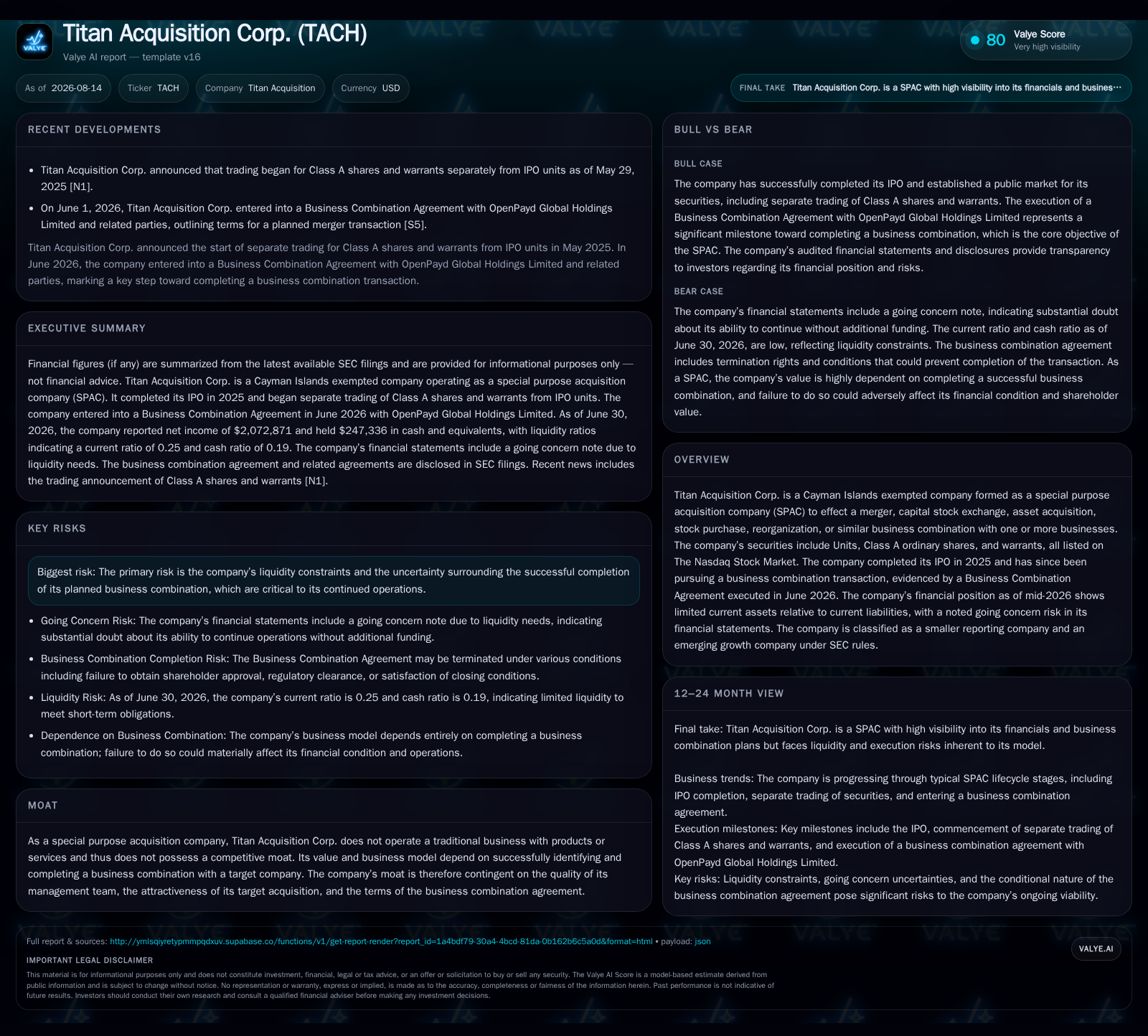
Titan Acquisition Corp, a Cayman Islands-based SPAC, amended its Business Combination Agreement in June 2026 to prioritize redeeming all outstanding warrants prior to or concurrent with the pending merger closing. This amendment highlights the company's growing focus on managing dilution risks and capital availability as it nears the de-SPAC transaction. Meanwhile, its latest quarterly filing reveals significant liquidity constraints, with a sub-1 current ratio underscoring going concern risk before deal completion. Redemption rights held by public shareholders add further complexity by potentially reducing cash available for acquisition funding, marking key risk points that will define shareholder value realization. Peer SPACs’ deal timelines and redemption profiles offer useful benchmarks to contextualize Titan's progress and challenges.
SPAC Execution Milestone: Recent Amendments Set New Redemption Efforts Timeline
Titan Acquisition Corp materially updated its path toward completing its targeted business combination through a First Amendment executed on June 11, 2026. This amendment explicitly commits the parties to use their "reasonable best efforts" to redeem all outstanding purchaser warrants either prior to or concurrently with the acquisition closing [S3]. The practical effect is a concerted effort to manage dilution by synchronizing warrant redemptions with deal consummation. This coordination shapes the future capital structure of the combined entity by controlling how many warrants convert into equity at or immediately after closing, thereby mitigating unexpected expansion of share count that would dilute existing investors.
This development signals a sharpening of focus on post-deal equity economics as Titan approaches the execution point. It also suggests that both Titan and its target company are actively refining transaction terms in response to market feedback or internal funding assessments, consistent with best practices among well-managed SPACs where warrant exercise can significantly influence valuation dynamics.
Understanding Titan's Financial Architecture: Units, Warrants, and Sponsorship Alignment
Titan was formed as a special purpose acquisition company (SPAC) with an IPO completed in 2025 that raised capital by selling units comprising one Class A ordinary share plus one-half warrant exercisable at $11.50 per share [S1]. The sponsorship structure includes founder shares subject to vesting conditions linked closely to stock price milestones post-business combination [S20]. This alignment creates incentives for sponsors to pursue value-accretive deal closure while balancing risks related to delayed or unsuccessful combinations.
Unlike traditional operating companies, Titan operates purely as a capital vehicle upstream from private companies seeking access to public markets. Revenues do not derive from product sales but from monetization events—namely the completion of a 'de-SPAC' transaction.
The sponsor's promote percentage and vesting tied to share price thresholds serve as retention mechanisms that incentivize driving deal success and sustained post-combination performance [S20]. Lock-up periods enforce temporary holding of shares received from the merger, further aligning interests in medium-term value creation.
Investor Dynamics: Redemption Rights Impacting Available Capital for Acquisition Closing
A defining feature impacting Titan’s capital adequacy entering the business combination phase is public shareholder redemption rights allowing electing holders to redeem their Class A ordinary shares for a pro rata portion of the trust account prior to deal close [S23]. This mechanism presents a double-edged sword: while reassuring investors about risk mitigation, it complicates available funding by potentially reducing cash accessible for acquisition funding.
High redemption rates reduce net proceeds from IPO trust accounts deployed toward buying out target shareholders or financing growth initiatives. Titan’s filings underscore this dynamic since high levels of redemptions amplify liquidity pressure — introducing uncertainty over sufficiency of funds for closing conditions tied to minimum proceeds quantum [S3], [S2]. The presence of redemption agreements sought with PIPE investors signals attempts to secure non-redemption commitments enhancing deal capital stability.
This nexus between public shareholders’ redemptions and acquisition financing marks a critical operating KPI—redemption rate—to monitor closely as it directly affects deal feasibility and ultimate shareholder value realization.
Liquidity Constraints Reveal Heightened Going Concern Risk Preceding Business Combination Close
Titan’s financial statements as of June 30, 2026, reveal a stark imbalance between current assets ($335K) and current liabilities ($1.33M), resulting in a critically low current ratio of approximately 0.25 [F1]. This metric indicates severe liquidity constraints that intensify operational sustainability challenges ahead of transaction close [S2]. The company explicitly acknowledges going concern risk owing to this financial position.
Given the SPAC structure’s limited operational cash flow generation until de-SPAC closing unlocks combined enterprise economic activity, these constraints reflect inevitable pre-close burn rates largely driven by administrative costs such as professional fees associated with offering expenses, regulatory compliance, and ongoing corporate governance.
Comparison With SPAC Peers: Redemption Rates, Trust Size, and Timing Benchmarks Matter
In broader sector context, Titan’s situation typifies key SPAC execution challenges evidenced across peer vehicles targeting technology or fintech sectors. Comparable peers often exhibit similar redemption patterns influencing available acquisition funds, necessitating calibrated trust account sizing relative to minimum proceeds needed [S3].
Titans’ amended strategy around simultaneous warrant redemptions aligns with industry trends aiming to stabilize post-deal capitalization tables by curbing dilutive surprise elements typical in multi-stage warrant exercises.
Benchmarking against peer SPACs also stresses importance of timing; completing business combinations within mandated lifespans maintains listing compliance while safeguarding shareholder value by minimizing prolonged exposure to pre-close dilution or market volatility risks.
Sponsor track records become critical differentiators in securing investor confidence crucial for PIPE commitments which supplement trust funds when public redemptions are elevated.
Growth Prospects Hinge on Timely De-SPAC Closure Amid Market Conditions and Sponsor Incentives
Growth outlook for Titan fundamentally depends on successfully executing its business combination agreement within stipulated timelines while navigating market liquidity fluctuations affecting investor appetite for SPAC IPO follow-ons or PIPE rounds [S20]. Sponsors' vested interest via promote shares structured around post-close stock price milestones offers positive alignment incentive to expedite quality deal sourcing and closing
Market trends favoring alternative routes for private companies seeking public listings enhance demand potential for deals like Titan’s target merger; however, macroeconomic conditions impacting volatility or capital markets liquidity can delay or derail transaction progress.
Risks to Completion: Redemption Volatility, Dilution Effects, and Sponsor-Public Shareholder Conflicts
Titan faces several material risks germane to all SPACs but amplified by its tight liquidity scenario. Chief among them are:
- Failure to complete business combination within required deadlines risking liquidation and loss of strategic value.
- Elevated shareholder redemptions depleting cash reserves required for acquisition payment obligations increasing dependency on PIPE investors.
- Dilution pressures from potential warrant exercises coupled with high sponsor promote stake exacerbating shareholder conflicts if not transparently managed.
- Regulatory hurdles including SEC scrutiny over disclosures could delay proxy statements or approvals adversely impacting timelines.
- Limited operating history confines management assessment primarily around financial structuring capabilities rather than operational execution prowess [S2], [S3].
Close monitoring of these vectors is indispensable as incremental developments unfold toward closing milestones.
What To Watch Next: Upcoming Proxy Filing Milestones Will Signal Deal Viability Outlook
Key near-term milestones will crystallize investor perception regarding Titan’s path forward:
- Filing and SEC effectiveness of Form F-4 registration statement incorporating detailed proxy materials clarifying business combination terms [S4].
- Scheduling Extraordinary Meeting of shareholders voting on approval coupled with Special Warrantholder Meetings targeting warrant treatment adoption.
- Disclosure updates on subscription agreements with PIPE investors alongside non-redemption commitments strengthening confidence in minimum proceeds satisfaction requirements.
- Management commentary on any renegotiations addressing timing extensions or amended covenants due to market developments.[S3], These milestones comprise evidentiary touchpoints validating whether Titan's strategic plans withstand execution realities amidst an intensely competitive SPAC environment.
Financial Profile Discussion
Disclaimer: This is research-only, informational analysis and not investment advice. It may include AI-generated interpretation and general industry context. Always verify important details using primary sources.

Comments