
Spruce Power’s Leverage Strategy Tests Liquidity Amid Solar Asset Expansion
The company's latest quarter reveals growing financing pressures as aggressive solar portfolio growth challenges cash flow flexibility.
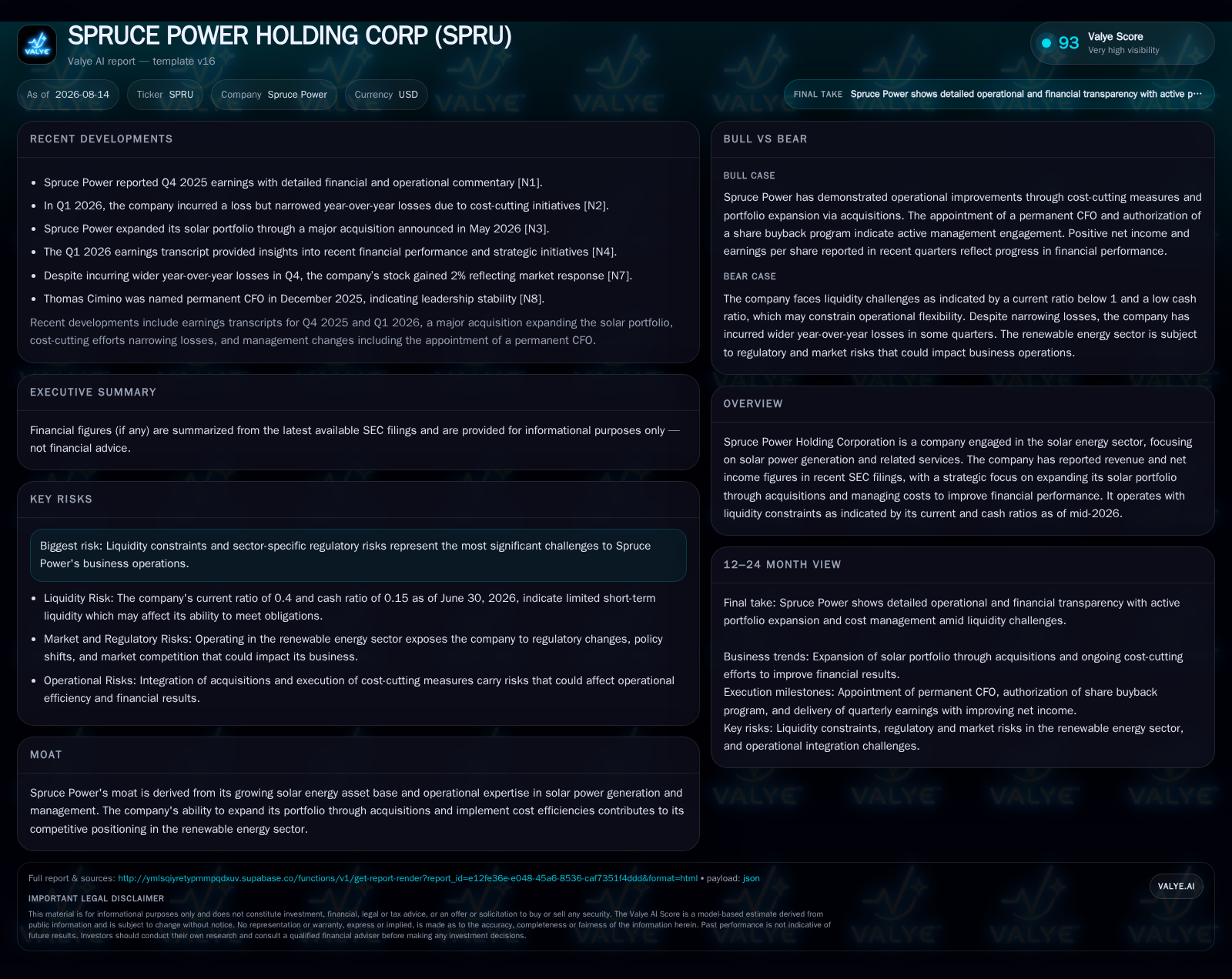
Spruce Power Holding Corporation's Q2 2026 filing underscores the tension between rapid solar asset acquisitions and mounting liquidity constraints. While expanding its installed megawatt capacity via acquisitions bolsters its revenue base tied to long-term PPAs and renewable energy credits, the company's low current ratio and elevated net debt highlight potential operational risks. Cost management in operations and maintenance is a focal point, though financial leverage remains a key concern amid capital-intensive growth plans.
Q2 Operating Update Signals Growing Pains in Asset Expansion
Spruce Power’s most recent quarterly filing dated August 13, 2026, paints a picture of simultaneous portfolio expansion and tightening liquidity. While the company pursues aggressive growth of its solar asset base—a key driver of future revenue—the balance sheet reveals stress points with current liabilities nearly triple current assets, reflecting a constrained current ratio of about 0.4 [F1], [S2]. This disparity raises questions about near-term financial flexibility during capital-intensive operations.
The company’s disclosures do not indicate a material shift in risk factors since the prior year but emphasize continuing uncertainties around liquidity and execution risks tied to rapid scaling [S2]. The latest event filing also confirms ongoing press communications aligning with these themes but stops short of providing detailed operational KPIs such as installed capacity or generation volumes [S3], [S5]. This pattern suggests Spruce is still in a phase of assimilating acquired assets while managing cost structures.
Unpacking Spruce Power’s Solar Asset Revenue Drivers and O&M Efficiency
Spruce Power’s business model centers on owning photovoltaic (PV) solar generating assets, which produce electricity sold primarily under long-term power purchase agreements (PPAs) [S1]. These contracts provide predictable revenue streams from utilities or commercial counterparties. Additionally, Spruce monetizes associated renewable energy credits (RECs), including solar renewable energy certificates (SRECs), which supplement income alongside government incentives
Crucial to understanding revenue mechanics is the pace at which Spruce expands its installed megawatt capacity through acquisitions—the principal means by which it grows contractual cash flows [S1]. The SEMTH acquisition exemplifies this approach, with 20-year use rights on some 22,500 customer contracts contributing durable payment streams
Cost management in operations and maintenance (O&M) is critical for margin enhancement. Maintaining low O&M expenses per installed MW optimizes operational margins within an industry where levelized cost of energy (LCOE) competitiveness matters significantly. However, the filings provide limited granularity on O&M cost trends or efficiency gains this quarter, suggesting room for closer monitoring as Spruce scales its asset portfolio.
Competitive Dynamics for Solar PPAs and Renewable Credit Monetization
Within the solar independent power producer (IPP) segment, PPA contract quality—defined by duration, counterparty creditworthiness, and price terms—is vital for stable cash flows. Spruce occupies a middle tier compared to large-scale renewable energy utilities such as NextEra Energy, which benefit from massive scale and vertically integrated distribution networks.
Peers like Brookfield Renewable Partners focus heavily on asset acquisition and long-term contracts providing steady cash flow visibility. Residential-focused platforms such as Sunrun blend asset ownership with installation services but face distinct customer dynamics compared to Spruce's commercial PPA-heavy portfolio.
Monetization of renewable energy credits supplements power revenues but is susceptible to fluctuations in regulatory policy and REC market dynamics. This exposes Spruce to sector-wide risk factors distinct from pure electricity market price volatility, especially given regulatory sensitivity surrounding government incentives.
Growth Potential Fueled by Acquisitions versus Capital Intensity Risks
Spruce’s expansion strategy primarily uses acquisitions to grow contracted capacity rapidly rather than organic greenfield development alone. Such asset purchases directly add installed MW capacity along with associated contract rights but require significant upfront capital investment.
This approach creates an inherent tension: while acquisitions boost top-line visibility through incremental PPA revenues and RECs, they also increase indebtedness. As of June 30, 2026, total debt stood near $679.5 million against cash reserves under $45 million—a leverage profile that underscores high financial risk relative to liquidity buffers [F1]
In this capital-intensive sector where depreciation spans decades but debt service is immediate, failure to optimize debt costs or refinance expediently could constrain future acquisition activity. Confirmation of sustainable growth would come from improved operating cash flow conversion alongside strategic deleveraging or access to enhanced credit lines.
Risk Assessment: Liquidity Constraints and Regulatory Sensitivities
Liquidity challenges are plainly reflected in the low current ratio (~0.4) which signals potential difficulty meeting short-term obligations without external financing or operational cash flow improvements [F1]. The company explicitly acknowledges no material changes in known risk factors but maintains scrutiny over regulatory uncertainties affecting tariffs, incentive programs, and environmental permitting requirements—areas that can materially impact revenues or project economics [S2].
Other typical industry risks persist including PPA counterparty credit exposure and operational risks from weather variability or equipment performance deviations. These could impair generation volumes or increase unplanned maintenance costs, pressuring margins further.
Catalysts and Milestones to Watch in Portfolio Expansion and Contracts Renewal
Upcoming quarters will be revealing regarding Spruce’s ability to continue signing new PPAs or acquiring additional portfolios on accretive terms. Events such as government incentive modifications or expanded tax credits could alter financial projections positively or negatively.
Refinancing efforts that improve liquidity profiles would represent pivotal milestones reducing balance-sheet strain. Similarly, announcements regarding improvements in contracting terms or customer retention rates would indicate strengthening revenue quality.
Tracking developments on these fronts—via SEC filings or investor communications—will illuminate whether Spruce can break free from its liquidity bottleneck while sustaining aggressive growth plans [S3], [S5].
Financial Profile Discussion: Leverage Burden Amid Growth Ambitions
Spruce Power balances roughly $679.5 million in total debt against cash & equivalents near $44.7 million as of mid-2026, translating into net debt around $635 million—a considerable leverage burden for a company operating in a capital-intensive segment reliant on steady operating cash flows [F1]
The current ratio of approximately 0.4 highlights tight short-term liquidity that may challenge working capital management absent additional financing maneuvers or improved operational cash generation [F1], [S2]. This stretched liquidity contrasts somewhat with larger solar IPPs or utilities like NextEra Energy that tend to exhibit more robust balance sheets supported by diversified asset bases.
Continued dependency on external capital markets or refinancing poses execution risk especially if interest rates rise or credit availability tightens market-wide. Thus, financial discipline alongside operational execution will be critical markers going forward.
This analysis focuses strictly on officially reported metrics and disclosures through Q2 2026 without speculative insight into proprietary contracts or forward guidance beyond documented evidence [F1][S1][S2][S3][S5]
Disclaimer: This is research-only, informational analysis and not investment advice. It may include AI-generated interpretation and general industry context. Always verify important details using primary sources.

Comments