
LENSAR’s ALLY System Growth Defies Merger Fallout Amid Operational Challenges
After a terminated merger with Alcon, LENSAR reports improved profitability driven by rising ALLY System placements and consumable sales, yet faces inflationary and market adoption risks.
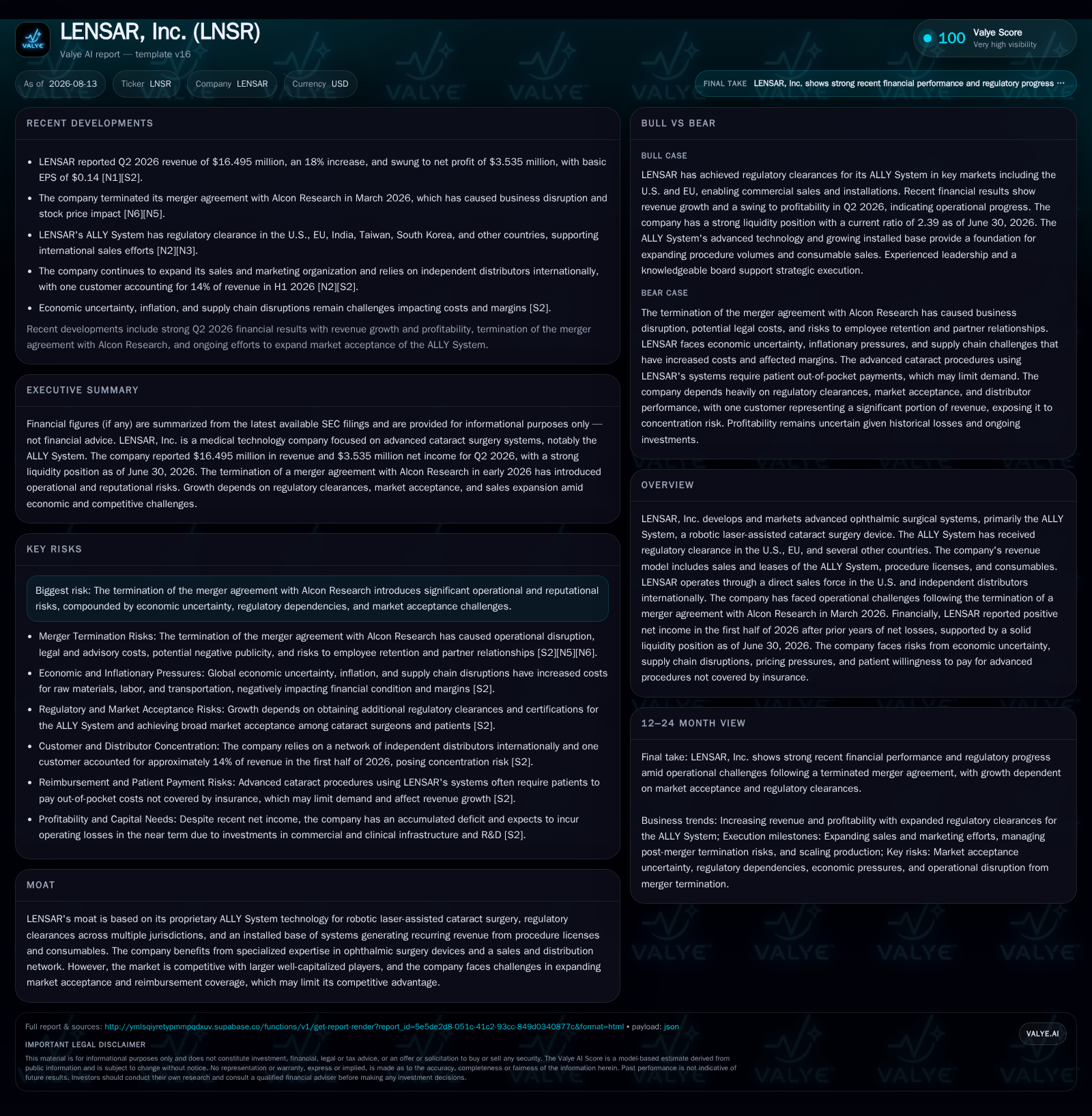
LENSAR, Inc. posted an 18% revenue increase in Q2 2026 and swung to profitability after terminating a merger agreement with Alcon Research earlier in the year. Its ALLY robotic laser-assisted cataract surgery system continues to gain market penetration supported by regulatory clearances across major geographies. The company's direct U.S. sales combined with international distributor channels underpin revenue growth, particularly from device sales, leases, procedure licenses, and consumables. However, economic uncertainties, supply chain inflation, reimbursement challenges, and competitive pressure from larger ophthalmic device manufacturers remain key risks dampening near-term margin and growth prospects. LENSAR’s ability to recover and expand its installed base usage following the merger fallout will be critical in sustaining positive operating momentum.
Recent Operating Update
However, this performance arises in the shadow of significant strategic turbulence—the termination in March 2026 of a previously announced merger agreement with industry heavyweight Alcon Research introduced considerable operational disruption risks [S2]. These include potential retention challenges among key personnel pivotal for commercial execution as well as strained relationships with collaborators, suppliers, and partners wary of the changed corporate trajectory. Additionally, LENSAR faces ongoing legal exposures stemming from shareholder litigation tied to the aborted merger transaction. Management acknowledges uncertainty on how long these disruptions may impair momentum or investor sentiment surrounding system placements going forward.
Business Model
LENSAR generates revenue primarily through three streams: sale and leasing of the ALLY Systems themselves; procedure licenses granting surgeons access to software functionalities; and consumables used during cataract surgeries performed with these systems [S1]. This mirrors common medical device business archetypes where upfront capital equipment sales are supplemented by recurring revenues tied directly to procedure volume — critical for margin sustainability given the high fixed costs inherent in surgical device manufacturing.
The ALLY System distinguishes itself as a robotic laser-assisted platform designed to improve surgical precision in cataract procedures—a segment driven structurally by an aging global population and rising cataract prevalence. Revenue depends on both growing the installed base (system placements) and increasing utilization rates reflected in procedure licenses and consumable throughput per installed unit. The company’s balance between selling outright systems versus leasing reflects customer preferences in hospital budgets constrained by capital expenditures cycles.
Maintaining regulatory clearance across major markets is fundamental not only for new sales but also support services that encourage surgeon adoption and lock-in through clinical validation programs—another moat element protecting product uptake against competing technologies [S1]
Industry Structure and Competitive Position
Operating within the ophthalmic surgical medical devices industry situates LENSAR among players specializing in highly regulated capital equipment that requires extensive clinical evidence and surgeon training for adoption. Peers typically include companies developing laser-based surgical tools or robotic platforms focused on eye surgeries.
The competitive landscape is dominated by larger well-capitalized firms capable of significant R&D investment alongside robust regulatory affairs teams ensuring rapid approval cycles globally. While LENSAR maintains its niche through proprietary technology embodied in the ALLY System and multi-jurisdiction clearances, its smaller scale relative to incumbents represents both opportunity—through innovation-driven differentiation—and risk given limited resources to expand breadth or manage reimbursement hurdles.
The recent failed merger with Alcon underscores these pressures: larger competitors consolidate scale advantages that can compress reimbursement rates while intensifying aftermarket consumable capture.
Growth Drivers
Structural industry tailwinds underpinning LENSAR's long-term potential include:
- Demographic trends driving increased cataract incidence worldwide;
- Continued adoption of robotic-assisted techniques promising better outcomes driving surgeon preference shifts;
- Expansion into new geographic markets facilitated by ongoing regulatory submissions;
- Development of next-generation ALLY systems aiming at broader indications or enhanced functionalities;
- Improving reimbursement coverage encouraging broader hospital procurement;
- Scaling installed base to amplify recurring revenue from consumables and licenses;
- Partnering strategies enhancing distribution reach beyond core markets.
Despite short-term headwinds post-merger termination, these drivers represent durable market opportunities hinging on consistent system placement cadence backed by clinical validation efforts reinforcing the value proposition.
Risks and Watchpoints
Key risks challenging LENSAR’s progress include:
- Operational disruption resulting from aborted merger activities—employee attrition or slowed new hires could stall commercialization efforts;
- Supply chain inflation notably affecting component costs amid global shortages without full price pass-through curbing margin expansion prospects [S15];
- Market acceptance risk where surgeon switching costs or hospital budget cycles delay wider adoption;
- Pricing pressures as payors increasingly scrutinize expensive capital equipment purchases resulting in tightened reimbursement coverage;
- Litigation risk linked to merger fallout potentially diverting management focus and financial resources;
- Dependency on a limited number of products (ALLY System) heightens vulnerability if competitive or technological obsolescence occurs;
- Economic uncertainties impacting elective surgery volumes especially given broader macroeconomic instability affecting patient willingness to pay.
Monitoring sequential system placement trends post-merger disruption alongside evolving gross margin performance amid inflationary pressures will provide concrete signals on operational resilience.
What to Watch Next
Upcoming milestones crucial for validating ongoing momentum include:
- Quarterly updates on ALLY System unit placements indicating recovery or acceleration post-merger termination;
- Progress on further regulatory clearances expanding addressable markets;
- Updates on procedure license uptake per installed system signaling improved utilization rates;
- Gross margin trends reflecting either mitigation of supply cost inflation or continued compression;
- Announcements regarding strategic partnerships or expanded distributor agreements outside core U.S. markets;
- Developments related to shareholder litigation resolution timelines reducing overhangs on management bandwidth;
- Any changes in pricing strategy reflecting market reception to cost pressures.
Tracking these KPIs together will clarify sustainability of recent profitability gains amid external pressures.
Financial Profile Discussion
As of June 30, 2026, LENSAR maintained cash and cash equivalents totaling approximately $13.57 million alongside current assets aggregating $47.03 million versus current liabilities near $19.64 million producing a healthy current ratio of approximately 2.39 — indicative of solid near-term liquidity sufficiency [F1]
LENSAR's credit facilities remain undrawn at quarter-end although subject to covenants restricting certain operational flexibilities such as dividend payments or additional indebtedness without lender consent—a standard constraint that necessitates cautious cash flow management moving forward [S4][S16]
Capital allocation decisions will likely prioritize sustaining commercial infrastructure investment needed for continued ALLY System rollout plus R&D spending aimed at product refinements essential in this innovation-dependent sector.
Conclusion
LENSAR's interim operating performance substantiates incremental progress reclaiming growth momentum after a disruptive merger collapse earlier this year. The combination of expanding ALLY System placements authorized via multi-region regulatory clearances plus recurrent revenues from licenses and consumables underpin a resilient business model characteristic of successful ophthalmic device developers.
Yet material execution risks remain heightened due to economic uncertainties fueled by inflationary cost pressures unrecouped via selling prices alongside challenges in fully restoring confidence among key stakeholders post-merger termination. Navigating these factors effectively while driving cascade adoption through strong clinical validation programs will be critical determinants shaping whether LENSAR can translate recent profitability achievements into sustainable long-term value creation.
This analysis is prepared solely for informational purposes without any research view or investment advice.
Disclaimer: This is research-only, informational analysis and not investment advice. It may include AI-generated interpretation and general industry context. Always verify important details using primary sources.

Comments