
GraniteShares Gold Trust Reports Steady NAV Growth Amid Gold Price Volatility
The Trust's latest quarterly filing highlights stable net asset value growth and a modest decline in shares outstanding, reflecting typical passive trust dynamics amid fluctuating gold prices.
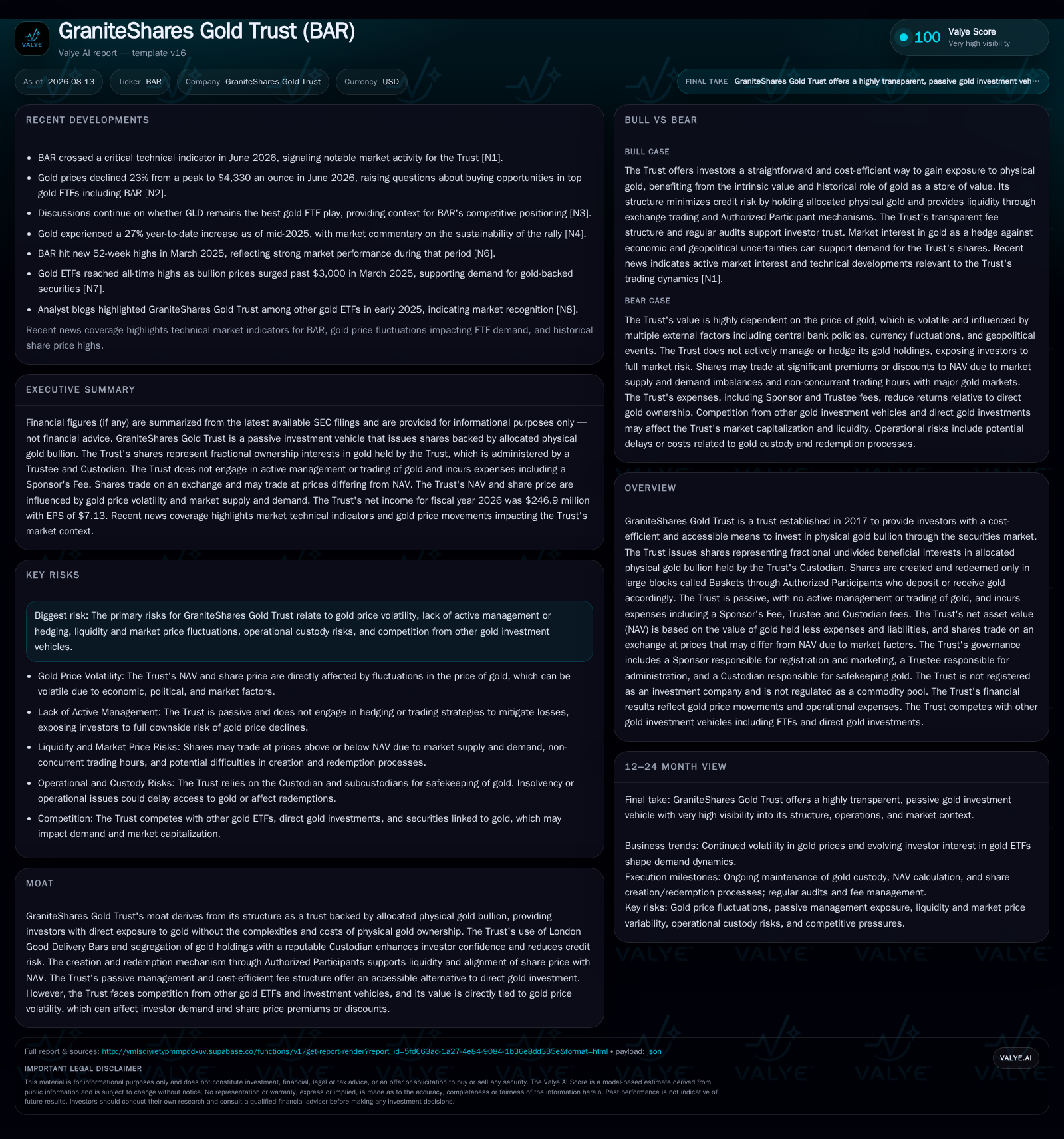
GraniteShares Gold Trust’s Q1 2026 report shows its net asset value increased to approximately $1.33 billion by June 30, 2026, up from $1.11 billion a year prior, while shares outstanding declined slightly to about 33.65 million. Operating as a passive physical gold trust, GraniteShares provides investors fractional ownership of allocated bullion held by ICBC Standard Bank, with liquidity facilitated by Authorized Participants through creation and redemption of large basket units. Share prices may trade at premiums or discounts to NAV due to commodity price volatility and market timing differences. The Trust’s fee structure gradually reduces the gold backing per share, imposing a structural cost on returns. Positioned alongside peers like SPDR Gold Shares (GLD) and iShares Gold Trust (IAU), GraniteShares competes on custodial quality, fee levels, and liquidity mechanisms. Demand drivers include inflation hedging and portfolio diversification, while risks center on gold price swings, premium/discount variability, and dilution from ongoing fees.
Recent Operating Update: Sustained NAV Growth with Moderate Share Adjustments
GraniteShares Gold Trust reported its net asset value (NAV) at approximately $1.33 billion as of June 30, 2026, up from about $1.11 billion one year earlier [S1]. This growth reflects favorable movements in the underlying price of gold tempered by the impact of the Trust's operating expenses. Concurrently, the number of shares outstanding declined modestly from roughly 34.1 million to 33.65 million during this period [S1]. Such a reduction indicates modest net redemptions executed through Authorized Participants who redeem baskets of shares for physical gold or cash equivalents.
The combination of rising NAV alongside fewer outstanding shares suggests that while some investors exited positions—leading to decreased share count—the overall value entrusted increased due to appreciating bullion prices. This dynamic is typical for passive physical commodity trusts where investor demand directly influences assets under management through creation and redemption activity rather than active portfolio management or trading.
Business Model: Passive Ownership of Allocated Physical Gold Bullion
GraniteShares operates as a grantor trust issuing exchange-traded shares representing fractional undivided ownership interests in allocated physical gold bullion securely held by ICBC Standard Bank acting as Custodian [S1]. The bullion complies with London Good Delivery standards; individual bars are identifiable via serial numbers, refiner marks, assay certificates, and weight records maintained meticulously through custodial books [S20]. This transparency fosters investor confidence in tangible asset backing versus unallocated claims.
The Trust offers investors an accessible alternative to direct bullion ownership that circumvents complexities such as transport logistics, safekeeping costs, insurance burdens, and assaying requirements. Authorized Participants facilitate liquidity by creating or redeeming large basket units—each consisting of 50,000 shares—via in-kind transfers of equivalent amounts of physical gold during these transactions [S24]
Operating passively without active trading or derivatives exposure [S1], GraniteShares generates revenue primarily through a Sponsor's Fee accrued daily at an annualized rate near 0.1749% of NAV payable monthly [S16]. This fee is satisfied through incremental sales of physical gold held by the Trust—a mechanism that gradually diminishes the ounce-equivalent backing per share over time unless fully offset by rising gold prices.
Liquidity Framework: Creation/Redemption Mechanisms and Market Pricing Dynamics
Liquidity is chiefly maintained via Authorized Participants who arbitrage disparities between secondary market share prices and the Trust’s NAV derived from the LBMA Gold Price PM benchmark calculated daily around 4 p.m. New York time [S24]. By creating new baskets amid buying demand or redeeming baskets when selling pressure arises, these participants help keep market prices aligned with intrinsic NAV.
Nonetheless, GraniteShares’ shares may trade at premiums or discounts relative to NAV during periods when major global gold markets are closed but NYSE Arca remains open—creating timing mismatches that lead to short-term dislocations [S24]. Such deviations arise from supply-demand imbalances combined with asynchronous trading hours rather than fundamental changes in asset values.
Investors should understand these premium/discount fluctuations can amplify volatility beyond underlying bullion price movements—a characteristic common among physical commodity trusts lacking active hedging strategies.
Competitive Positioning: Peer Context in Physical Commodity Investment Trusts
GraniteShares competes within a broad universe of precious metals investment vehicles offering exposure through exchange-traded securities backed by allocated bullion. Key peers include SPDR Gold Shares (GLD) and iShares Gold Trust (IAU), which similarly provide passive access but differ materially in scale—with GLD commanding significantly higher assets under management—and fee structures influencing total investor costs.
Custodial arrangements vary among peers; GraniteShares employs ICBC Standard Bank as custodian adhering strictly to London Bullion Market Association delivery rules audited biannually by specialist assayers ensuring compliance and transparency [S20], [S27]. The Trustee role is fulfilled by The Bank of New York Mellon whose capital adequacy (exceeding $150 million) supports operational continuity under regulatory supervision [S19].
Compared with futures-based commodity funds or mining equity investments that expose investors to leverage or company-specific operational risks respectively, GraniteShares’ pure-play passive model offers direct commodity exposure without derivative counterparty risk but accepts structural costs from sponsor fees and potential liquidity-driven pricing inefficiencies.
Growth Drivers: Inflation Hedging Demand & Enhanced Liquidity Networks
Investor demand for safe-haven assets amid macroeconomic uncertainty continues fueling inflows into physical commodity trusts like GraniteShares. Rising inflation pressures globally enhance appeal for direct bullion exposure as a portfolio diversifier uncorrelated with traditional equity or fixed income markets.
Regulatory clarity regarding trust structures bolsters institutional adoption—particularly among retirement plans constrained by fiduciary prudence rules under frameworks such as ERISA—which prefer straightforward bullion exposure without complex derivatives or custody challenges [S14].
Expanding Authorized Participant networks improves creation/redemption flexibility fostering tighter alignment between share prices and underlying NAV—a key factor enhancing liquidity attractiveness during volatile conditions.
Technological innovations improving custody security including blockchain-enabled tracking or multi-party verification hold potential for future efficiency gains that could compress expense ratios thereby benefiting investors indirectly.
Risks & Watchpoints: Commodity Volatility, Dilution Effects & Market Pricing Variability
Gold’s inherent price volatility remains the primary risk driving unpredictable fluctuations in share value regardless of investment horizon—historical patterns caution against assuming guaranteed mid- or long-term profits even absent fees given extended flat or declining price cycles [S1].
Liquidity constraints can cause persistent premiums or discounts relative to NAV especially during off-hours across global markets risking elevated trading spreads detrimental to retail execution quality.
Ongoing sponsor fees necessitate regular sales of underlying gold reducing ounce-equivalent holdings per share over time unless offset sufficiently by price appreciation—a subtle dilution mechanism eroding gross returns emphasizing reliance on sustained bullish bullion trends.
Operational custody risks persist despite stringent controls through reputable custodians; segregation requirements under LBMA practices and frequent independent audits mitigate but do not eliminate remote default possibilities.
Investors should monitor quarterly disclosures detailing creation/redemption volumes as net creations suggest growing confidence while sustained redemptions warrant evaluation of sentiment shifts or competitive pressures [S2]. Regular tracking of premium/discount spreads assists assessment of liquidity health; wide persistent deviations may reflect arbitrage friction or market disruptions requiring caution.
Regulatory developments affecting institutional eligibility or tax treatment could materially influence inflows given institutional size importance; custodian audit outcomes also warrant scrutiny enabling early detection of operational issues potentially impacting trust reputation.
Macro indicators such as inflation expectations provide leading signals on demand fundamentals underpinning longer-term growth prospects.
Collectively observing these metrics provides actionable insights into evolving market dynamics shaping GraniteShares’ positioning within precious metal investment vehicles.
Disclaimer: This is research-only, informational analysis and not investment advice. It may include AI-generated interpretation and general industry context. Always verify important details using primary sources.

Comments