
Superstar Platforms Advances PawnTrust Amid Early Reliance on Loan Interest Income
The fintech marketplace platform is in beta, with current revenues driven by interest from promissory notes while operating losses and liquidity pressures persist.
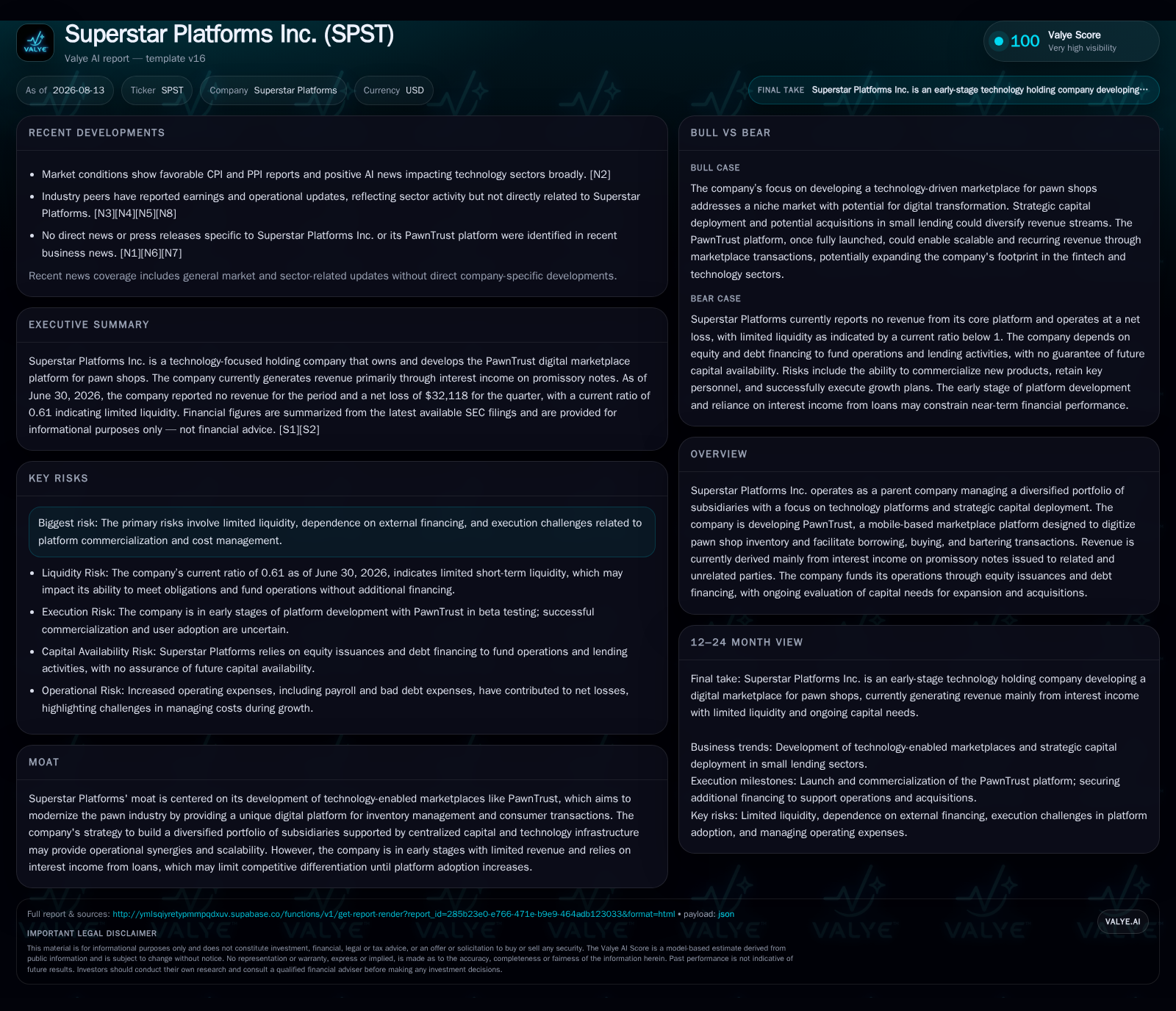
Superstar Platforms Inc. is progressing in developing PawnTrust, a mobile-based digital marketplace tailored for pawn shops that remains in beta testing as of mid-2026. The company’s revenue continues to come primarily from interest income on promissory notes issued to related and unrelated parties, with no marketplace sales recorded yet. Operating expenses have surged due to increased payroll and bad debt provisions linked to lending and platform development activities, resulting in widening net losses. Liquidity constraints are evident with a current ratio below one and total debt near $2.8 million, underscoring dependence on external financing through equity and debt issuances. The company’s strategy focuses on scaling PawnTrust’s user base and transaction volume while managing credit risk within its lending portfolio. Execution risks remain elevated given the early commercialization stage and financial stress, with key near-term milestones including the public launch of PawnTrust, loan portfolio growth without credit deterioration, and securing additional capital to support operations and acquisitions.
Recent Operating Update: PawnTrust Still Pre-Revenue; Loan Interest Income Sustains Operations
In its latest quarterly filing dated August 13, 2026, Superstar Platforms reported no revenue generated from the PawnTrust marketplace platform, which remains in beta testing ahead of an anticipated public rollout [S2], [S13]. The company continues to derive its primary income from interest earned on promissory notes issued to both related parties and independent borrowers. These loans carry fixed interest rates averaging around 24%, providing a recurring but early-stage revenue stream [S1], [S24]. This reliance on loan interest highlights the nascent commercial status of its marketplace business as it transitions from development toward monetization.
Business Model: Digital Marketplace Supported by Lending Portfolio
Superstar Platforms operates as a holding company managing subsidiaries focused on technology platform development paired with strategic capital deployment [S23]. Its core initiative is PawnTrust—a fintech-enabled digital marketplace designed exclusively for pawn shops to digitize their inventory and enable multiple transaction types including borrowing against collateral, buying, and bartering via a mobile app [S13]. While marketplace-generated transaction fees are expected post-launch, current revenues stem from interest income on loans funded through notes payable totaling approximately $2.7 million as of late 2025 [S6]. These borrowings support working capital needs and loan portfolio funding.
The loan receivable balance stood near $2.6 million at year-end 2025. These promissory notes mature typically within a year and require monthly interest payments [S6], [S24]. Management prudently maintains an allowance for credit losses around 3% of outstanding loans per ASC 326 CECL guidelines to mitigate expected impairments despite all loans performing per contractual terms as of end-2025 [S20]. Operating expenses surged by roughly 230% year-over-year reaching $541K in fiscal 2025 due largely to increased payroll tied to platform development efforts plus higher bad debt provisions associated with lending activities [F1], [S3]. Consequently, net losses widened to $335K in 2025.
Industry Context and Competitive Positioning
Superstar Platforms operates within the fintech marketplace platforms sector where firms combine technology-enabled marketplaces with embedded lending services targeting traditionally offline or underserved segments. PawnTrust’s vertical focus on pawn shops differentiates it within niche online marketplaces such as PawnGuru but requires overcoming significant offline operational inertia through mobile adoption incentives. Peers like Affirm Holdings or LendingClub exemplify hybrid lender-marketplace models but operate at more mature commercial stages.
Superstar’s competitive advantage lies in its integrated approach uniting technology-driven marketplaces with centralized funding platforms that provide working capital loans alongside a disciplined acquisition strategy aimed at expanding subsidiary capabilities [S23]. Operational scalability hinges on growing KPIs like active user counts, transaction frequency, loan origination volumes without rising defaults, and effective capital allocation balancing organic growth with acquisitions.
Growth Drivers
Key growth enablers include:
- Digital Adoption: Consumer and industry trends favoring digital transformation create structural tailwinds for PawnTrust’s mobile-first approach transitioning analog pawn transactions online.
- Platform Engagement: Expanding the number of participating pawn shops and consumer users drives network effects essential for marketplace viability.
- Loan Portfolio Growth: Increasing loan originations enhance interest income streams while leveraging underwriting discipline mitigates credit risk.
- Strategic Acquisitions: Targeted acquisitions in small lending businesses diversify footprint and enable cross-subsidiary synergies.
- Regulatory Evolution: Fintech regulatory clarity or easing facilitates faster geographic expansion.
Tracking loan default rates relative to allowance adequacy alongside customer acquisition costs versus lifetime value will be critical execution metrics going forward.
Risks and Watchpoints
Material risks include:
- Liquidity Pressure: A current ratio of approximately 0.61 alongside total debt near $2.82 million indicates tight working capital conditions requiring continuous equity or debt financing for operational continuity [F1].
- Execution Uncertainty: Commercializing PawnTrust depends heavily on overcoming early-stage user adoption challenges inherent in digitizing traditional pawn shop operations.
- Credit Risk Exposure: Concentrated loan portfolios combined with high fixed interest rates (~24%) amplify vulnerability should borrower repayment capacity weaken amid economic headwinds despite currently performing loans [S20].
- Regulatory Compliance: Complex fintech lending regulations and data privacy requirements could constrain market access or increase costs.
- Cost Management: Rising operating expenses without matching revenue growth pressure profitability; expense discipline will be essential during scale-up.
What to Watch Next
Upcoming milestones include:
- PawnTrust Public Launch: Monitoring timing adherence versus initial Q2/2026 target along with user onboarding metrics.
- Loan Portfolio Development: Growth trajectory balanced against stable performance metrics.
- Capital Raising Efforts: New equity or debt financings extending operational runway.
- Expense Trends: Whether cost growth stabilizes or persists indicating delayed market traction.
- Regulatory Updates: Changes impacting compliance burden or expansion plans.
Financial Profile Discussion
As of June 30, 2026, Superstar Platforms reported total debt approximating $2.82 million against current liabilities exceeding current assets (current liabilities ~$4.58 million vs assets ~$2.79 million as of prior quarter), resulting in a low current ratio near 0.61—signaling liquidity constraints typical among early-stage fintech firms investing ahead of revenue realization [F1]
Operating losses expanded substantially in fiscal 2025 driven by increased payroll supporting platform development plus elevated bad debt expense aligned with CECL credit loss provisioning standards [F1], [S3], [S20]. The company depends heavily on ongoing capital infusions via equity issuances—largely through share offerings linked to debt conversions—and promissory note borrowings mainly from affiliated parties underpinning working capital needs [S19], [S6]. Free cash flow generation remains distant given the early commercialization phase pending scaling of transactional revenues beyond current reliance on loan interest spreads.
In sum, Superstar Platforms’ financial profile typifies a nascent fintech marketplace entity transitioning from concept toward commercial launch with attendant execution challenges marked by operating losses and financing dependency. Continued progress hinges critically on successful product commercialization coupled with prudent credit risk management amid evolving market dynamics.
This analysis is based solely on publicly filed SEC disclosures as of August 13, 2026 and does not constitute investment advice or endorsement.
Disclaimer: This is research-only, informational analysis and not investment advice. It may include AI-generated interpretation and general industry context. Always verify important details using primary sources.

Comments