
NET Power Shifts Strategy to Rapid Natural Gas Deployment with Post-Combustion Capture Amid Offtake Uncertainty
The company pivots from proprietary oxy-combustion tech to licensing post-combustion carbon capture, focusing on early-stage Project Permian amid customer and financing challenges.
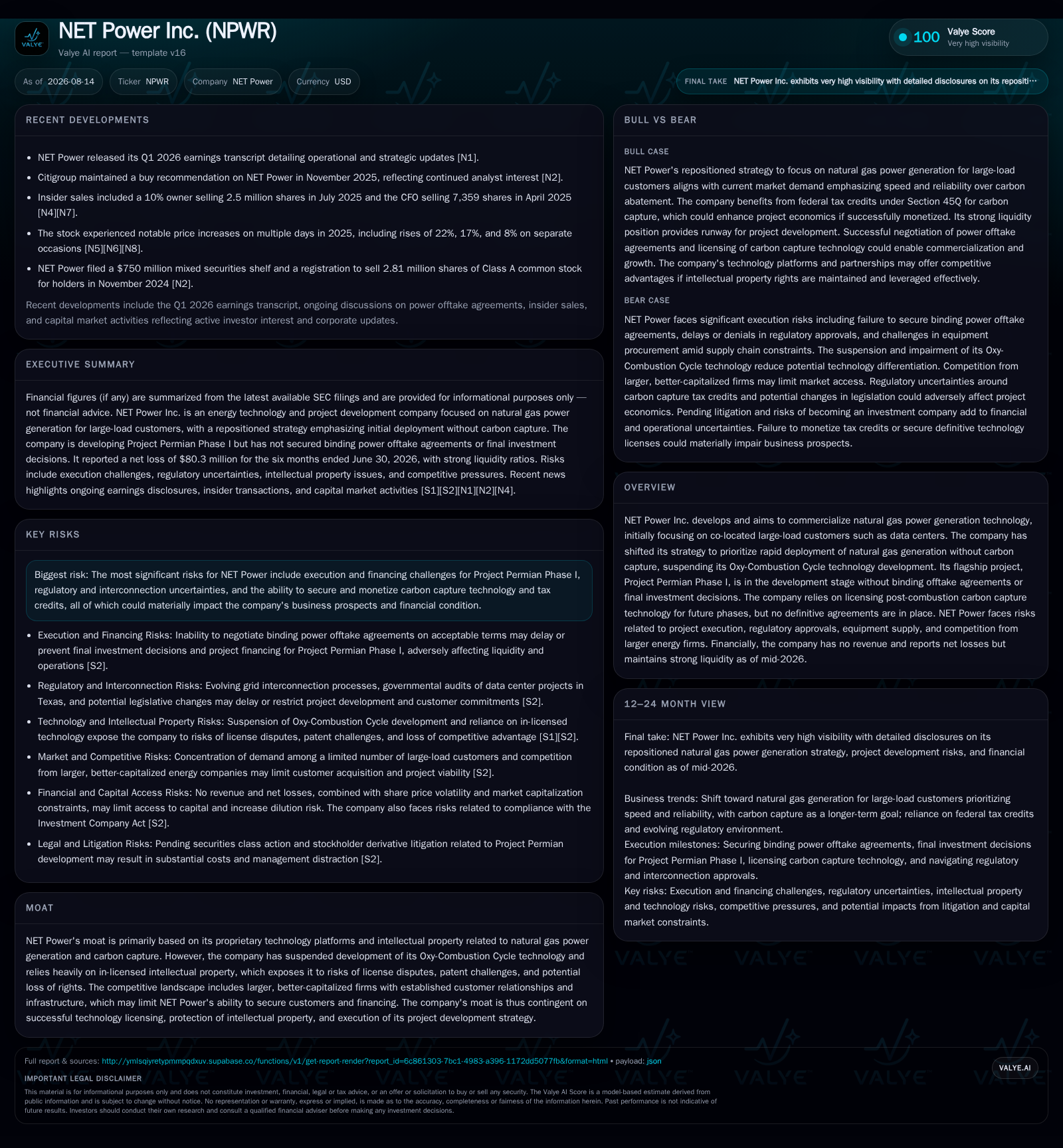
NET Power Inc. has realigned its market approach by suspending development of its flagship oxy-combustion cycle technology and prioritizing quick deployment of natural gas turbines combined with licensed post-combustion capture (PCC) technology. Its initial commercial project, Project Permian Phase I, remains in development without binding power offtake agreements or final investment decisions, exposing the company to significant execution and financing risks. The firm targets large-load customers like data centers but faces demand concentration and capital spending cycle vulnerabilities. While NET Power retains valuable intellectual property, growth depends on securing licenses, negotiating long-term customer contracts, and navigating regulatory incentives for carbon capture. Financially, the company remains pre-revenue with substantial net losses but maintains strong liquidity as of mid-2026.
Recent Operating Update: Strategic Shift and Project Development Status
In its latest quarterly filing dated August 13, 2026, NET Power Inc. revealed a significant strategic pivot away from its originally proprietary oxy-combustion cycle power generation technology towards deploying more conventional natural gas turbines paired with licensed post-combustion carbon capture (PCC) systems developed by Entropy [S2][S24]. This marked a deliberate suspension of testing at the La Porte Demonstration Facility and cessation of equipment procurements under previous arrangements such as the BHES Joint Development Agreement (JDA) [S2][S19].
The company's flagship initiative under this revised approach is Project Permian Phase I—a modular clean firm power plant located in West Texas aiming at roughly 60 megawatts gross capacity using two modular natural gas turbine sets with Entropy's PCC integration [S24]. Although an agreement to purchase these turbines was executed in late 2025, final investment decision (FID) has been deferred into the latter half of 2026 pending successful negotiation of binding power offtake agreements that enable project-level financing. Targeted commercial operations are planned around early 2029 if FID proceeds [S24].
However, no binding power purchase agreements have been signed as of the latest quarter, reflective of ongoing discussions characterized by term sheets, letters of intent, or memoranda of understanding rather than firm commitments [S2]. Given the typically capital-intensive nature of utility-scale generation projects that require assured revenue streams over multi-year contract tenors to secure financing at reasonable cost, this lack presents substantial execution risk that could delay or derail Project Permian or increase required equity contributions. The company's prospective customer base is concentrated among large-load electricity consumers such as data center developers and hyperscale computing infrastructure providers whose demand depends heavily on discretionary capital expenditure decisions often driven by macroeconomic cycles and regulatory restrictions on data center siting or interconnection capacity (notably within ERCOT) [S2].
Business Model: Natural Gas Generation Plus Licensed Carbon Capture
Historically focused on integrating proprietary oxy-combustion cycle combustion technology designed to inherently capture CO2 emitted during natural gas power generation without separate capture units, NET Power’s business model has shifted substantially. Instead of selling complete technology packages based on its own patents—with direct construction and operation involvement—it now aims primarily at licensing externally developed post-combustion carbon capture technology from Entropy Technologies [S1][S24].
Revenue generation hinges predominantly on executing long-duration power sales contracts at pricing levels sufficiently above standard unabated natural gas-fired electricity prices to justify the incremental costs associated with carbon capture equipment integration. These premiums arise from customer commitments to cleaner energy procurement or anticipated regulatory frameworks incentivizing greenhouse gas reductions through mechanisms such as carbon credits or clean energy premiums. Therefore, technology licensing fees may supplement income but are contingent upon downstream power project execution success.
Further complexity resides in contract structures: binding power offtakes generally contain reciprocal credit support obligations—cash reserves or letters of credit—that impose ongoing liquidity demands through development phases until commercial operation starts [S2]. The concentration risk regarding a few major customers further heightens dependency on their creditworthiness and capital investment cycles. NET Power also faces timing uncertainty because its adapted product now relies on existing combined cycle or simple cycle turbine technologies integrated with licensed PCC units rather than fully proprietary systems potentially subject to distinct operational efficiencies or cost curves.
Industry Structure and Competitive Landscape
The natural gas electricity generation sector integrated with carbon capture technology is undergoing a transition phase where incumbent energy firms (Occidental Petroleum, ExxonMobil) focus primarily on enhanced oil recovery applications of carbon capture or large-scale industrial decarbonization projects. Utilities like Calpine Corporation operate traditional natural gas fleets while exploring low-carbon options.
NET Power positions itself uniquely as a developer-licensor hybrid specializing in advanced capture technologies tailored for clean firm power applications catering especially to demanding large electricity users such as data centers insisting on decarbonized solutions compensating for their high energy intensity [S1][S2]. However, this niche status imposes constraints due to limited scale relative to entrenched players who leverage broader asset bases and financing access.
Critical KPIs in this context include megawatt capacity constructed under licenses purchased or own-operated plants completed, off-take contract signing rates including volume commitments and duration terms that underpin project financing feasibility, plant utilization targets aligned with customer load profiles, and demonstrated carbon capture efficiencies meeting evolving environmental mandates.
Growth Drivers: Regulatory Incentives and Corporate Sustainability Demand
Increasing governmental pressure worldwide mandates reductions in greenhouse gas emissions alongside incentivizing clean energy investments through tax credits authorized notably by legislation like the Inflation Reduction Act (IRA). Such fiscal stimuli lower effective capex hurdles for projects combining natural gas turbines with carbon capture retrofits or new builds integrating licensed PCC units where NET Power focuses its development efforts [S1]
Additionally, corporate sustainability commitments by large industrial users including hyperscale data centers create demand pull for cleaner dispatched power sources willing to pay premiums beyond conventional market rates if delivered reliably. Technological advancements reducing PCC costs enhance competitiveness vis-à-vis both unabated fossil fuel-fired power plants and intermittent renewable resources requiring backup capacity.
Investment facilitation from public-private partnerships or green bonds also supports progression from development stages through commercial operation provided contractual revenue certainty can be established.
Risks & Watchpoints: Execution Uncertainty Remains Dominant
Foremost is the inability thus far to finalize binding power purchase agreements which have repeatedly delayed making definitive investment decisions required for moving Project Permian Phase I into construction [S2]. Market dynamics affecting potential customers’ capital spending decisions — fluctuating demand for hyperscale computing capacity impacted by economic conditions or technological shifts reducing load per compute unit — amplify revenue predictability challenges.
Intellectual property dependence on Entropy for PCC licensing exposes NET Power to rights enforcement risks including patent validity challenges or disputes jeopardizing integration plans if licensing terms cannot be secured comprehensively or economically favorable; moreover no definitive license agreement disclosures suggest ongoing negotiations add timing uncertainties [S1]. Regulatory policy volatility—particularly regarding federal incentive programs—and community opposition risks around plant siting/interconnection further complicate the pathway.
Technological risk stems from transitioning from inherently integrated oxy-combustion designs initially promoted toward conventional turbine-plus-PCC configurations possibly entailing different operational characteristics impacting plant efficiency or maintenance costs.
Contingent litigation including shareholder suits alleging misleading prior communications about project costs/timelines add potential financial exposures though currently not deemed material enough by management to derail operations but reflect reputational hazards [S16].
What To Watch Next
Key upcoming milestones pivot upon executing binding power purchase agreements that provide acceptable pricing levels and contract tenure commensurate with capital expenditure requirements for Project Permian Phase I’s progression toward final investment decision in H2 2026. Monitoring announcements relative to these contract closures provides near-term indicators of achievable project finance support.
Progress in formalizing licensing arrangements with Entropy will clarify IP position stability while project construction starts will provide tangible confirmation of commercial momentum. Regulatory developments concerning extensions or renewals of federal tax credits incentivizing carbon capture integration bear watching since these directly affect project economics.
Cost management measures during the pre-commercial phase coupled with any future equity raises or debt offerings linked to financing specific projects will signal balance sheet flexibility sustainment beyond current liquidity reserves.
Financial Profile Discussion
As of June 30, 2026, NET Power held approximately $118 million in cash and cash equivalents alongside total current assets reaching $313 million against modest current liabilities around $17.6 million yielding a strong current ratio near 17.8x indicative of ample short-term liquidity supporting operations through ongoing development phases absent immediate revenue production [F1]
Despite this liquidity cushion, the company reported cumulative net losses exceeding $578 million recorded in full-year 2025 reflecting heavy pre-commercial cash burn typical for advanced-stage technology developers before first plant deployments generate revenues [S1][S2]. R&D expenses decreased modestly year-over-year following the suspension of proprietary oxy-combustion testing programs offset partially by sustained spend on engineering efforts related to the Project Permian clean gas approach.
With zero top-line revenue recorded so far due to absence of operating plants under commercial contracts, positive EBITDA or profits remain distant targets [F1]. Net operating losses are expected to continue until at least after Project Permian Phase I achieves commercial operation allowing monetization via power sales contracts supplemented potentially by licensing fees if subsequent projects progress.
All forward-looking references rely strictly on cited source material; readers should independently verify facts before acting.
Disclaimer: This is research-only, informational analysis and not investment advice. It may include AI-generated interpretation and general industry context. Always verify important details using primary sources.

Comments