
Stardust Power Confronts Liquidity and Market Risks While Developing US Lithium Refinery
Development-stage lithium refinery faces capital challenges amid evolving supply-demand forecasts and nascent market positioning.
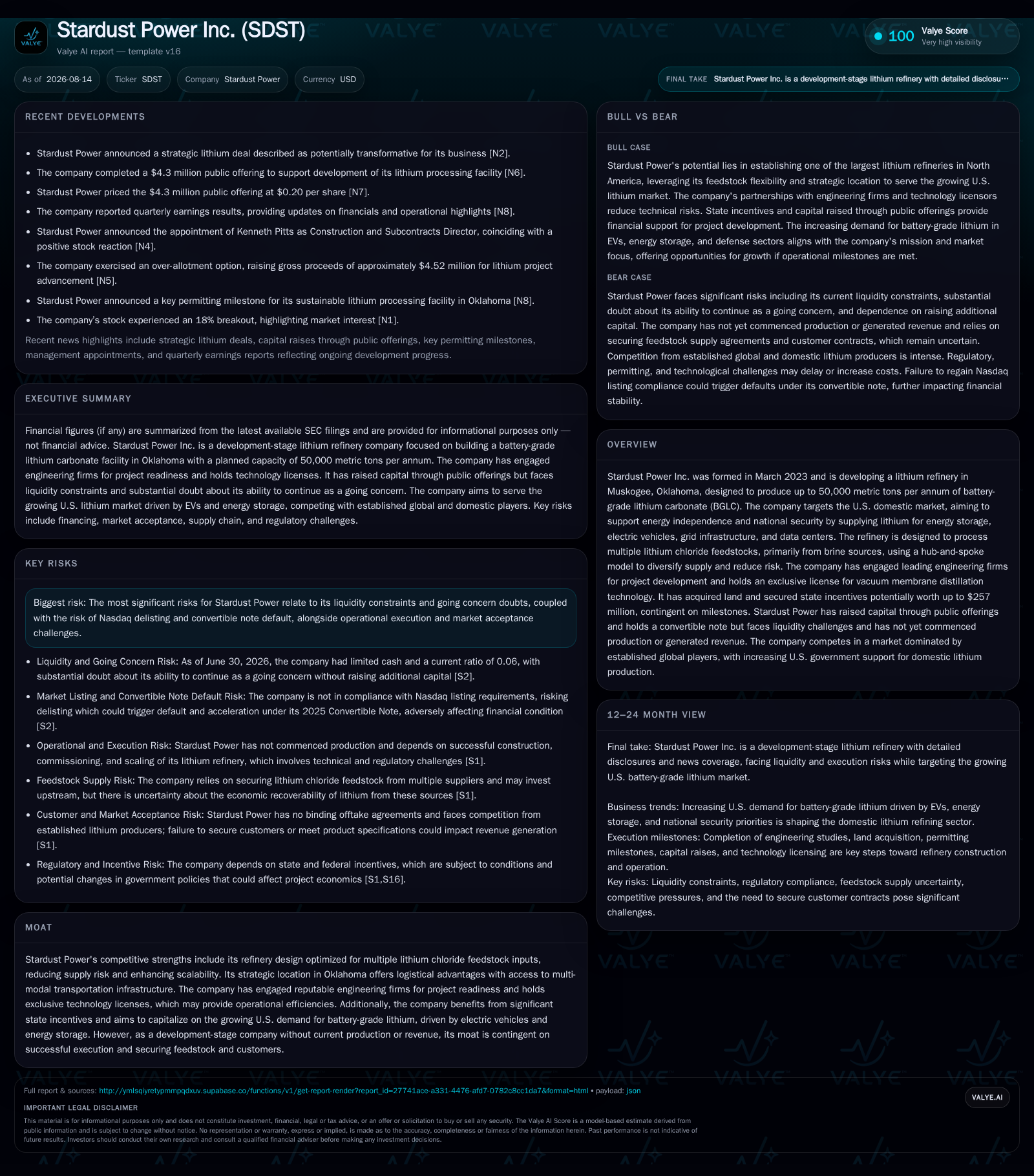
Stardust Power Inc. is advancing a lithium refinery project in Oklahoma with an anticipated capacity of 50,000 metric tons per annum of battery-grade lithium carbonate. Although strategically positioned to serve the growing US critical minerals supply chain and leveraging patented vacuum membrane distillation technology, the company faces severe near-term liquidity constraints and Nasdaq listing compliance risks. Its business model centers on sourcing diverse lithium chloride feedstocks using a hub-and-spoke logistics approach to mitigate supply risk. A recent non-binding letter of intent with a US battery tech firm signals early customer interest but execution milestones and capital raising remain pivotal.
Recent Operating Update
Stardust Power Inc.'s latest quarterly filing dated August 13, 2026 underscores ongoing liquidity concerns and threats of Nasdaq delisting due to sustained low market capitalization below $35 million as of April 2026 [S2]. The company holds only $540K in cash against $14.9 million in current liabilities at quarter-end June 30, highlighting acute working capital deficiencies that raise substantial doubt about continuing operations without additional funding [F1][S4]. A triggering event occurred for the senior secured convertible note held by Lind Global Asset Management XIII LLC when market cap remained below $15 million for ten consecutive trading days. This triggered mandatory default payments equal to 110% of outstanding principal plus accruing default interest at 10% per annum [S24], intensifying near-term capital pressures.
Meanwhile, Stardust announced a non-binding Letter of Intent (LOI) on August 5 with Charge CCCV LLC (C4V), an American battery technology company, which forecasts phased demand for up to 20,000 metric tons of battery-grade lithium carbonate (BGLC) by 2030 aligned with C4V's battery manufacturing expansion plans. The LOI contemplates collaboration on product qualification and commercial terms but remains subject to negotiation and definitive agreements [S6][S7]. This early customer interest is crucial signaling for Stardust’s development-stage business.
Business Model and Strategic Position
Founded in March 2023 via merger with Legacy Stardust Power LLC, Stardust Power pursues building one of the largest lithium refineries in North America at Muskogee, Oklahoma targeting up to 50,000 metric tons per annum capacity of BGLC once operational [S1]. The refinery is tailored for processing multiple lithium chloride feedstocks primarily sourced from brine extractions using an innovative hub-and-spoke logistics model meant to distribute supply risk across several feedstock inputs rather than relying on a single source. This diversification strategy aims to mitigate potential supply shortages or quality issues which are common in brine mining operations.
Stardust holds exclusive licenses for vacuum membrane distillation technology that potentially enhances separation efficiency and cost-effectiveness relative to conventional refining methods—an element that could differentiate operating margins once commercial production begins [S1]. The company's value proposition focuses on supporting U.S. energy independence by supplying domestically refined BGLC for electric vehicles (EVs), grid-scale energy storage systems (ESS), data centers requiring reliable energy infrastructure, and defense industrial base needs.
Revenue generation will hinge on long-term offtake agreements typically negotiated with battery manufacturers and OEMs who prioritize quality-certified lithium carbonate meeting technical specifications for battery cathodes. Monetization occurs mainly through volume shipments where pricing can fluctuate based on raw material cost inputs and market pricing dynamics.
Industry Structure and Competitive Context
Lithium refining is a capital- and technology-intensive segment nested between upstream lithium mining (brine or spodumene sources) and downstream battery or chemical manufacturers. Refiners like Albemarle Corporation, Livent Corporation, Piedmont Lithium, SQM, or Lithium Americas offer useful scale benchmarks though most have integrated mining-refining models unlike Stardust’s pure refining approach.
The industry experiences cyclical yet structurally expanding demand driven by accelerating EV adoption worldwide alongside grid storage deployment. However, oversupply conditions are forecasted through 2028 delaying tightness until expected deficits emerge around 2029 per Fastmarkets’ Q4 2025 report cited by Stardust [S1]
Supply chain security has become paramount given geopolitical tensions affecting raw material import reliance. Stardust’s strategy aligns strongly with U.S. government initiatives promoting critical minerals domestic production supported by significant state incentives potentially totaling $257 million contingent on project milestones.
Operational KPIs critical to success include ramping refinery throughput while maintaining product purity standards that meet OEM qualifications; securing diverse lithium chloride feedstock volumes; minimizing cost per ton via process efficiencies; ensuring logistical cost containment within the hub-and-spoke model; plus timely achievement of construction milestones.
Growth Drivers
The principal growth tailwinds are macro-driven: the steady rise in U.S. electric vehicle sales requiring escalating BGLC volumes; expansion of ESS deployments fueled by renewable integration and AI data center power backup needs; governmental policy incentives to bolster domestic critical minerals capabilities; increasing emphasis on sustainability credentials favoring refined lithium from low-carbon processes; strategic partnerships such as the recent LOI with C4V signaling nascent commercial traction.
Technological advantages achieved through licensed vacuum membrane distillation may drive unit cost reductions enhancing competitiveness against established refiners primarily relying on traditional evaporation or precipitation methods.
Additionally, multi-feedstock ability allows sourcing flexibility helping survive pricing or availability shocks in any single source basin—a notable supply risk mitigation rarely seen among peers relying heavily on either brine alone or hard rock conversions.
Risks and Constraints
Further execution risks encompass typical challenges for development-stage refiners: delays or budget overruns during plant construction have direct impacts on timelines and costs; feedstock acquisition efforts carry uncertainty over economically recoverable volumes and quality fluctuations especially given reliance on third-party brine operations; regulatory compliance encompassing environmental permits poses ongoing complexity; operational logistics involving hub-and-spoke transport modes could inflate costs beyond acceptable economic thresholds impacting margins; market acceptance is unproven since commercial production has not yet commenced.
Legal contingencies exist including an ongoing lawsuit alleging breach regarding an engagement agreement that could impose financial burdens if resolved unfavorably despite defenses asserted [S1].
Observing these factors will help assess whether Stardust can transition from its development stage toward viable commercial operations.
Financial Profile Discussion
As of June 30, 2026, Stardust held $540,264 in cash and equivalents facing current liabilities exceeding $14.9 million resulting in a strained current ratio near 0.06 which illustrates extreme working capital tightness [F1]. Total debt measured approximately $103,848 representing convertible notes secured by nearly all company assets intensifying lender influence should defaults occur [F1][S4][S24].
The company has historically relied exclusively on equity financing rounds—including offerings generating roughly $10 million gross proceeds since inception—but remains pre-revenue incurring significant net losses above $15 million reported at year-end December 31, 2025 [F1][S9]
Liquidity constraints are underscored by notes indicating management doubts about continuing as a going concern absent successful capital raises or amended credit arrangements within the next twelve months [S2][S4]. Moreover Nasdaq rule non-compliance risks compound financing challenges given associated acceleration clauses embedded in convertible debt terms posing a material threat to asset retention.
Hence financial metrics spotlight acute dependency on external investor confidence coupled with effective milestone execution to unlock incremental funding needed through equity issuances or debt restructurings guardedly priced considering inherent developmental risks.
This analysis synthesizes recent filings as primary evidence reflecting Stardust Power's evolving corporate trajectory amid significant financing uncertainties characteristic of early-stage lithium refinery developers within a dynamic supply-demand environment for critical minerals.
Disclaimer: This is research-only, informational analysis and not investment advice. It may include AI-generated interpretation and general industry context. Always verify important details using primary sources.

Comments