
Veritone’s Debt Pressures and aiWARE SaaS Platform Shape Its AI Growth Trajectory
Veritone balances AI innovation and restructuring amid debt maturities and liquidity constraints, navigating a competitive SaaS market with strategic alliances.
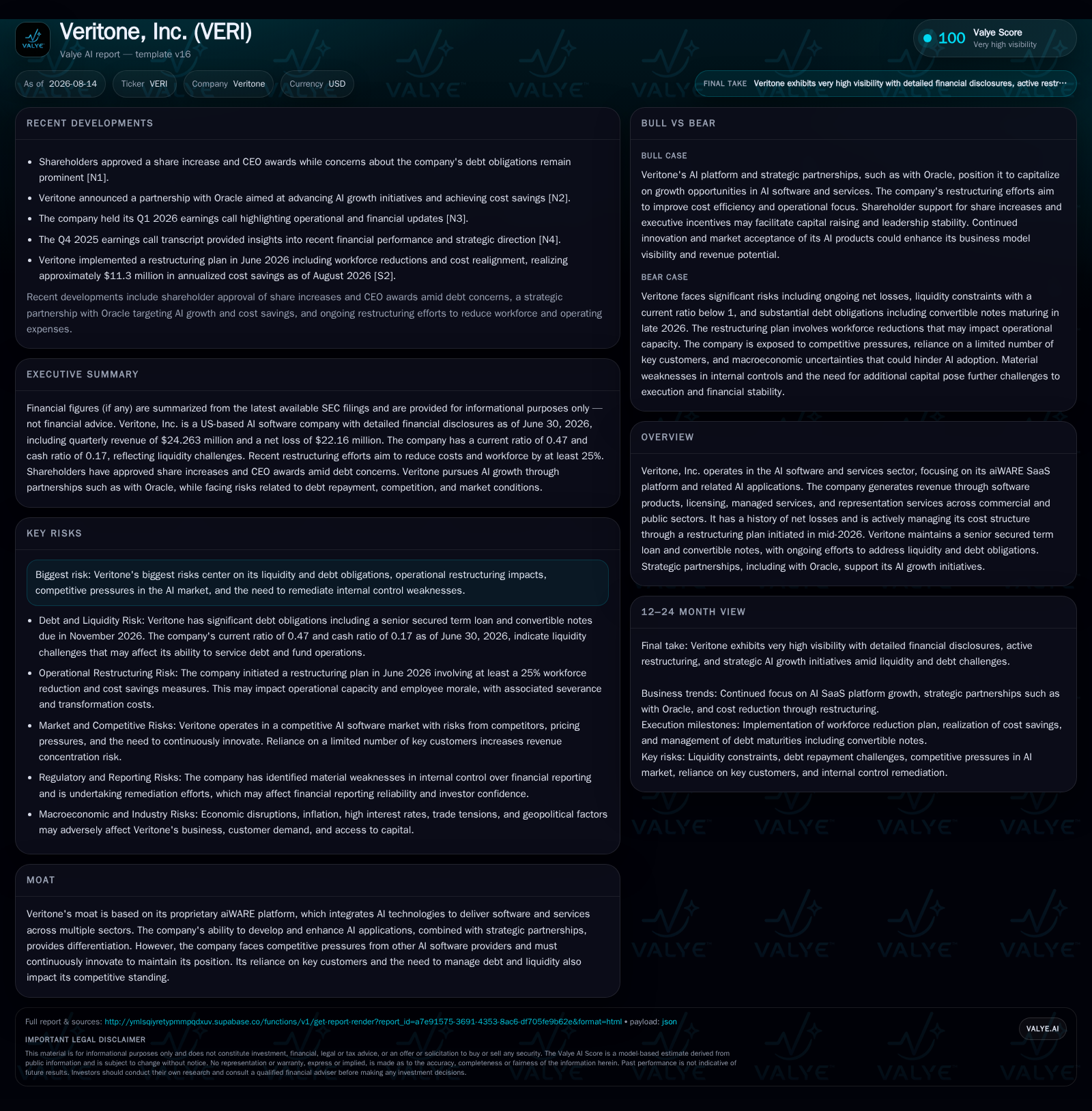
In its Q2 2026 report, Veritone disclosed ongoing net losses totaling $41.7 million for the first half of the year alongside a significant working capital deficit and $45.5 million of convertible notes maturing later in 2026. The company’s core business centers on its proprietary aiWARE AI operating system delivered via SaaS, targeting commercial and public sectors through software licensing, professional services, and managed content services. Operational restructuring in 2026 aims to reduce cost pressures, while a strategic partnership with Oracle supports future AI growth. Veritone’s competitive moat is rooted in aiWARE’s modular cloud-native architecture but is offset by liquidity challenges and intense competition from other AI SaaS providers. Key near-term focus areas include managing debt maturity risks, improving cash flow conversion, and demonstrating traction in recurring revenue streams.
Recent Operating Update
Veritone’s latest quarter (Q2 ended June 30, 2026) underscored persistent financial pressures with a reported net loss of $41.7 million for the first half of the year and net cash used in operations totaling over $22 million during that period [S2]. The liquidity snapshot reveals cash and cash equivalents standing at approximately $12.4 million against current liabilities exceeding $100 million—resulting in a challenging current ratio of roughly 0.47 [S2], [F1]. This liquidity stress is exacerbated by outstanding convertible senior notes amounting to roughly $45.5 million that mature imminently in November 2026 [S2]. These notes carry a low interest coupon of 1.75% but present a material refinancing or repayment obligation which must be addressed promptly.
The company operates under one reportable segment encompassing its suite of AI software products, managed services, and related offerings. Operationally, Veritone has embarked on a cost restructuring program initiated mid-2026 designed to streamline expenses including headcount reductions and software cost optimizations aimed at improving cash burn trajectory over time [S2]. Complementary to this internal drive is Veritone's strategic partnership with Oracle announced earlier in July 2026 intended to harness Oracle’s cloud infrastructure efficiencies to drive down cost of operations while fueling growth ambitions within its aiWARE platform ecosystem [N1].
Business Model Overview
At its heart, Veritone functions as an AI software-as-a-service (SaaS) provider anchored by its proprietary aiWARE™ platform—an AI operating system integrating multiple machine learning models across hundreds of cognitive categories ranging from perception to prediction tasks. This platform is architected for deployment flexibility: cloud-native but extendable to edge or hybrid environments enabling broad industry applicability covering commercial enterprises and public sector clients alike [S1].
Revenue generation is primarily derived from three main buckets: subscription-based software licenses granting access to aiWARE components; professional services focused on implementation and customization tailored to client workflows; plus managed services that include content licensing along with influencer marketing representation within the commercial division [S1]. Historically, Veritone also operated Veritone One, a full-service advertising agency leveraging its own technology for media placements; though divested in late 2024 this shift represented a strategic move away from agency services toward pure tech-driven SaaS solutions emphasizing scalability
Subscription revenue underpins recurring revenue stability; however, the blended model involving usage-based fees from managed content rights monetization adds complexity to revenue visibility. Customer acquisition cycles can be lengthy given solution complexity and public sector procurement processes which together contribute to fluctuating revenue growth patterns typical of emerging AI-focused SaaS vendors.
Industry Structure and Competitive Position
Veritone competes in the rapidly evolving segment of artificial intelligence software platforms tailored for enterprise-scale data processing and analytics workflows alongside managed content services—a space populated by specialists such as Palantir Technologies (enterprise data/AI platform), C3.ai (enterprise AI applications), Nuance Communications (speech recognition), Splunk (data analytics with embedded AI), and Alteryx (AI workflow automation).
The key moat for Veritone lies in aiWARE's modularity and open architecture allowing integration of third-party AI models within one cohesive environment supporting unstructured data processing at scale. Such versatility enables serving diverse industries spanning media companies monetizing digital content via licensing contracts to government agencies employing cognitive computing for operational insights [S1]. Nevertheless, competitive pressures accelerate from peers emphasizing platform scalability improvements, customer retention via expanded ARR per client, as well as development pace on novel use cases powered by continual R&D investment.
Compared with larger peers like Palantir or C3.ai who benefit from marketed scale advantages plus wider enterprise penetration footprints, Veritone remains relatively smaller with concentrated customer relationships which introduces both opportunity for deepening wallet share but also heightened concentration risk and churn sensitivity.
Growth Drivers
Veritone's growth drivers follow broad secular trends propelling enterprise adoption of AI-based solutions: accelerating volumes in unstructured data require transformational cloud-native platforms capable of real-time analysis; expansion across industry verticals including media rights management fuels demand for AI-enhanced content monetization; regulatory compliance imperatives encourage adoption of cognitive computing tools for transparency; plus broader public sector digitization drives heightened spending on intelligent automation.
Strategic partnerships function as pivotal accelerants—evident from Veritone's alliance with Oracle—improving both infrastructure cost structure while jointly targeting enhanced AI service scalability which will aid margin improvement beyond raw top-line expansion [N1]. Furthermore, operational restructuring initiatives started in mid-2026 focus on reducing fixed costs aligning expense base more closely with anticipated recurring revenue growth trends [S2]. Monitoring ARR growth velocity alongside net retention rates will best reveal whether these efforts translate into sustainable business momentum.
Risks and Growth Constraints
Near-term risks remain heavily dominated by balance sheet pressures; the looming maturity of convertible senior notes with limited accessible liquidity risks tightening financial flexibility if adequate refinancing alternatives are not secured swiftly [S2]. Working capital deficits signal potential shortfalls requiring capital raises or asset monetization just to maintain baseline operations.
Operationally, execution risk associated with restructuring programs may disrupt ongoing client projects or slow product enhancements critical in defending market share against established incumbents investing aggressively into R&D innovation cycles. Additionally, reliance on key customers intensifies vulnerability should any major contract lapse occur given concentration levels implied by disclosure narratives.
Market risks stem from rapidly changing technology stacks within enterprise AI where incumbent software vendors continuously expand cognitive computing capabilities creating pressure on pricing power or contract terms. Data privacy regulations add further complexity affecting deployment choices especially pertinent when dealing with public-sector clientele requiring high compliance standards.
Finally internal controls weaknesses identified previously pose added governance challenges potentially impacting financial reporting accuracy adversely affecting investor confidence until fully remediated.
What To Watch Next
Critical milestones to gauge going forward will encompass successful management of debt obligations through either refinancing or repayment ahead of November 2026 maturity dates; any announcements relating to additional capital raises or alternative financing sources will prove telling about liquidity sustainability.
Operational metrics including quarterly progression in ARR levels—particularly net retention improvements indicative of expanding usage within existing clients—and churn rate moderation offer essential visibility into revenue quality acceleration. Enhancements or new releases expanding aiWARE’s application breadth across industries or capability dimensions could validate innovation pipelines are delivering differentiation against competitors.
Further updates around execution of Oracle partnership deliverables focused on operational cost synergies would signify tangible progress toward margin enhancement objectives underpinning path to profitability aspirations amid ongoing investment in R&D.
Finally, resolution of any outstanding internal control adjustments disclosed historically will be essential for restoring full financial statement reliability crucial to maintain stakeholder trust.
Financial Profile Discussion
As of June 30, 2026, Veritone holds $12.4 million in cash versus current liabilities aggregating over $100 million yielding a stark current ratio near 0.47 highlighting liquidity strain that necessitates urgent capital management strategies [F1], [S2]. Total debt remains significant with convertible notes outstanding at roughly $45.5 million approaching maturity within months presenting clear refinancing needs or repayment demands that must be met imminently under terms stipulated [S2].
Operating losses continue at scale — totaling $41.7 million over six months into 2026 accompanied by negative operating cash flow exceeding $22 million — reflecting high fixed cost absorption during growth phase combined with investment-heavy R&D spend typical for AI SaaS players transitioning toward profitability trajectories [S2]
The company’s restructuring plan initiated during mid-2026 aims squarely at cutting overheads including employment severance costs incorporated within Q2 charges anticipated to improve subsequent quarters’ margin profile gradually although free cash flow conversion remains pressured currently.
While recurring revenue models supported by subscription licenses promise longer-term top-line visibility akin to peer SaaS companies such as Palantir or C3.ai who emphasize ARR growth as valuation anchors—the near-term financial health hinges critically on tightening operational spending controls paired with securing sufficient liquidity buffers preceeding upcoming debt maturities.
This analysis focuses solely on publicly reported information without offering investment advice or research views. Readers should consider the full range of company disclosures alongside broader market developments when forming views about Veritone's business outlook.
Disclaimer: This is research-only, informational analysis and not investment advice. It may include AI-generated interpretation and general industry context. Always verify important details using primary sources.

Comments