
Trailblazer Acquisition Corp. Advances Toward Business Combination Deadline with $275M Trust Fund
Trailblazer Acquisition Corp., a Cayman Islands-based SPAC, maintains strong liquidity as it targets media, technology, and consumer retail sectors ahead of its September 2027 merger deadline.
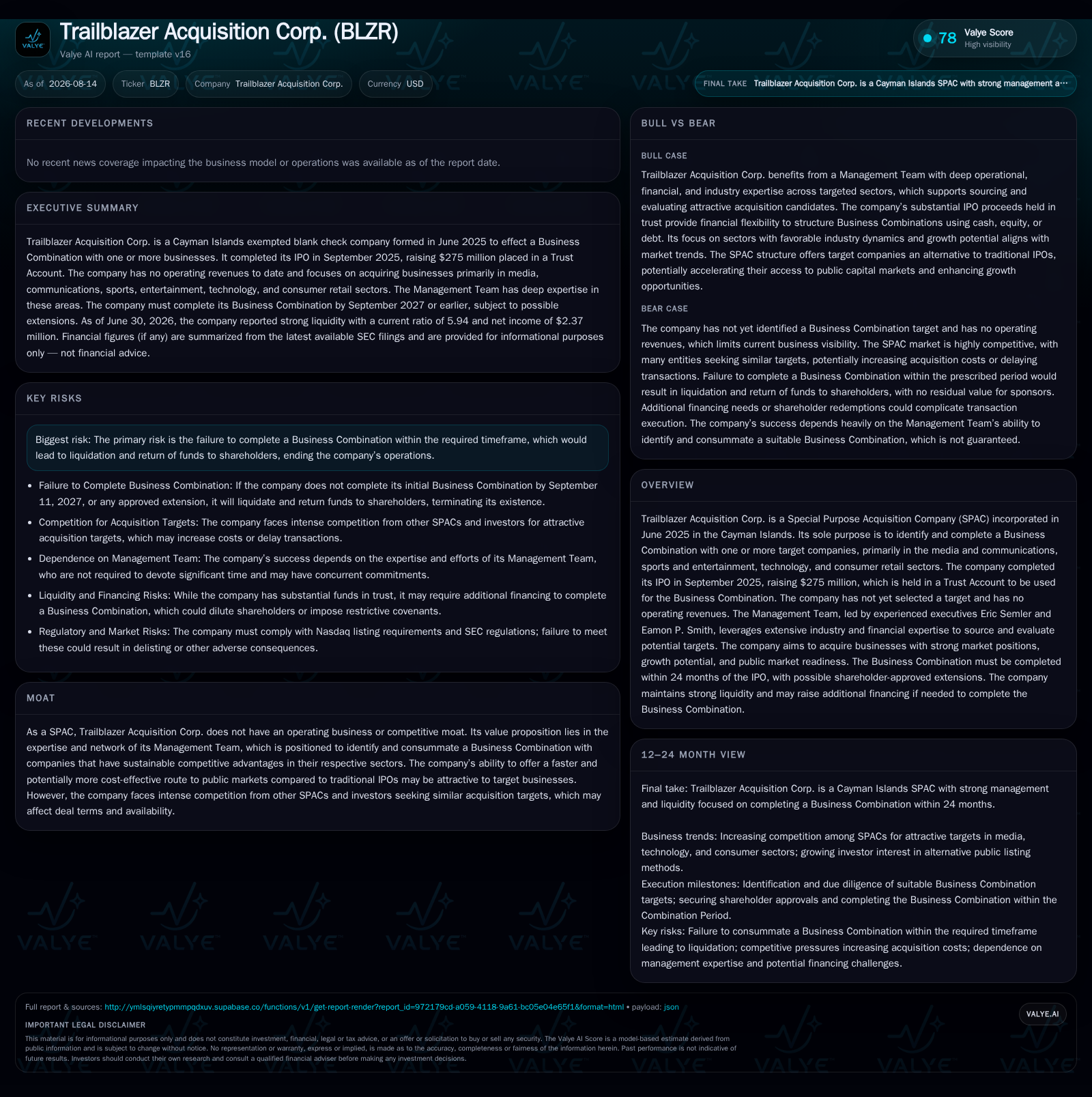
Trailblazer Acquisition Corp. continues its search for an initial Business Combination within its defined sectors, holding $275 million in trust from its September 2025 IPO. With no operating revenues and about one year remaining before the mandated combination deadline, the company leverages seasoned management expertise to identify acquisition opportunities while navigating typical SPAC risks such as shareholder redemptions, dilution from warrants and founder shares, and timing pressures.
Recent Operating Update: Maintaining Search Momentum with Strong Liquidity
Trailblazer Acquisition Corp.'s August 13, 2026 quarterly report underscores the company's ongoing status as a Special Purpose Acquisition Company (SPAC) without operating revenues or active commercial operations beyond preparatory activities [S2]. The firm remains focused on identifying a suitable Business Combination target within media and communications, sports and entertainment, technology, and consumer retail sectors. With roughly one year left before the statutory Combination Period expires on September 11, 2027, Trailblazer is positioned to capitalize on market opportunities while managing timing constraints [S1].
Financially, as of June 30, 2026, Trailblazer holds approximately $951 thousand in cash and equivalents within total current assets of about $1.07 million against current liabilities near $180 thousand. This results in a conservative current ratio of approximately 5.94 indicating ample short-term liquidity to cover administrative expenses typical of pre-combination SPACs [F1]. Overall, the financial profile is dominated by trust-account holdings earmarked for transaction execution.
Business Model: Sponsor-Driven Capital Vehicle Enabling Alternative Public Market Access
Incorporated in June 2025 as a Cayman Islands exempted company, Trailblazer’s business model centers on raising capital through an initial public offering (IPO) completed in September 2025 that generated gross proceeds of $275 million placed into a trust account managed by Continental Stock Transfer & Trust Company [S1]. This trust safeguards investor funds exclusively for consummating a Business Combination or returning capital if no deal materializes.
Capital structure details include units priced at $10 each comprising one Class A ordinary share plus one-third of a Public Warrant exercisable at $11.50 per share. Concurrently, Private Placement Warrants sold to sponsors raised approximately $6.8 million at $1.50 per warrant [S1]. These warrants along with founder shares represent sponsor equity stakes designed to align incentives toward completing an acquisition while introducing potential dilution risks upon exercise.
As is standard for SPACs pre-combination, Trailblazer currently generates no operating revenue; future revenue generation depends entirely on the acquired entity’s business model post-merger. Thus, value creation hinges on deploying management’s expertise—led by CEO Eric Semler and CFO Eamon P. Smith—to identify high-potential targets capable of thriving as public companies through this alternative listing route.
Industry Context and Competitive Landscape: Navigating a Crowded SPAC Market
Trailblazer operates amid a crowded SPAC ecosystem where numerous blank-check companies compete to acquire private firms seeking expedited public market access outside traditional IPOs. Prominent peers include large-cap-focused Pershing Square Tontine Holdings (PSTH), tech sector specialist Social Capital Hedosophia Holdings (IPOA), and multi-SPAC sponsor Churchill Capital Corp series.
The company's differentiator lies in its management team’s sector focus on media-tech-retail verticals combined with substantial capital resources held in trust providing credible acquisition firepower. Nonetheless, intense competition for quality targets drives valuation pressures that may compress deal economics.
Additionally, regulatory mandates impose a strict two-year timeline to consummate an initial Business Combination or face liquidation—a constraint that heightens execution risk and may affect negotiation leverage.
Growth Drivers: Favorable Market Demand Meets Experienced Leadership
Tailwinds supporting Trailblazer's growth thesis include robust demand from private companies seeking faster public market entry via SPAC mergers that bypass lengthy traditional IPO processes vulnerable to market volatility.
Target sectors—media/communications innovation; sports and entertainment technologies; consumer retail undergoing digital transformation—align well with secular growth trends attracting investor interest [S1]. This sector concentration enhances deal sourcing discipline relative to broadly diversified peers.
Experienced management increases access to proprietary deals and supports structuring complex transactions potentially supplemented by PIPE financing enhancing post-merger capitalization quality.
Regulatory clarity around SPAC reporting requirements since early-2020s has improved investor confidence supporting capital raising despite macroeconomic uncertainties.
Risks and Watchpoints: Execution Timing and Redemption Dynamics
The primary risk is failing to complete an initial Business Combination by September 11, 2027 triggering mandatory liquidation that returns funds net expenses—an outcome detrimental financially and reputationally.
Competitive pressures raise concerns about overpaying or accepting unfavorable terms undermining post-merger value creation. Shareholder redemption behavior following merger announcements can reduce available funding impacting deal viability.
Sponsor-held founder shares and warrants introduce dilution potential if exercised post-combination affecting shareholder returns.
Market volatility further complicates valuation stability between announcement and closing necessitating flexible deal structures such as earn-outs or renegotiations.
Any extension of the Combination Period requires shareholder approval adding governance complexity if pursued due to incomplete pipelines.
Key Developments to Monitor: Path Toward De-SPAC Transaction Closure
Investors should track announcements of definitive merger agreements or letters of intent indicating negotiation progress aligned with stated sector focus.
Shareholder redemption rates post-announcement will indicate confidence levels influencing transaction financing dynamics.
Proposals to extend the Combination Period merit scrutiny regarding rationale balancing time constraints against deal quality.
Warrant exercise trends following business combination initiation will affect dilution forecasts relevant for valuation assessments.
Management disclosures during earnings calls or filings will provide insights into pipeline health and strategic adaptations amid evolving capital market conditions.
Financial Profile Discussion
Trailblazer's mid-2026 financial snapshot shows cash reserves near $951 thousand complemented by current assets exceeding $1 million against minimal current liabilities yielding a strong current ratio around 5.94 indicative of solid short-term solvency [F1]. This liquidity supports necessary administrative functions including legal compliance during extended search phases prior to consummating any combination transaction.
Operating losses reflect anticipated administrative expenditures such as professional fees common for pre-combination SPAC entities; net income benefits recorded previously stemmed from non-recurring accounting adjustments rather than core operations. The absence of debt underscores prudent balance sheet management given no operational cash flow generation yet.
Sponsor-related equity instruments like Founder Shares carry dilutive implications post-combination but serve standard incentive alignment functions promoting transaction completion [S1]. Monitoring the interplay between sponsor promote interests and shareholder accretion remains essential for evaluating post-merger value proposition.
In conclusion, Trailblazer Acquisition Corp.'s financial position is stable but unremarkable pending transition through its critical Business Combination milestone which will define future operational performance.
Disclaimer: This is research-only, informational analysis and not investment advice. It may include AI-generated interpretation and general industry context. Always verify important details using primary sources.

Comments