
Melar Acquisition Advances Everli Merger with Redemption Dynamics Highlighting SPAC Risks
MACI progresses toward business combination completion with Italian e-grocery platform Everli, navigating shareholder redemptions and liquidity pressures.
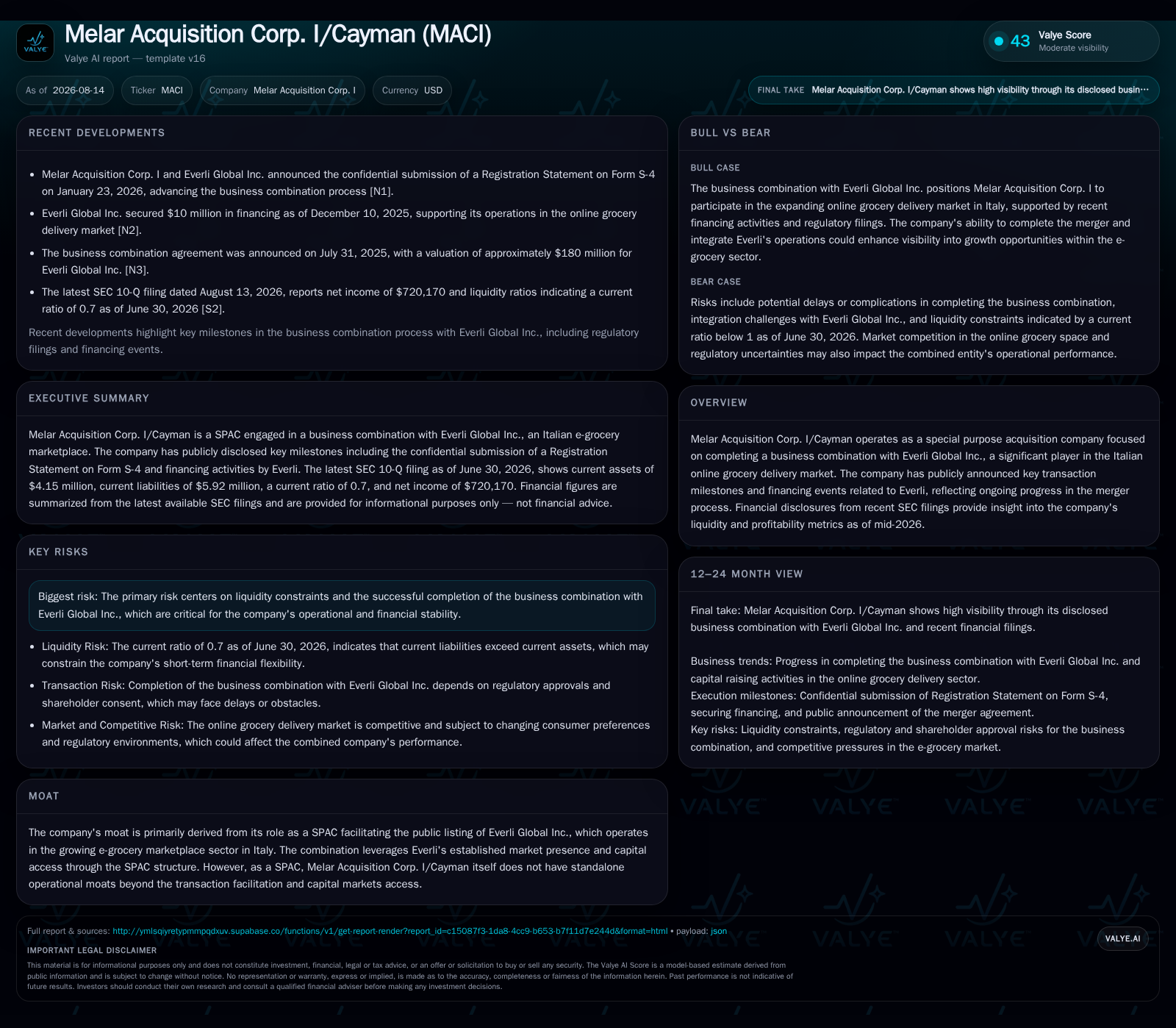
Melar Acquisition Corp. I/Cayman (MACI) reported continued progress on its business combination with Everli Global Inc., a leading Italian online grocery delivery player, as of the quarter ended June 30, 2026. The SPAC has faced significant public shareholder redemptions that reduced its outstanding shares to under 4 million, emphasizing the liquidity and deal closure risks inherent in the SPAC model. MACI’s management team leverages deep financial expertise targeting emerging finance sectors, focusing now on closing the Everli merger before the mandated deadline. The outcome depends critically on navigating shareholder votes, redemption rates, and supplemental financing efforts such as PIPE transactions.
Recent Operating Update: Approaching Merger Deadline Amid Redemption Pressures
Melar Acquisition Corp. I/Cayman (MACI) filed its latest quarterly report on August 13, 2026, revealing critical developments in its path toward completing a business combination with Everli Global Inc., an online grocery delivery service operating primarily in Italy [S2]. The company disclosed a significant redemption event earlier in the year where holders of over 12 million Class A Ordinary Shares exercised their redemption rights at approximately $10.89 per share, resulting in aggregate cash outflows of around $131.5 million [S3]. This substantially reduced the number of public shares outstanding to just under 4 million.
This dynamic typifies a key structural risk intrinsic to SPAC transactions: public shareholders retain rights allowing them to redeem shares for cash prior to deal consummation, which can impose liquidity strains and complicate merger viability—especially if redemptions approach or surpass available cash reserves from the trust account.
Current assets stood at roughly $4.15 million against liabilities of about $5.92 million as of June 30, yielding a current ratio near 0.7 [F1]. While this metric reflects primarily non-operational positions—typical for SPACs—it signals limited near-term cash flexibility outside of trust account protections.
The deadline to finalize the Everli Business Combination remains June 20, 2026—24 months from IPO—which represents a non-negotiable structural constraint whereby failure would compel liquidation and distribution of remaining trust funds to shareholders [S1]. Recent amendments approved by shareholders have sought extensions or procedural flexibility to facilitate deal completion amid negotiation complexities [S3].
Business Model: Capital Markets Intermediary Facilitating Everli’s Public Listing
As a special purpose acquisition company incorporated in the Cayman Islands with no operational revenues or standalone business activities yet [S1], MACI functions solely as a financial intermediary designed to raise capital via an IPO by selling units combining public shares and warrants and then use those proceeds to merge with or acquire a private company—in this case, Everli Global Inc.
Investors initially subscribed to units at $10 each during the June 2024 offering raising gross proceeds of $160 million [S1]. The bulk ($157 million) was sheltered in an interest-bearing trust account managed by an independent trustee until deployment upon deal closing or liquidation.
Revenue generation mechanisms for MACI hinge principally on transaction fees triggered when completing the combination, warrant exercises providing secondary equity infusions upon conversion rights being fulfilled, and potential equity appreciation post-merger contingent on market reception of the combined entity. However, these revenue streams are contingent upon successful deal execution; failure results in merely returning trust capital less costs to shareholders.
The company's experienced management team brings strategic focus on 'Emerging Finance' verticals such as fintech and specialty lending but has elected Everli—an online grocery delivery platform focused on Italy—as its initial target [S1]. This pivot reflects opportunistic targeting within attractive growth sectors rather than strict adherence to predefined industry verticals. This flexibility is common among SPACs seeking viable incumbents with strong market positions and scalability.
Industry Structure & Competitive Position: Navigating SPAC Market Realities & Sector Nuances
Operating within the broader special purpose acquisition company ecosystem—a sector marked by vehicles established to expedite private companies' access to public capital—MACI engages upstream of operational value chains by supplying financial capital and market listing facilitation rather than direct business operations.
Within this structure, MACI contends with peers including other fintech- or e-commerce-focused SPACs; traditional IPO processes compete directly as alternative routes for private companies like Everli considering public listing options. The advantage offered by SPACs is typically speedier access with greater valuation negotiation flexibility but carries distinct governance and shareholder approval risks.
MACI's choice of an Italian online grocery delivery platform intersects burgeoning e-grocery markets—a segment characterized by rapid digital adoption accelerated by consumer behavior shifts—but distinct from its originally stated Emerging Finance focus. This dislocation may pose integration and investor perception challenges that require clear communication and execution clarity post-combination.
Redemption rates observed in MACI are consistent with heightened skepticism toward SPAC valuations generally seen in recent years—a trend amplified by macroeconomic uncertainties affecting investor confidence across speculative public listings [S3]. These dynamics elevate scrutiny on deal terms and necessitate supportive PIPE financings or alternative funding strategies.
Growth Drivers: Merger Closure & Everli’s Market Expansion Potential
Key drivers underpinning potential growth post-business combination include:
- Completion of MACI’s Merger Proxy Process: Securing shareholder vote approvals while managing redemption rights ensures transactional closure that unlocks operational status for Everli within public markets.
- Market Appetite for Digital Grocery Platforms: Italy’s expanding e-commerce grocery penetration offers scalable revenue growth opportunities leveraging existing infrastructure and brand presence.
- PIPE Financing Availability: Supplemental investment commitments alongside public equity enable funding gap coverage amid redemptions and support operational scale-up post-merger.
- Management Expertise: Leadership’s extensive financial sector experience provides strategic vantage computing target valuations effectively while advising integration pathways post-combination.
Successful alignment on these fronts would validate MACI’s primary value proposition as a conduit channeling private high-growth companies into efficient capital markets access through streamlined merger structures.
Risks & Watchpoints: Deal Completion Uncertainty & Liquidity Constraints
Prominent risks present include:
- Combination Period Expiry Without Closing: Failure to close definitive agreements by June 20, 2026 forces liquidation returns rather than value-accretive outcomes.
- Shareholder Redemptions Impacting Capital Availability: Large-scale cash outs erode investment base required for target capitalization maintenance or operational needs realization.
- Valuation & Market Sentiment Pressures: Negative perceptions regarding SPAC-sponsored listings could constrain aftermarket trading performance thereby depressing stock valuations post-merger.
- Dilution Risks From Warrant Exercising & PIPE Issuances: Increased share counts may impact ownership percentages reducing founder/sponsor incentive alignment post-deal.
- Competition For Targets & Regulatory Scrutiny: Crowded SPAC market landscape reduces target availability while evolving SEC guidance imposes compliance costs impacting timing/feasibility.
Monitoring upcoming shareholder vote outcomes along with finalization status of merger proxy filings serve as critical demand-side markers reflecting investor endorsement levels needed for deal viability [S3].
What To Watch Next
Observers should focus on:
- Timelines Around Final Vote Meetings: Confirmations or further extensions affecting binding authorizations enabling merger closure.
- Redemption Rate Trends Pre-Vote Window: Indications whether redemptions stabilize or accelerate revealing investor sentiment trajectory.
- PIPE Financing Announcements: Size/timing disclosures signal whether additional capital backstops exist for post-deal operational plans.
- Proxy Statement Updates & Regulatory Filings Disclosures: Provide insights into negotiated deal terms adjustments responding to market conditions or shareholder feedback.
These milestones will inform the likelihood gradient for successful transaction completion against looming deadlines.
Financial Profile Discussion
As a non-operating shell vehicle structured primarily as a blank check company pending transaction consummation, MACI's financial statements predominantly reflect cash management within its trust account less liabilities associated with deferred fees or early stage operating costs [F1]
By June 30, 2026, current assets totaled roughly $4.15 million against current liabilities near $5.92 million resulting in a current ratio below unity at approximately 0.7 [F1], denoting typical working capital constraints faced by late-stage SPACs after accounting for redemption-induced cash outflows. Since revenues are nonexistent pre-combination (operating income posted losses previously) [F1], maintaining adequate liquidity exclusively depends on entrusted funds plus any financing arrangements linked directly to transaction progression.
In comparison with peer SPACs executing deals during similar market cycles, MACI's financial profile aligns closely with standard industry patterns where trust accounts diminish via redemptions triggering tight cash positions requiring additional PIPE support or sponsor contributions ahead of final transaction consummation phases.
This analysis synthesizes filings up through August 13, 2026 (10-Q), incorporating key disclosures from prior events (8-K) and annual documents (10-K). Commentary is grounded purely on documented evidence without projecting beyond official guidance or filing data sources referenced herein. This report does not constitute investment advice or suggest specific buy/sell decisions but aims to contextualize Melar Acquisition Corp. I/Cayman within the evolving special purpose acquisition company landscape.
Disclaimer: This is research-only, informational analysis and not investment advice. It may include AI-generated interpretation and general industry context. Always verify important details using primary sources.

Comments