
Healthcare Triangle Advances AI and Cloud Integration Amid Concentrated Customer Base
Latest quarterly highlights acquisition-driven capital shifts and ongoing tech adoption balanced against liquidity pressures and customer concentration risks.
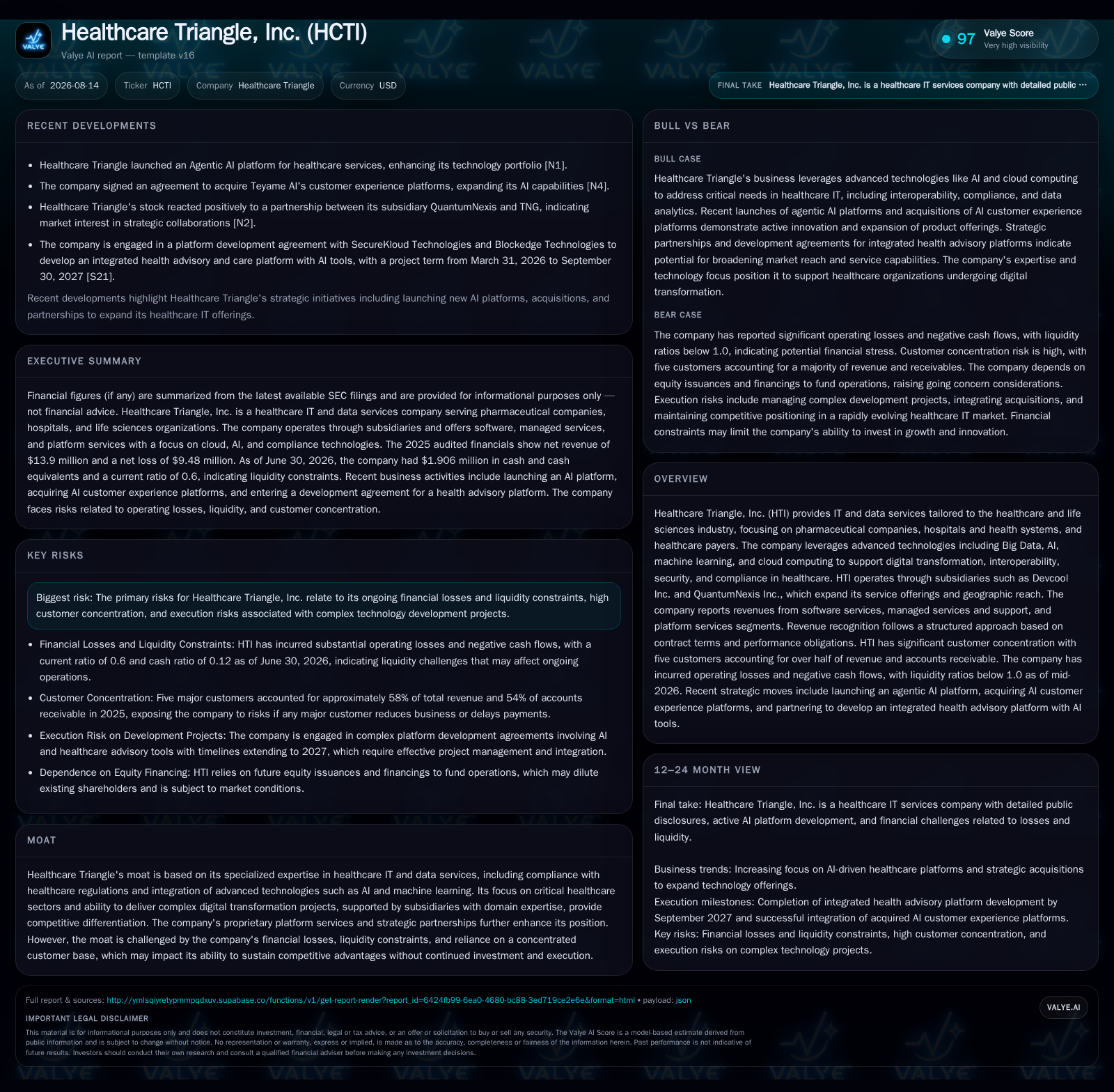
Healthcare Triangle's Q2 2026 filing reveals a sizable equity issuance tied to the January Teyame AI acquisition, significantly expanding its shares outstanding and adjusting its capital structure. The company continues to deepen integration of AI, machine learning, and cloud services within its healthcare IT offerings, aiming to strengthen its digital transformation solutions for healthcare providers, payers, and life sciences clients. However, liquidity constraints evidenced by a current ratio around 0.6 and persistent operating losses underscore funding challenges amid high customer concentration. Monitoring contract backlog, customer retention, and technology rollout progress will be critical in assessing execution and growth sustainability.
Q2 Operating Update Reflects Strategic Acquisition Integration and Capital Changes
Healthcare Triangle filed its latest quarterly report on August 13, 2026, revealing material changes stemming from the closing of the Teyame AI acquisition earlier that year [S2][S3]. In connection with this transaction finalized on January 29, 2026, the company issued approximately 9.7 million shares of common stock to entities directed by Teyame AI LLC as part of the purchase consideration. Subsequent disclosures show total shares issued related to this transaction topped 12.5 million following additional share issuances during July 2026 under a Securities Exchange Agreement involving SecureKloud Technologies Ltd. [S3][S8]. This share count expansion marks a significant alteration from approximately 2 million shares outstanding reported pre-acquisition, diluting ownership but infusing capital necessary for integration.
The expanded equity base indicates a pivot toward funding growth initiatives through stock-based consideration rather than debt or cash alone. However, this substantial issuance has contributed to liquidity tightness highlighted by a reported current ratio around 0.6 at June quarter-end—$9.65 million in current assets against roughly $16 million in current liabilities—and cash resources sitting at only $1.9 million [F1][S2]. These figures emphasize the company's need to carefully manage working capital during integration costs while scaling operations.
No material changes were noted in risk disclosure sections beyond those already expressed in the April 2026 annual report [S2], maintaining focus on financial losses, concentrated customers, and execution risks.
Specialized Healthcare IT Services Model with Performance-Driven Revenue Recognition
Healthcare Triangle operates within the specialized niche of healthcare information technology services targeting pharmaceutical companies, hospitals and health systems, as well as healthcare payers. Its service portfolio includes strategic advisory engagements assessing enterprise networks; implementation services encompassing deployment and migration of electronic health records (EHR) systems; plus ongoing managed services support structures [S1]. These solutions are tailored for regulatory compliance (e.g., HIPAA) demands and facilitate digital transformation projects leveraging interoperability frameworks.
Revenue streams emanate from software-as-a-service (SaaS) licenses or fee-based subscriptions for proprietary platforms; managed service contracts recognized ratably over contract periods based on standalone selling prices (SSP); as well as implementation fees recognized upon delivery milestones tied to performance obligations under complex contracts [S1]. The company also operates as an agent where third-party cloud infrastructure providers are involved in integrated service bundles.
A notable characteristic is significant customer concentration: approximately five customers generate over half the company’s revenues along with a similar proportion of accounts receivable balances. This profile increases volatility risk if any major client curtails spending or switches vendors.
Technology Adoption: AI, Machine Learning, and Cloud underpin Digital Transformation Efforts
Technological innovation stands central to Healthcare Triangle’s competitive positioning. The company integrates artificial intelligence (AI), machine learning (ML), cloud computing infrastructures, and big data analytics within its service offerings designed specifically for the healthcare domain. These technologies drive advancements in clinical data interoperability across electronic health record systems and support compliance monitoring critical under evolving regulations.
Adopting AI/ML not only enhances customer value by enabling predictive analytics for patient outcomes or operational efficiencies but also acts as a stickiness factor due to customization complexity and continual updates required by healthcare payers and providers. Coupled with cloud-native platforms facilitating scalability and remote access capabilities increasingly demanded post-pandemic telehealth expansion trends, these technologies help HTI build differentiation despite smaller scale relative to large incumbents.
Competitive Landscape Highlighting Scale Gaps and Subsidiary Expansion Benefits
While Healthcare Triangle remains relatively modest in scale vis-à-vis industry giants such as Cerner Corporation or Allscripts Healthcare Solutions—which combine extensive EHR software suites with managed IT services—HTI leverages domain specialization coupled with strategic geographic expansion through subsidiaries Devcool Inc. (likely focused on software development) and QuantumNexis Inc. (enhancing regional access or niche platforms).
This subsidiary model allows HTI to expand footprint beyond domestic markets without incurring prohibitive direct salesforce or infrastructure overheads typical of larger players. However, operating leverage challenges persist due to comparatively lower economies of scale impacting margins especially during high R&D investment phases linked to AI platform development.
Peers like IBM Watson Health illustrate how heavy investments into AI-backed healthcare cloud solutions can generate higher margin SaaS recurring revenue streams but require sustained capital backing—a dynamic mirroring HTI’s present financial posture.
Growth Vectors: Managed Services Uptick, Platform Scale and Broadening Customer Footprint
Looking forward, key drivers expected to bolster Healthcare Triangle’s top-line trajectory include ramping managed service contracts translating into more predictable recurring revenue bases; scaling proprietary platform usage as digital transformation accelerates demand for interoperable cloud-based solutions; plus deepening penetration within existing large client accounts addressing lifecycle phases from EHR implementation through analytics enablement [S1]
The healthcare IT sector’s structural tailwinds such as expanding regulatory requirements for data security compliance—and provider pressure to cut costs via outsourced IT operations—favor managed service adoption growth—a segment generally accompanied by higher gross margin profiles owing to subscription-like billings versus one-off implementation fees.
Enhancements in contract backlog figures or remaining performance obligations recorded in future filings will provide quantifiable interim evidence validating these growth assumptions.
Risks: Concentrated Customer Base, Financial Losses, Liquidity Pressures Plus Execution Complexity
Multiple risk vectors temper optimistic growth scenarios at Healthcare Triangle. The dominant among these is the pronounced reliance on a small set of customers who represent more than half of its revenue stream; such concentration poses material risks if even one client alters purchasing behavior or suffers financial difficulties themselves.
Financially, operating losses nearing $9.8 million most recently reflect ongoing negative cash flow trends typical during growth-stage tech-service investments but which also constrict maneuverability unless offset by successful financing strategies or accelerating sales velocity [F1]
Liquidity constraints are acute with current liabilities far outstripping liquid assets at mid-2026 quarter end resulting in a low current ratio (~0.6), signaling potential challenges meeting short-term obligations without additional capital infusion or improved working capital management [F1][S2]
Execution complexity inherent in large-scale digital transformation projects within tightly regulated healthcare ecosystems adds further unpredictability—delays or cost overruns could amplify financial pressures alongside reputation risk.
Watchpoints: Contract Backlog Evolution, Customer Retention, Milestones in AI Platform Rollout
Several operational KPIs merit close observation going forward:
- Tracking contract backlog levels or remaining performance obligations from periodic disclosures will indicate near-term revenue visibility improvement essential for planning resource allocation.
- Monitoring client retention rates particularly among top five accounts provides insight into revenue durability given current dependency concentration.
- Milestones related to rolling out newly acquired AI-enhanced platform functionalities or integration success post-acquisitions will reveal Technology adoption efficacy necessary for competitive moat reinforcement [S1][S2]
Strong execution here will underpin gradual margin improvements and support confidence that R&D investments translate into commercial outcomes.
Financial Profile Discussion: Balancing Cash Constraints Against Growth Investment Need
As of June 30, 2026 financial snapshots portray Healthcare Triangle confronting pronounced liquidity challenges with approximately $1.9 million cash juxtaposed against almost $16 million current liabilities yielding a stretched short-term liquidity position (current ratio ~0.6) [F1][S2]. Total debt stood close to $10.5 million by end-2025 with net debt around $8.6 million after subtracting cash balances pointing toward moderate leverage pressure accompanying growth investments.
Operating losses near $9.8 million underscore continued cash burn typical among companies investing heavily into technology platforms including AI capabilities critical for sustaining differentiation yet intensifying near-term funding needs [F1]. Equity issuances totaling over 12 million shares linked primarily to the Teyame AI acquisition have supplied essential capital but diluted existing ownership stakes considerably raising shareholder composition considerations [S3][S8].
Future capital adequacy hinges on improving organic cash generation from managed services recurring revenues combined with judicious cost management amid intensifying competition from larger integrated players wielding deeper pockets.
This analysis is based solely on publicly available information including recent SEC filings dated August 2026 for Healthcare Triangle Inc., combined with general industry context but does not constitute investment advice.
Disclaimer: This is research-only, informational analysis and not investment advice. It may include AI-generated interpretation and general industry context. Always verify important details using primary sources.

Comments